

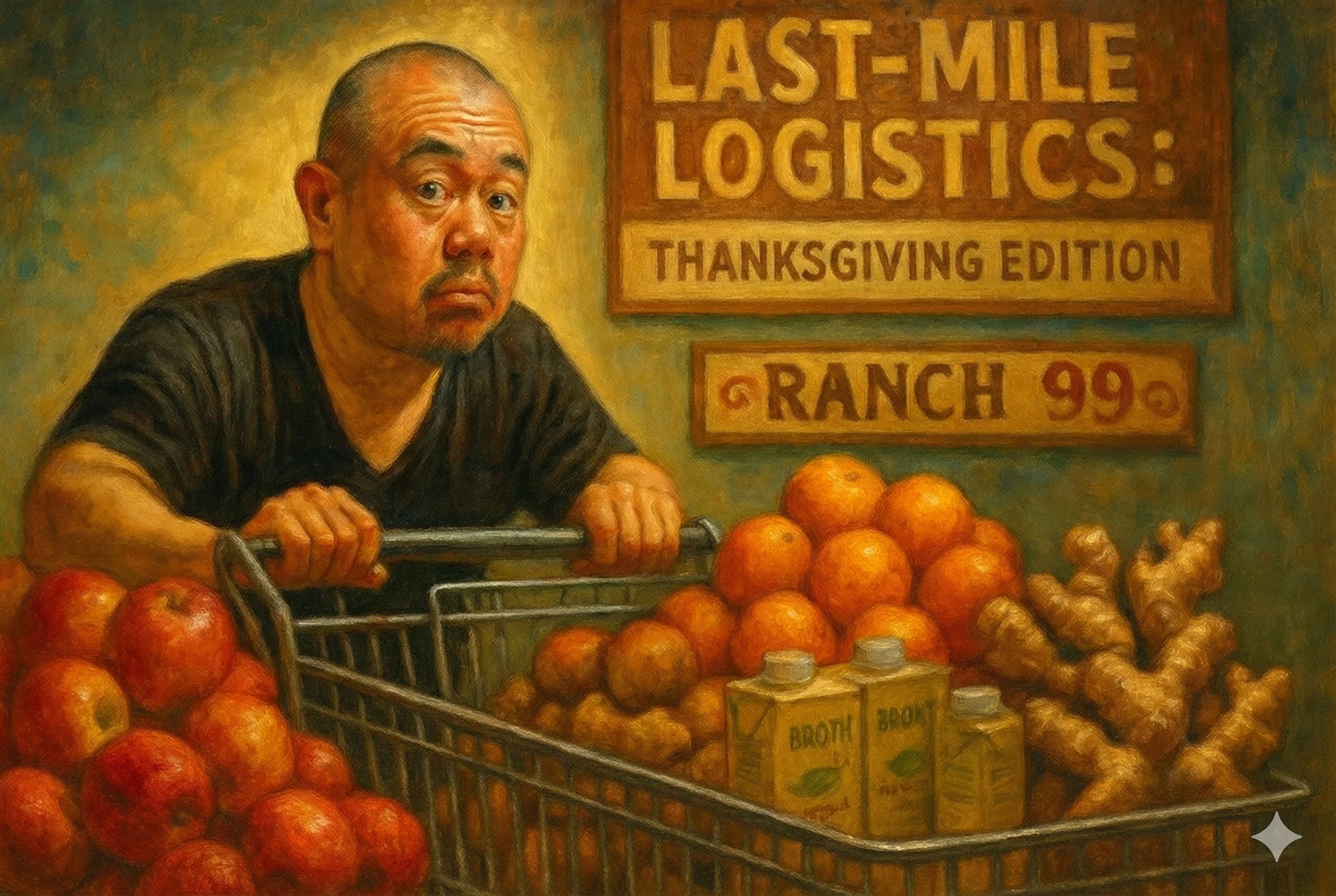
It’s Thanksgiving. Or as you call it this year: Thursday.
The day before, you have no plan. No vision. No roadmap. No clue whether you’re driving out to see Mom or dragging Daniel along to make everyone uncomfortable. Strategic vacuum. Total lack of command & control. Which is impressive, given that logistics is basically your love language.
Thursday morning, the decision makes itself. Mom’s sick—cough, low fever, sore throat, mucus percussion section. And she’s doing the classic requirements oscillation:
“I need fruit,” she says. Then, fifteen minutes later: “Actually, don’t get fruit.”
DoorDash could technically deliver fruit. But you know better. The problem isn’t capability. It’s stakeholder happiness. You can ship almost anything with a delivery API. But you can’t ship mood stabilization to an Asian mom mid-fever spike.
So you deploy analog. You drive to Ranch 99 because culturally, that just makes sense. You move through aisles like a fulfillment bot with emotional dependencies, loading the cart with recovery inventory that doubles as affection packaging:
Apples (she mentioned these three times, as if I’d forget)
Oranges (or were they pears? The request kept shifting)
Congee ingredients: 1 cup rice to 8 cups liquid (at least the math is consistent)
Chicken broth cartons, or pork bone broth if available
Ginger slices with brown sugar or honey
Ginger throat lozenges (backup ginger, apparently)
Your cart looks like a clinical ethnography of affection. Meanwhile, the internet is busy litigating turkey techniques you will never care about.
At checkout, it hits you: logistics is family. Messy, improvisational, last-mile logistics. The kind where love speaks in groceries and worry.
By the time you get back to her place with the full care package, she’s already feeling a little better—or maybe she’s just relieved someone took her contradictory grocery tickets seriously and converted them into real, physical inventory. You slice up an Asian pear—the kind that looks like it’s wearing a knit sweater for bruise resistance—and hand her a few pieces. She starts sipping NyQuil afterward, but what actually helps is the broth: one carton of chicken broth, warmed and served without ceremony. She drinks. She breathes. The system responds: she feels better.
You look at the television and notice she’s watching a Fred Flintstone/Hanna-Barbera version of a Christmas tale.
“What,” you ask, “no Chinese television?”
She doesn’t answer. She’s already half-asleep.
Three days later, you call to check in. She hasn’t called you first, which is unusual, which means something’s wrong.
She launches into a story. The fever broke yesterday, she says. She took some NyQuil—she pronounces it “Night Quill”—and started undressing to take a shower. Got halfway there and started to faint.
“完蛋了,” she says. I’m done for. It’s an informal phrase that conveys a bad situation with no hope of improvement. Dramatic, sure, but she’s not exaggerating for effect. She actually thought she was dying.
Then she tells you the story again. Same details. Same panic frequency.
Then again.
Then a fourth time.
You realize: she’s not repeating herself because she thinks you didn’t hear. She’s repeating herself because she’s still scared. Because she was alone in that moment. Because next time, she might not catch herself.
She is telling you that “完蛋了” is a preview of things to come. And for the first time in a while, it freaks you out.
And somewhere between broth cartons and fruit negotiations and the sudden, panic-filled realization that once Mom is gone, that’s it, I’m all alone, the thought repeats itself: caregiving logistics is family.
Not the version that runs without a hitch. Not the optimized, frictionless kind. This is the sweaty, model-free, last-mile delivery kind. The kind that says I love you, stay alive in produce and pain reliever. The kind that knows the system is failing but keeps patching it anyway, one grocery run at a time.
完蛋了?
Nah, not on my watch. We’re just getting started.
Wow! Home run of a fabulous essay, Ernie.
Yes, there is that feeling. When my parents were gone, there was that moment of, "wow, I'm an orphan." I quickly realized that was silly. I was 37 when Mom died, and the "orphan" title doesn't really apply. Yes, it's a terrible feeling, but you move forward and find company in friends. No one can replace your mom, but we all have to deal with that eventually. In your case, you'll always be able to know that you did yeoman's work taking care of her. Hopefully, it's still a long time before you have to face that, but I hope you realize that you have gone--and continue to go--way beyond what many family members (even Asian ones!) would do for their parents. You really are amazing, and you should feel proud.