

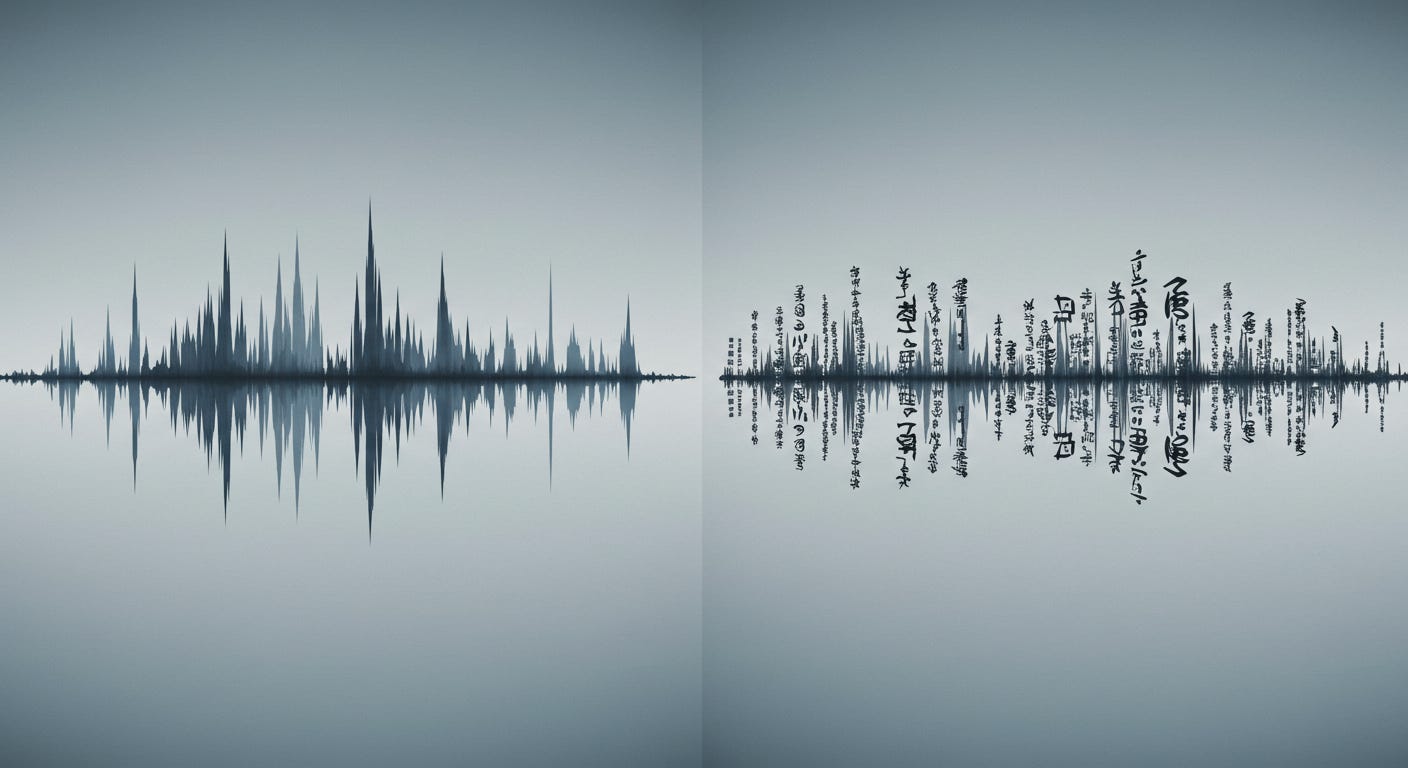
This is a clip of me speaking perfect, fluent Mandarin. I discuss vertigo and dizziness and various ways to deal with them.
And it’s a complete lie.
I do speak some Chinese, but I don’t talk at a level like that. I technically didn't say any of those things, and I don't even know what half those words mean.
Let me explain.
Mom's been complaining a lot about her dizziness this week. She gets these spells from time to time, enough where it gets me worrying because I'm not sure if she's talking about dizziness or if it's a symptom of her thyroid. It could be any of those, and it could be none of those. “It could also be anxiety,” I usually interject before Mom brushes it all off or changes the subject. Apparently, Chinese people over the age of 60 don’t get anxiety. None! Depression? Isn't that when you're just sad? Stop being sad!
This week has been particularly bad, though. She doesn't want to call into the advice nurse because she "doesn't like the way she looks" on the webcam. When I try to book an appointment with her primary care physician and tell her the earliest date is next week, Mom quickly tells me she'll deal with it; the spells will almost certainly be over and done with by then.
There are some generic texts on what to do if you have vertigo, but even with Google Translate, my fourth-grade-level Chinese isn't cutting it. That's where the AI magic comes in. Turns out that if you ask ChatGPT nicely, it can take medical jargon and turn it into simple, clear Chinese that an 86-year-old mother might actually read—not just translated but written in a way that sounds natural, like something her friends might forward on WeChat.
But Mom isn’t looking at my screen right now. She is in the living room watching a Chinese soap opera at volume 11 because she doesn’t use her hearing aid at home. This means I should read this material to her.
Eh, well, “I” should.
I end up using ElevenLabs for the voiceover. It's a website that specializes in "natural-sounding speech synthesis software using deep learning" — in other words, it can sample your voice and use that to say anything you want. I'm experimenting with using it to auto publish podcasts and voiceovers using my voice, with mixed results — maybe I'll talk about experiences there soon enough, but it amazes me that we have the technology that any word can sound like it comes from me in 10–20 seconds of audio. What was cooler than even that ten to twenty seconds of audio could make me sound… more… Chinese… I guess.
Was there an uncanny valley? A little bit. This sample recording makes me sound like I’m from mainland China as it picks up certain sounds my parents never used. But I do love how quickly I came up with a kinda cool thing that wouldn’t have been thinkable to pull off as recently as… like… 3–4 years ago.
I figure this could get me into YCombinator as I hear the “children of stressed out Immigrant mothers who don’t speak English and have basic communication troubles with them” market demographic is gonna surge in about a couple of months.
“That's you?” Mom asks after I play the clip with her. “Your Chinese sounds so good!”
For a moment, I considered letting her believe it. But lying to Mom about my Chinese feels worse than lying to her about my actual Chinese. “It's AI, Ma. They took my voice speaking English and made it speak Chinese.”
The pride in her voice deflates. “Ah.” A familiar silence follows - the kind that's filled with all the what-ifs of my childhood. What if I had paid more attention in Chinese school? What if I hadn't fought so hard against those weekend Mandarin lessons? What if I had become the perfectly bilingual son she had hoped for?
“I remember you working so hard to learn Chinese in college. And then you said you didn’t have time any more. I was so sad.” She says it like I deserted her and not 400 flash cards full of HSK 5 characters, abandoned somewhere between Abstract Data Structures and Operating Systems.
Instead, here I am at 48, using artificial intelligence to tell my mother about vertigo symptoms because I can't string together enough Chinese medical terms to explain why she needs to see a doctor.
The irony isn't lost on me - I can finally speak perfect Mandarin, but only through technological sleight of hand. It's both a solution and a reminder of what's missing.
"你要看医生," I say in my actual Chinese - clumsy but genuine. You need to see a doctor.
Mom waves her hand dismissively. 不用了. No need.
Even perfect Mandarin can't solve everything. The AI might bridge the language gap, but the cultural one - where anxiety doesn't exist, where depression is just sadness, where seeing doctors means admitting weakness - that gap remains as wide as ever.
Mom still complains that my Chinese sounds like a kindergartener's. She still hasn't seen a doctor. But at least when she hears my voice stumbling through the words for "vertigo" and "anxiety," she knows it's really me trying to reach her - across language, across culture, across generations.
Sometimes, the gaps don't need to be bridged perfectly. Sometimes, they just need to be acknowledged.
Even if that means admitting that some lies—like perfect Mandarin from imperfect sons—are better left untold.
Even without having met her, I know your mom well enough to know her pride in your being fluent, if you'd managed that, would have been very brief and then she would have moved on to another reason to give you headaches. Just focus on how well you did in finding a workable solution.