

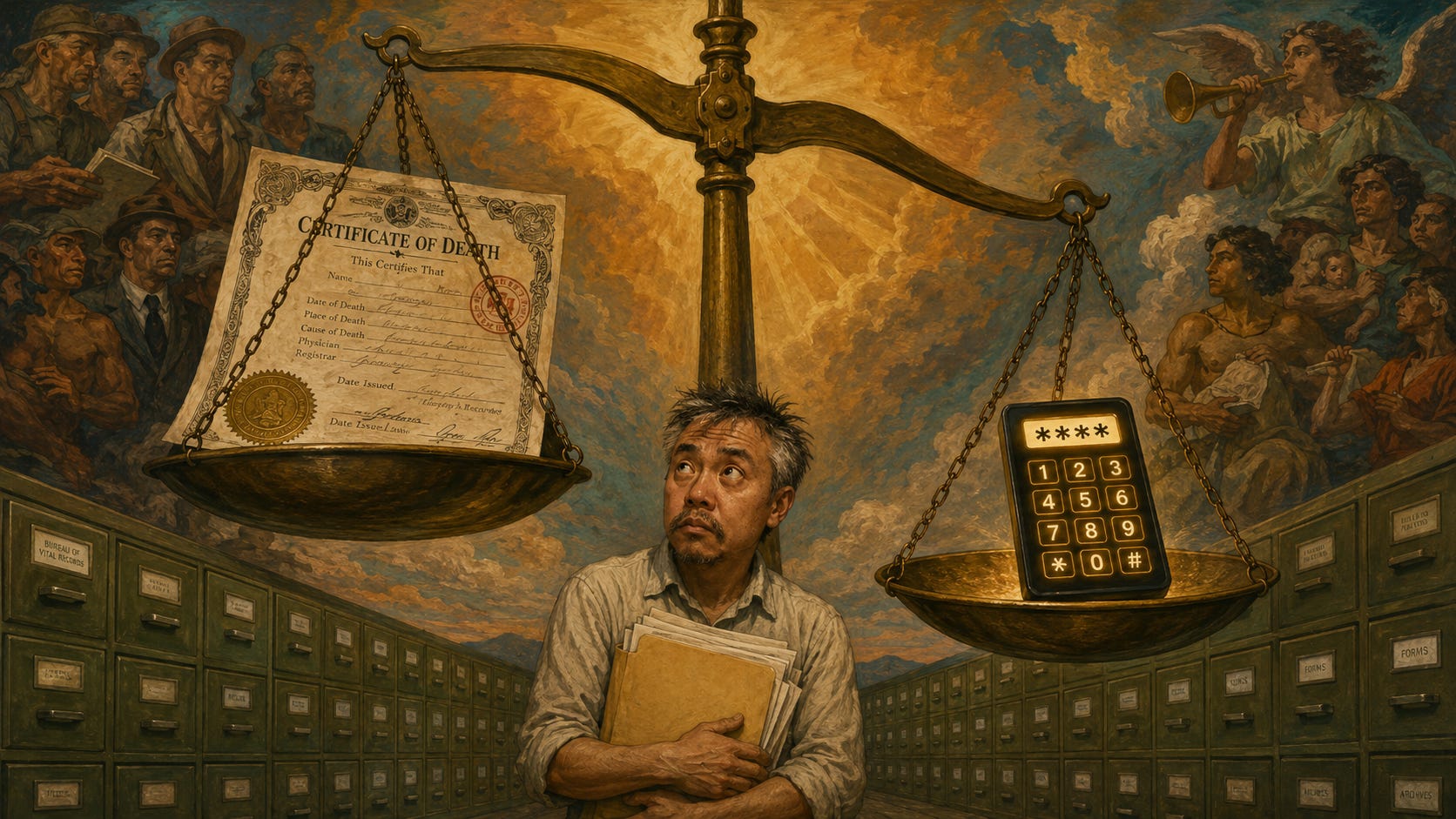
It’s 12:15 on a Friday afternoon, and you’re on the phone with the AT&T bereavement line for the second time, explaining that your father died in May.
The first call didn’t work. This one isn’t working either, and now you find out why: the PIN. Every AT&T account has a four-digit PIN, and without it the agent can’t access the account. They can’t close it. They can’t pause the billing. They can’t, as far as you can tell, even officially acknowledge that the account exists.
You mention the death certificate. You have a stack of them: certified copies with embossed seals, ordered in bulk because everyone at the funeral home says to get extras, and they were right. A death certificate is the most final document a government makes. File number, registrar’s signature, cause of death typed out in the calm little font of the State of California.
Turns out the PIN trumps that. How would he remember that when he didn’t even know he had a phone the last three years of his life? (Also, Jesus, his phone was on auto-pay all this time.)
So the agent suggests a workaround, but there really isn’t one. Instead, you have to make a trip: go to a retail AT&T store in person, with his phone and a copy of the death certificate. Bring these things to the counter, and offer to the god of the corporation who can cancel accounts of dead people.
Meanwhile, AT&T has been emailing him this whole time. A bill in June. A past-due reminder over Fourth of July weekend. A bigger bill. And on July 23rd, a suspension warning: $251.38 by August 1st, or they’ll interrupt his service.
Sir, his service has been interrupted in ways you can’t imagine.
This is month three of learning that, to an institution, death is just an untransferable database status. Every company, agency, and county office needs the same fact proven, in its own way, and none of them will accept another’s word for it. The State of California has certified that your father is dead. Ten times. With a seal. This means nothing to a telecom.
Fidelity took up two hours of a Monday because, as far as you can tell, nobody who built their system ever thought to check if you can log into Fidelity.com after you’ve accessed Netbenefits.com first and then got laid off. It’s a bold choice for a company whose whole business is old people’s money. The fix was to wait twenty-four hours for your phone number to “propagate,” a word you accepted without asking more questions, since more questions just make the call longer.
Social Security wants Mom’s marriage certificate before she can get her survivor benefits — the certified kind, which means a records request to Alameda County, which means explaining that your parents married in Taiwan, divorced, and then married each other again in Oakland in 2019. (A love story. Also, now, a filing problem.)
The PG&E pension office involves a fax machine. You no longer have the energy to be surprised by fax machines.
After enough of these calls, you notice what you don’t feel. You keep waiting for the rage, but it never comes. Instead, something else shows up, flatter and infinitely more patient than you could ever imagine. A numbness that waits its turn.
You wait for the other shoe to drop. Um, the other other shoe.
And every part of this goes through a hold queue, so lately your grief comes with a soundtrack: smooth jazz, interrupted now and then by a voice thanking you for your patience.
The first time you heard music in a lobby, you were in second grade at the dentist’s office. It was faint and seemed to come from nowhere, and you sat in the waiting-room chair with a feeling you couldn’t name. Lately you wonder if that was the first one. Maybe the hold music was always grief.
Sorry. Forty-five minutes of hold music does things to a person.
Here’s what the death certificate really is: it’s just a passport for getting things done. It moves you through checkpoints, and that’s all. He stays just as gone. Nobody behind any of these counters has asked who he was, because there’s no field on any form for that. The forms want the account number, the date of death, your relationship to the deceased. The deceased. A word that turns your dad into a title.
Tomorrow, you’ll go to the store. You’ll stand at a counter between a family upgrading their plan and a teenager buying a phone case. A stranger will say sorry for your loss in the same voice they use for screen protectors, and honestly, that will be fine. The death certificate does the talking now. And after AT&T, there are at least three more organizations on the list, so you and the certificate have a long month ahead.
Tonight, you assemble the tribute: one certified copy of the death certificate. And your father’s old cellphone.
Wait.
Do you have his phone? You left the phone back at Mom’s, didn’t you?
Shit.
When I went through this when my father died, I discovered a 6th stage of grief: resentment
This stirs something in me that says, "You're going to have opinions about this someday."