

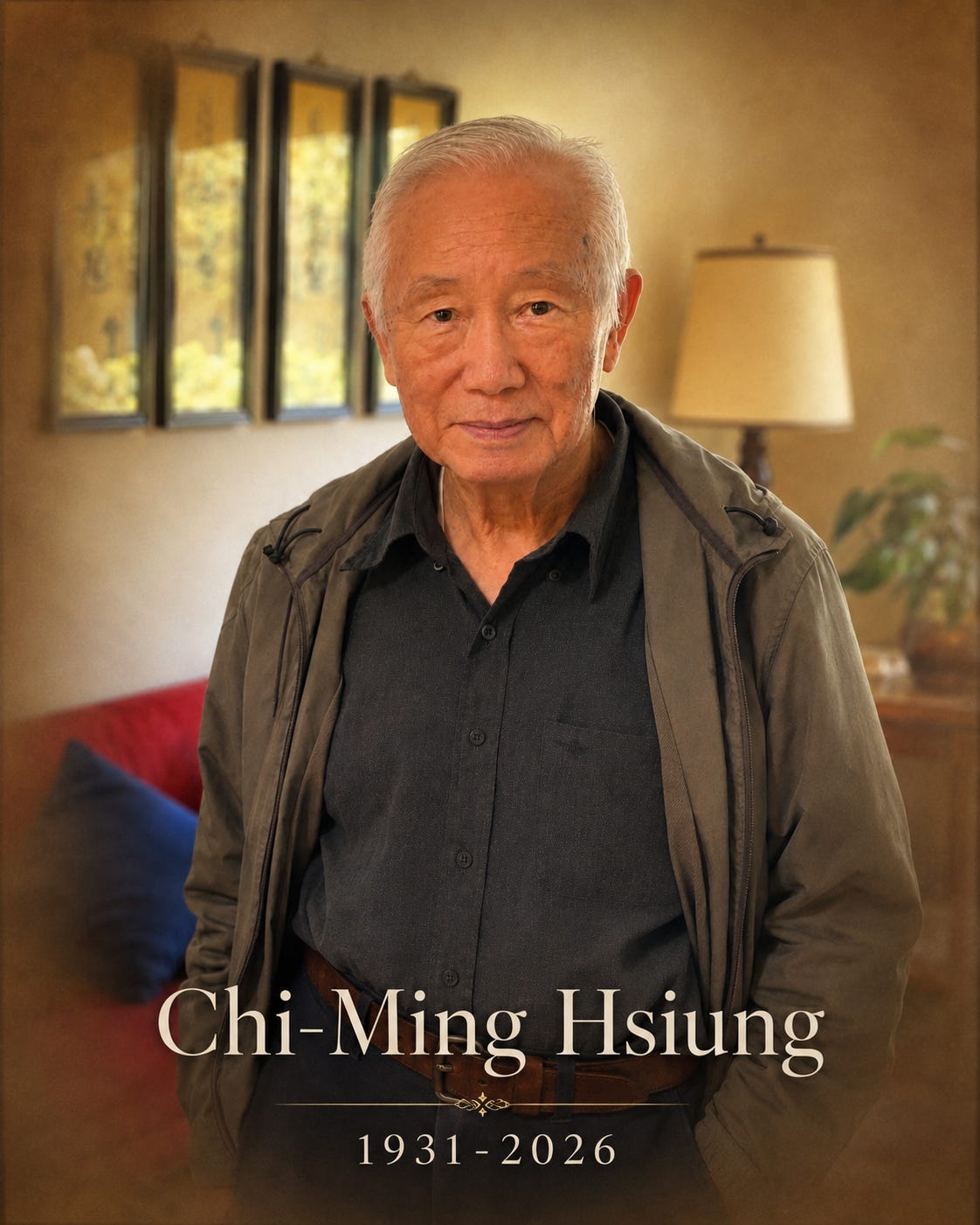
My father came to America with a plan.
He didn't talk much about what he left behind. A story here, a hardship there. What we knew was this: he came from a place of care — for family, for country — and he arrived here with his eyes pointed forward. That was just who he was. Once he committed to something, he didn't waver. He didn't look back.


Chi-Ming Hsiung was a commander in the Republic of China Navy, following a lineage that traced back through his father. He carried that quietly. You wouldn't always know it from conversation, but you'd feel it in how he held himself, what he talked about, what made him proud. Going through his belongings these past days, I've been finding things I never knew existed — medals, photographs, a record of a special diplomatic envoy he was part of in 1968, visiting Washington, D.C., and the Bay Area. Four years before immigrating to the United States. A whole chapter of a life he never felt the need to announce.


He eventually traded naval life for a career as a mechanical engineer at PG&E. He made sure the buildings people worked in stayed comfortable. He made sure his family had stability. Those two things weren’t so different, really. He was a man who showed up and kept things running, even when it cost him something.
If you were lucky enough to be at one of his dinner parties — and many of you were — you knew the other side of him. His naval buddies would come through, and the night would fill up with old stories and laughter. He was quick-witted. He had charm to spare. With people he trusted, he lit up.
He was also a product of his time and his upbringing. He was a commander at home the way he’d been a commander in uniform. He had expectations, and he made them known. Our relationship wasn’t easy. We fundamentally disagreed on a lot. He made his disappointments clear to me, and I to him. But I want to say something plainly: two people not always understanding each other doesn’t mean they didn’t love each other. I knew his world — the world that shaped him — was impossibly different from mine. The speed of change between his generation and my own was staggering. I think he felt that, even if he couldn’t say it.
Alzheimer’s took the ending from us that we might have had. They call it a long goodbye, but ours didn’t feel like one at all. The illness got in the way.
His last words to me that I can hold onto were simply this: to be Chinese. I’ve thought about those words a lot. I’m still thinking about them.
What I know is this: I moved back to California. I accepted the duty, sorted through the records and the hospital bills and the Medicare forms and the doctors’ appointments. To do what needed doing. I’m not sure he ever saw it for what it was.
But it was the most Chinese thing I knew how to do.
I am my father’s son. I have traits that some would call this passion but others would call a bad temper. I have his manic storytelling skills and the dreamer’s mentality he passed down, filtered through a discipline he also gave me, for better and worse. I’m still figuring out what I inherited and what I’ve made my own.
What I know about Chi-Ming Hsiung is that he was a good man. He arrived in this country with almost nothing and built a life. He loved his wife, Chi-Yung. He loved Angela. He loved me in the way he knew how.
He had all the best intentions in the world.
I am so sorry, Ernie. From experience, I know it's not so much of a long goodbye as a long loss. They are gone long before the body stops pumping. In this way, I'm sorry for the long loss as it has been, and is continuing. Your final words have made me reassess my rejection of my toddler's tea party request this morning. I think I can find five minutes.
This was so beautifully written, friend. I’m sending you my love