

It’s a Wednesday morning in July, and I’m deposing my own mother in her kitchen.
I made a list of questions. Typed them out lawyer-style the night before because, at eleven sharp, a social worker named Zanikya is coming to decide whether the state of California thinks my mother needs help. My mother, who has spent four decades making sure nobody thinks she needs a damn thing.
So I start with the thing that matters most for this interview: what she can’t do on her worst days.
“On very bad days,” I ask in Mandarin, “what is your energy like?”
I get dizzy. I need to sit down for a couple of minutes. One time it happened in the middle of cooking.
“On very bad days, when you’ve been by yourself—have you fallen?”
I almost did. But I grabbed onto something. I wouldn’t be able to do that outside. Which is why I’ve stopped falling.
She stopped falling by just not going outside anymore. PROBLEM SOLVED. Stay inside and the house will catch you every time: counter, railing, wall. Her world shrank, and she called it home safety.
Here’s the deal with IHSS, California’s in-home care program. They rank how independently you can perform different tasks. Independent means no help. The more human help you need to do something safely, the more time the program can authorize.
But the system can only count the limitations my mother is willing to admit out loud. To get help, she has to describe the version of her life she has spent decades hiding—the exact opposite of everything my parents ever taught me.
This is a woman who broke her wrist and her arm falling backward off a stepladder in her own backyard and reported it like a parking ticket. A woman who—I learned this mid-assessment, in front of a stranger with a clipboard—had leg cramps so bad last year that she dug my father’s old walker out of the living room, used it for three days, put it back, and never told me.
“When did that happen, Mom?” I said, in the special calm voice you use when you are not fucking calm at all but have to be calm because company is there.
She shrugged.
I don’t want to be 麻煩. A bother. There are people in worse situations than I am.
The pre-interview was just me trying to get her to stop downplaying everything. Tell them about your bad days, Mom. Not the good ones. There’s no box for “fine.”
Zanikya showed up at eleven. For the record, she was very nice. I’d left a voicemail asking for a professional Mandarin interpreter. The county has them. But of course, I ended up doing what I always do at banks, doctors’ offices, and the DMV—translating everything myself while my mother watched for mistakes and heckled me.
Yes, she heckles me. Every single time. Halfway through, I’m giving Zanikya the backstory: the backyard fall, the broken wrist, my father’s dementia, his death in May, and the part where my mother—who has always cooked everything—suddenly started asking for frozen dinners. That scared the hell out of me.
My mother cuts in, using her calm voice, to tell me I’m talking too much. Why not just let Zanikya ask the questions?
Ma. She asked me a question. This is me answering the question.
Zanikya asks if Mom is able to wipe down the kitchen table right now. Sure. No problem.
The table, the kitchen counters, and the bathroom counters—all at once? My mother says she can’t do that. No energy. If I had to clean the whole house, I’d be wiped out.
Can she take out the trash?
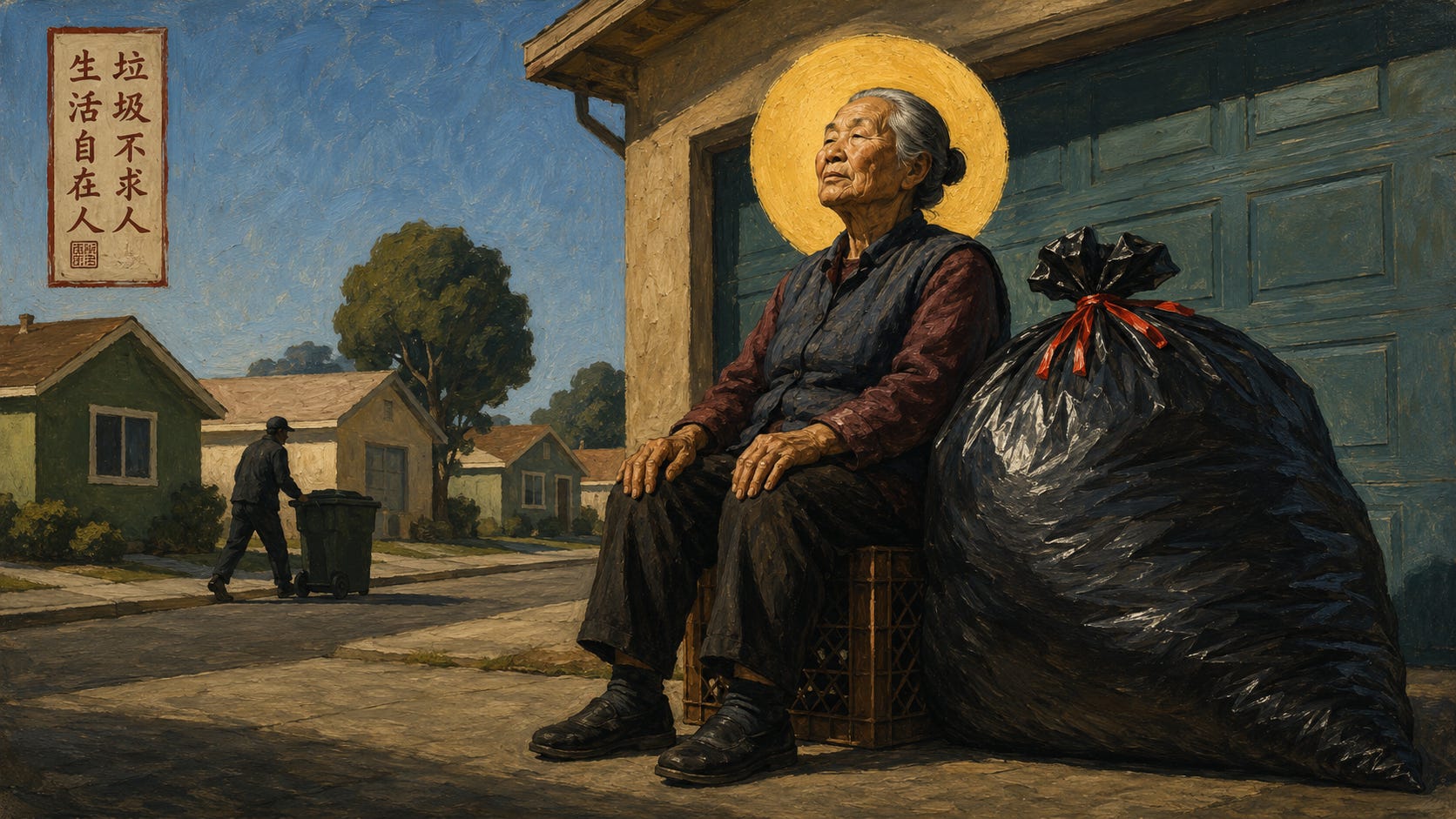
My mother tells a story I’ve never heard. She can get the bag out, but last time she had to set it down outside the garage and sit for ten minutes before dragging it the rest of the way. The neighbor has seen her struggle enough that now he just rolls the bin to the curb for her.
Ten minutes. Sitting next to a trash bag outside the garage. She never told me. Same reason she stopped going outside. Once she absorbs a problem, it disappears.
The almost-falls come up again, and this time she gives Zanikya the director’s cut:
I’ve had a bunch of almost-falls. The good news is that there have always been railings or a counter. The house isn’t very large, so I’ve been able to grab onto something without doing a complete fall. Unlike your father.
Unlike your father, who is two months dead and still on Mom’s angry list.
(One genuinely light moment: Zanikya asks about the dishwasher, and I get to explain that my parents, like most Asian parents I know, have never once run it. They store pots and pans in it. As far as they’re concerned, its function is to increase the resale value of the house, and it performs that function beautifully.)
The county’s paperwork comes in English or Chinese. It also comes in large print—but large print only comes in English. My mother can have letters she can see or letters she can read. Not both. She picked Chinese.
I want to learn English, she tells Zanikya, but they keep saying it’s so difficult.
The form asks for emergency contacts. I give my name and number.
It wants another.
I look at my mother. She looks at me. It’s just us. One of us says, “Well, that’s depressing.”
She gets a “high three, low four” on chores. The county approves her.
The help arrives the way state help arrives: after a provider orientation, after fingerprinting—$67 cash, $59 with a card, a pricing structure I’ve decided not to think about—after a two-week wait for one letter and a month’s wait for another.
California will pay her provider about $21 an hour, retroactive to March 8.
Her provider is me.
I’ll just say it: part of me is relieved to have paid work again.
Is it humbling that I now have to decide whether “caregiver” belongs on my résumé? A little bit. Is it also humbling to have no incoming cash flow that doesn’t route through my dead father’s bank accounts? Yeah. Will there come a day when she needs care—bathing, grooming, the later stuff—that should not come from her son? Will getting her to accept a stranger in the house be hell on earth? Without a shadow of a doubt.
She’s in her kitchen right now, probably. Washing her one dish the moment she finishes with it. Not taking her blood thinners. Having one of her best days.
Somewhere in her neighborhood, a neighbor I’ve never met knows that my mother once had to sit down for ten minutes halfway through taking out the trash.
She didn’t tell me that.
A stranger with a clipboard asked the right question.
I don’t know what else she hasn’t told me.
I really appreciate your posts on your mom. My mom is also quite old and tends not to tell me things unless I ask directly. How is your back? Bad. Did you call the spine clinic? *vaguely* I guess I could do that. (she did not do that). I keep asking myself how I can avoid becoming that person who doesn't ask for help.