

LYD Classic: Editor’s Note, 2026 —
I wrote this at three in the morning in August 2005. I was twenty-eight. That summer, my relationship had ended, and my parents had separated, and one night the thing I’d been outrunning for years finally sat down on my chest and started talking back. This is the first time I had ever tried to put depression into words on this blog. The elephant came back that December. He never fully left — but he did, eventually, get less obtrusive, exactly like he promised.
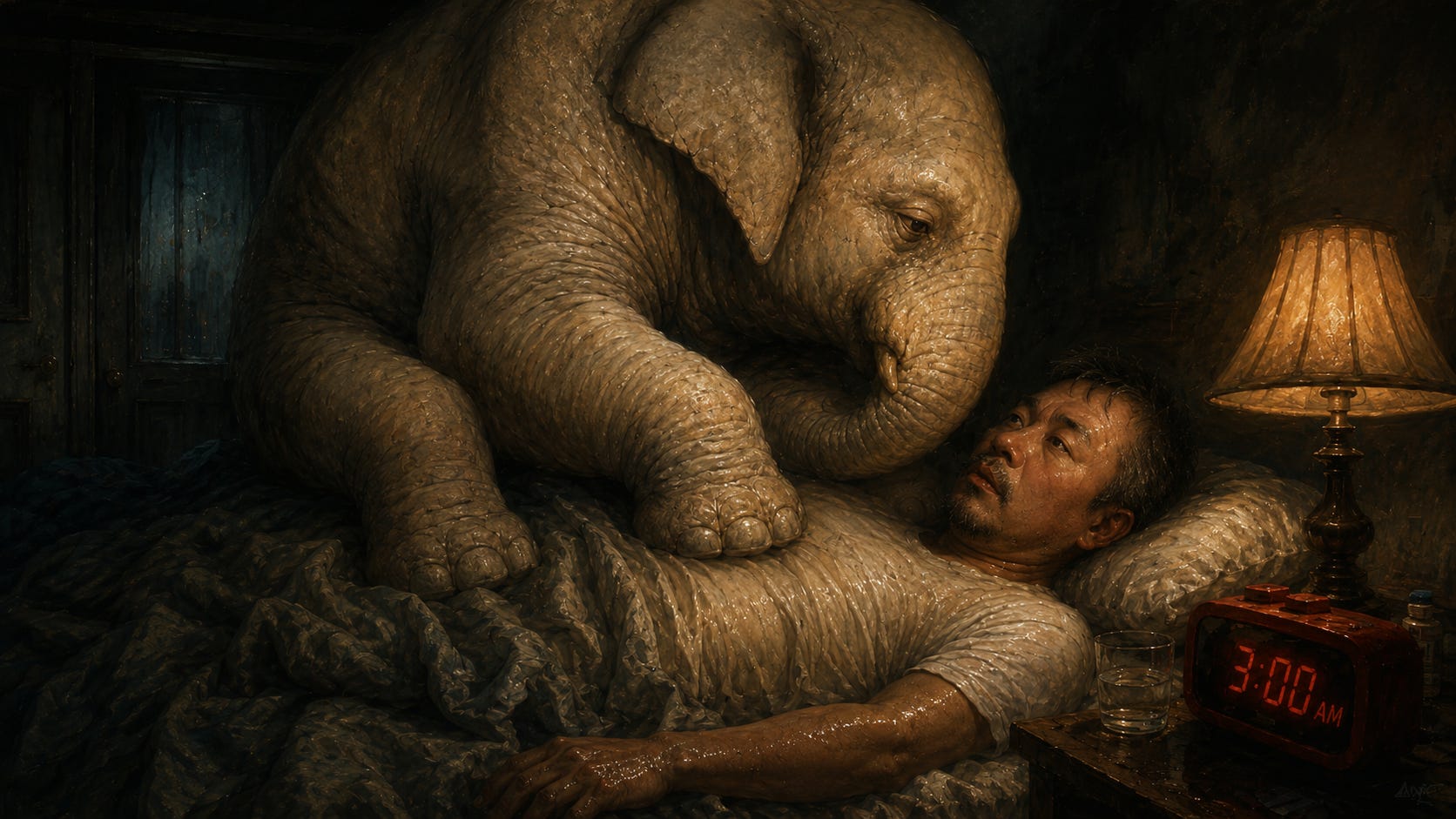
Lately, it’s showing up more. Always late. Always when I’m alone, sweating in a bedroom that feels like a sauna, hacking up phlegm from too many cigarettes. I try lying on my back. Nope, that’s useless. Flip to my side, face in the pillow, hoping something—anything—will just knock me out cold so I don’t have to think for a few hours.
It’s there. It’s back.
A thought pops up. Not a voice. I’m not that far gone. Just this idea: It never left. It’s always been there. Years of negativity, self-doubt, all the usual greatest hits—work, family, life—swirl together into this heavy, dark cloud. Except now it’s shaped like a giant white elephant, and it’s parked right on my chest while I’m just trying to get some sleep before work.
Look, I’m not losing it. There’s no actual elephant in my bed. It’s just a metaphor. Roll with it.
“The fuck you doing here?” I would ask, theoretically.
And the elephant would answer, “Fuck am I doing here? I’ve always been here. Was there when you were a kid when you dealt with the family, was there all through college. I’ve never left. You’ve pushed me in a corner for the last two and a half years, I’d say. I was, maybe, a tenth of the size I am now. But I’ve never left.”
Hack, cough cough, sputter wheeze.
“You need to stop smoking,” says the elephant.
“Fuck you.” I pause for a second. “I’m going to pull through this, you know. You’re going to go away, for good.”
“Fantastic. Maybe someone will do a Lifetime movie on your life, Meredith Baxter-Burney. You don’t believe half the shit you say.” Goddamn elephant, he sees right through me. “Besides,” he says. “I’ll never really go away. I’ll get less obtrusive, perhaps, and maybe you’ll forget about me down the line. But I’ll still be here.”
Now the sheets are soaked, pillows a mess. I get up and start remaking the bed. So, I ask, when are you going to be less annoying so I can actually sleep?
“I don’t know,” the elephant says. “When I feel like it. When you feel like it. Days, months. Not so sure. But in the meantime, while you’re sulking and feeling sorry for yourself, I’ll be watching infomercials.” Since this is my imaginary sequence, the elephant can pick up my remote control, turn on my cable television, and change channels. “You know, Ernie, you can become a millionaire just by working from home, thanks to tiny, tiny ads.”
But I’m not paying attention, because I’m on my bed, curled up in a fetal position, wishing everything — the dark elephant-shaped cloud, my coughing fit, myself — would disappear forever.