

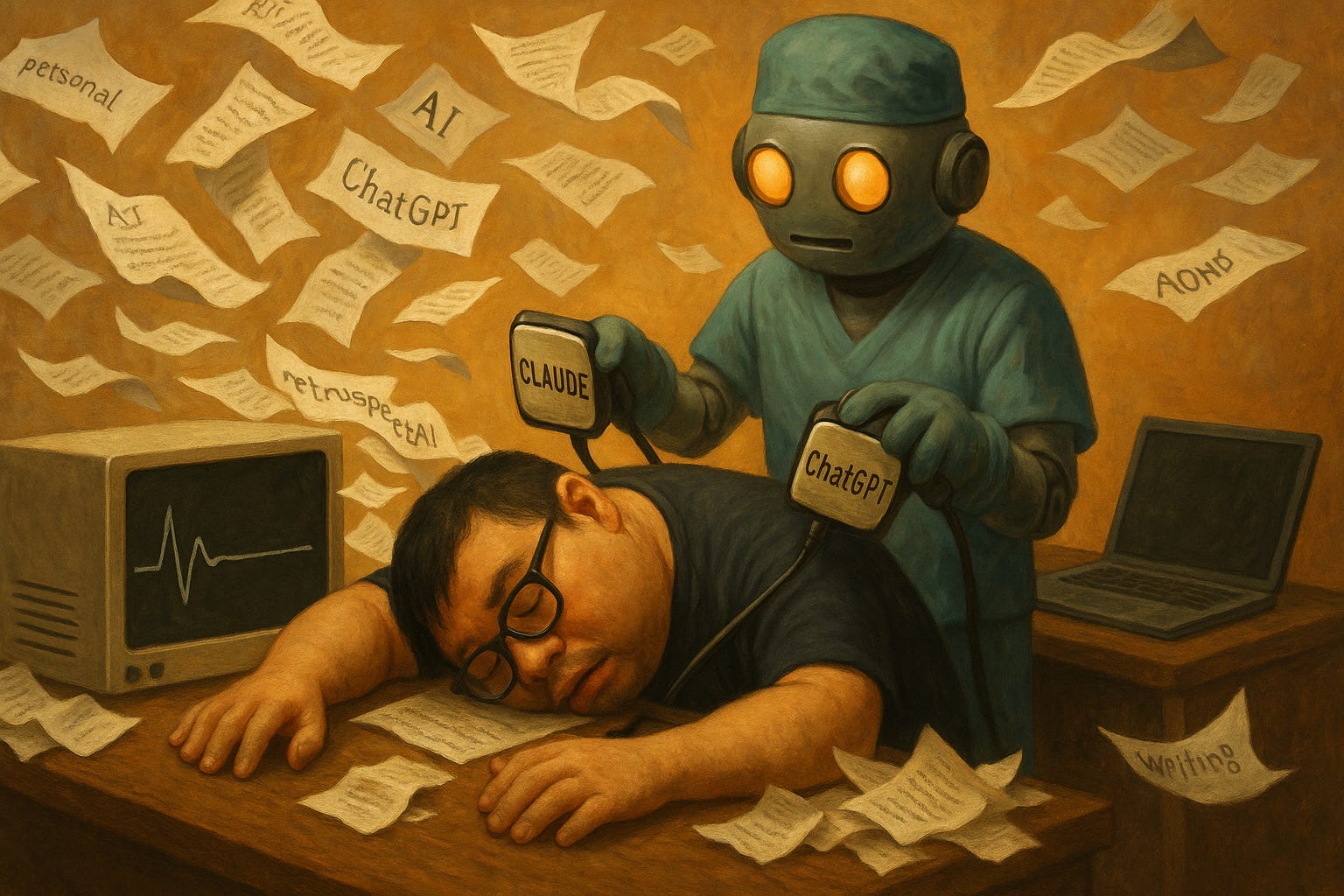
I sat down to write this, planning to flaunt slick AI hacks — instead, I discovered the system that resurrected my dead-writing self.
And hey, if that doesn’t sound like Substack fodder, I don’t know what does.
Creative Death, in Real Time
Picture this: me, in front of a blank Google Doc, cursor blinking like a taunt. I wasn’t “blocked”; I was constipated. To get anything out, I had to:
Generate ideas that wouldn’t make you unsubscribe
Execute on said ideas
Make them funny (because humorless me is just depressed me with a mailing list)
Do this every damn week like a machine
After publishing, I felt like I’d donated a kidney. Then—congrats—it was time to start again. Weekly slid to monthly. Monthly slid to “whenever the guilt hit.” Then it became the sad annual apology post. Then silence.
I convinced myself maybe it was ADHD, maybe I’d lost the spark, maybe I was just done. The blank page had won.
Enter AI: Not My Ghostwriter, But My Creative Defibrillator
AI didn’t show up as my ghostwriter — more like a creative defibrillator.
I use Obsidian with a plugin that pipes in AI. Every day I jot down notes — fragments, family drama, the usual beautiful catastrophe — then run them through a weekly prompt I call “Your week as writing inspiration.”
Four to six potential stories emerge, complete with themes, questions, and sometimes uncomfortably accurate therapy session insights.
Here’s a real one:
“The Accidental Medical Translator: Adventures in Generational Healthcare”

- Core Narrative: You spent the week shuttling your 87-year-old mom to ER visits, translating symptoms, and accidentally calling a car dealership instead of the nurse line.
- Themes: Cultural gaps, invisible labor, comedy in adult-child caregiving.
- Lessons: If you don’t laugh at the absurdity, you’ll cry — or buy a Camry by mistake.
Sometimes it nails my week. Sometimes it’s garbage. Either way, I’ve got something to react to.
The Accidental Medical Translator
I have a prompt that writes me first drafts, given the potential story. It’s true. I said it. I’ll even share it on request. But until then, here is a part of the output:
Knife Sentence:
Being the adult child of immigrants means you’re the family’s Swiss Army knife—translator, advocate, and accidental comic relief—navigating a healthcare system that’s as confusing as it is exhausting.

Cold Open
“Hello, this is the nurse line—how can I help you?”
“Hi, I’m calling about my mom’s chest pain—wait, is this… Bob’s Used Cars?”
A beat.
“Sir, are you interested in a 2012 Camry?”

Scene: The ER, the Waiting Room, and the Car Dealership
It’s 2:14 p.m. on a Tuesday, and I’m in a plastic chair that’s seen more butts than a public bus. My mom, 87, clutches her purse like it contains nuclear codes. Judge Judy blares from the waiting-room TV.

The nurse calls her name—well, a version that’s been through the spin cycle of American phonetics. I do the “interpreter shuffle.”
“Any allergies?”
Mom looks at me. I look at her. She mutters in Mandarin: “the one that makes my tongue feel like a balloon.”
I turn to the nurse: “Uh, penicillin, I think?”
I’m sweating like I’m on a game show.

Later, I call the nurse line for follow-up. After five minutes on hold, I’m transferred—somehow—to a car dealership. And honestly? Financing a Camry sounds simpler than decoding Tylenol dosages.

Between the third x-ray and the second round of paperwork, it hits me: I’m the family’s Swiss Army knife. Interpreter, scheduler, emotional support, and comic relief. The “default adult.” The one Googling side effects, juggling insurance cards, making sure Mom eats breakfast and doesn’t sign up for a timeshare.
What happened in real life was that I rolled my eyes, said something like “yeah, no, too cheesy,” and chose something else. But for the sake of this article, let’s say I went with this.
The Editing Process
Here’s the thing: AI gets dialogue wrong. It invents characters, misses the point entirely, and fails to evoke emotions.
But that’s a gift. I read the draft and immediately start heckling:
“Ugh, that’s not what she said.”
“Christ, why does Mom sound like a Golden Girl?”
“LOL, jokes on you, Dad only communicates in sighs.”
“This isn’t the point; I’m the point. I’m the mess.”
Those heckles become the writing. AI’s wrong version forces me into the right one. And then I edit and add more of my truths until it feels like it’s a piece I can accept 100% responsibility for.
The Uncomfortable Truth: I’m Basically a Cyborg
If ChatGPT or Claude were to disappear tomorrow, could I still write manually? Sure. Would I? Nope.
I’d quit, or limp along with scraps. I even dictated this whole piece with Whisper Flow. Without it, I’d be finger-pecking like a caveman.
My practice is built on AI scaffolding. And I’m not ashamed. It’s like being embarrassed about using a wheelchair because walking would be more “authentic.”
The Paradox of Authenticity
Weirdly, people say my writing feels more authentic now. Why? Because I actually show up.
Authenticity isn’t about purity of process. It’s about not vanishing for months in the name of “doing it right.” My imperfect weekly newsletter beats perfect silence every time.
Victory, Redefined
I haven’t missed a Thursday since I started. That’s huge for someone with ADHD who used to vanish like a literary Houdini.
I still procrastinate until 3:58 AM. I’m still anxious. However, the blank page no longer terrifies me. I know I’ll have something to work with — a bag of groceries for the potluck, not empty hands.
The Real Story (No Bullshit This Time)
I think the jury is out on whether people believe AI is making me a better writer. But more importantly, it’s about AI making me a writer who fucking writes.
To anyone who’s lost their practice to perfectionism, overwhelm, or life getting in the way: recovery is possible. I mean, sure, it might look different from what you dreamed. It might involve tools you never imagined. But messy words beat no words.
I’ll still be here next Thursday, probably at 3:58 AM, turning AI nonsense into something that sounds like me having a nervous breakdown in real time.
Because the alternative is not writing at all, and that isn’t an option.
P.S. — Yes, I used AI to help write an article about using AI to write. The irony isn’t lost on me. And you’re still here, which means it works — no matter what my imposter syndrome says.
You said you're not ashamed. That's good. You shouldn't be! AI is just a tool, and if it functions as your muse or creative spark, then good! It can't write like you do, but it can provide ideas, it can help get you going... it is a tool, so keep using it!
I don't trust AI to produce the final version of anything for me, but I've found it helpful in getting me started. I've used ChatGPT for a few things, and yes, it really can get me going. But it also has been horribly wrong a number of times, to the point that my AI friend and I had back-and-forth conversations where I told it that it was wrong and it responded with something like, "Good catch! You're absolutely right, but I did more digging and here's the definite right answer," followed by an eye-rollingly wrong answer.
Like any other tool, the end result will only be great if it's in the hands of a great craftsman, and that's you. So use it, let it spark ideas, and then take the ball and run with it! We're all here for you, not for the AI.
HELPFUL CONTENT. Thank you!
PS does your AI have a name? Mine is called Gerald.