

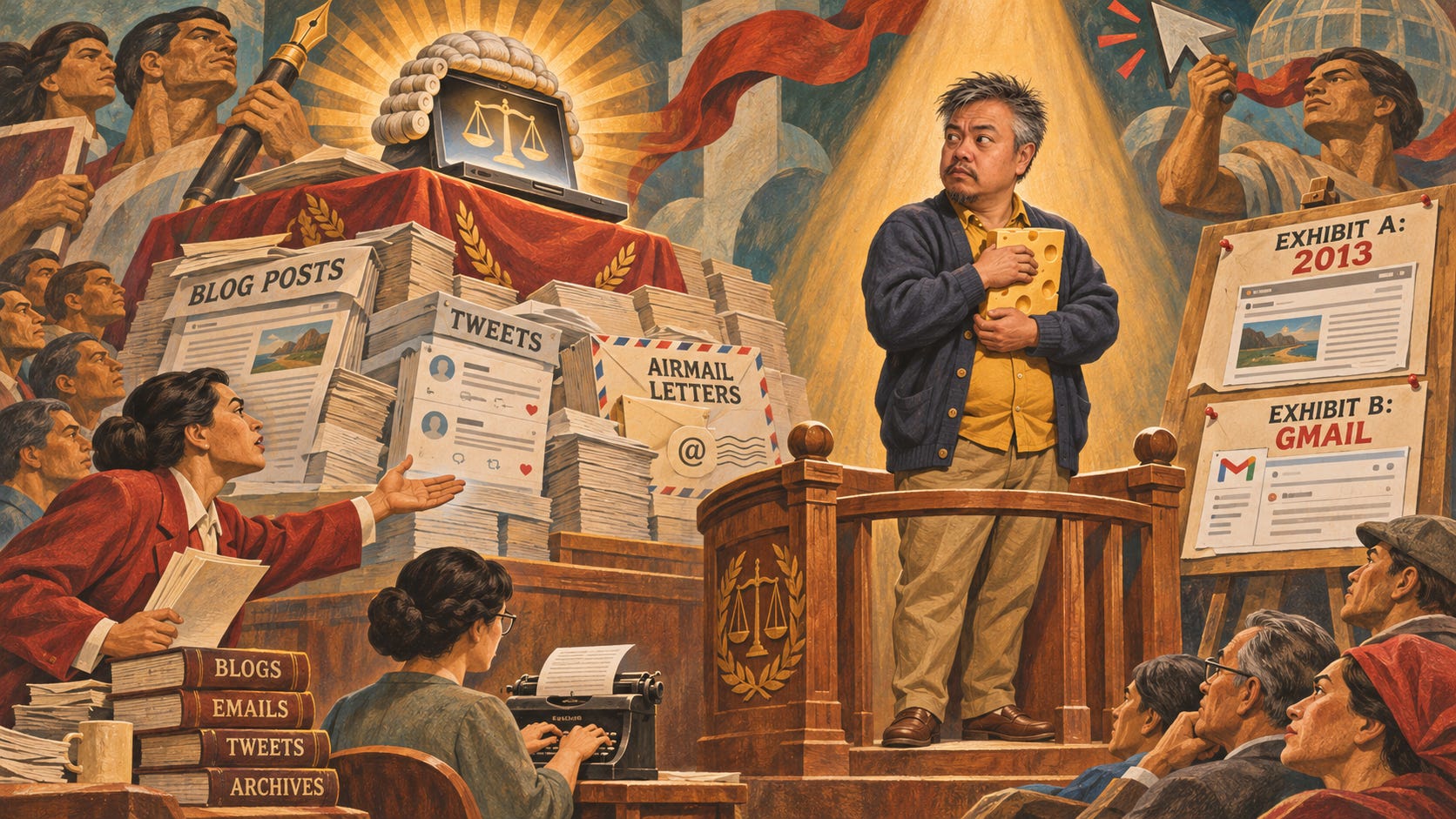
I’m lying on my bed, not doing anything in particular, when the thought shows up out of nowhere: Wait. Why don’t I use Fable to help me with my memoir plot?
Let me back up.
Turning Little Yellow Different into a book has been my white whale. People have been telling me to write one since 2002, and that’s not an exaggeration. I’ve made a couple of attempts—once in the mid-2000s and again in 2012, when I got far enough along to actually hire an editor.
Here’s the problem: a book is not a blog post. You can’t write a few hundred blog posts and have them magically form a book. I know this because I’ve tried.
So then I was like: could AI take these posts and turn them into one cohesive story? I tried that too. It suggested a bunch of things, and I went along with them, half-heartedly, and then slower, and then barely at all. Something felt off. Part of it was that I’d framed the whole book around AI, which, when read together, had that uncanny valley feeling. I don’t know a better way to explain it.
Meanwhile, I’d been using Claude’s Fable model for the intense stuff: the consultancy, my financial runway. Very powerful model. Also very expensive. Even the docs say to save it for the really complicated problems.
Wait. This book project is a complicated problem. I have 26 years of my life written down. My journal project—the one where I had an AI read everything I’ve written and build a wiki out of it—has 627 raw files and 396 wiki pages.
I’ll cut to the chase. The book isn’t out. I don’t know if it ever will be. But I have never looked at an outline before and said, “That’s it. That, right there, is what we’re going with,” until now. There was always a little hesitation. This time there wasn’t. This might be the push that finishes the project.
Possibly.
A prompt to write the prompt
I didn’t start with Fable. I started with a prompt whose whole job was to build another prompt — the one I’d eventually run on Fable — and to interview me first if it needed to.
Why? Because the real prompt had to be thorough, and I wasn’t going to get it right on the first try. I’d have to run the prompt, edit it, run the prompt again. Iterating on Fable means watching the context stack up, and the bill go up with it. So the back-and-forth happened on a cheaper model. (Opus 5.5, on medium.)
In other words: Opus interviewed me. Fable read my life.
It asked me four questions:
Where will the one-shot run? Claude Code, inside my wiki repo, reading my actual files.
What should it produce, a blueprint or a manuscript? A blueprint.
What’s the spine? Meaning the overarching plot. It proposed a few. I picked the one about my dad: he wrote to me for years, I have very mixed feelings about that, and now I’ve had an AI read it all back to me.
How many new pieces am I willing to write? Up to around six.
So before any machine read my life, I’d already picked the questions and the plot.
House rules
Then we set rules. And by “we,” I of course mean “AI created the rules, where I had the power to veto any of them.” Said rules:
50,000 to 70,000 words.
AI stays a small part. The book is about my dad and me. AI is a tool I use, with a much lighter touch than in my last attempt.
Only published blog posts and tweets can become book text. One exception: my dad’s letters. That was a judgment call. I want people to see how he actually phrased things, so his side is on the page and it’s less of a one-way conversation.
No invented details. If something’s missing, it goes on the list of new pieces I have to write.
For the AI nerds: no subagents and no helper runs. One budget, one worker.
I added two edits myself. Private tweets don’t get used as-is; if one comes up, we handle it case by case. And my sister Angela. That one’s tough. She’s part of my family, so she’s in the book, because that’s what a memoir does.
Moment of truth
I ran it. Fable read around 6.4 million tokens of my archive. It cost $21. It produced one file.
The produced file is a blueprint. About 15,000 words of structure and no manuscript. Six parts, 50 chapters, six letter interludes, 93% existing text. It compared the book to Crying in H Mart and The Magical Language of Others, both of which I now have to read. It also gave the book a working title, “Love, Father,” which we’re gonna workshop, because I’m not a fan of that, personally.
Then it argued with me
One line in the prompt said: “Here’s the story I believe the book is about. Test it against the archive. If the archive argues with it, tell me where.”
It argued. A partial list:
I said I shelved the last memoir because it “wasn’t as funny as it used to be.”
The archive said I wrote 22,000 words in 2013, had 48,000 by February 2017, and stalled on the structure in June 2017. I got stuck on the book’s shape, which is the same problem I’ve had ever since.
I said my dad’s dementia set in around 2021.
The archive said he named his own memory loss in a letter to me in June 2013, and the formal diagnosis came just after mid-2019. The blueprint notes that the book shouldn’t say 2021.
I said I found his letters in his desk after he died.
The archive said the letters I found were in Gmail, on August 31, 2026. The dresser drawer held two letters from 1993, from a pen pal. A different person entirely. (I did find more stuff in a binder the next day.)
I said my mother was Taiwanese.
The archive said she was born in mainland China and moved to Taiwan as a child.
I essentially told the model to take my old writing more seriously than my memory. Rude of it to follow instructions.
The takeaway from all of this: My memory is a block of Swiss cheese, and my dad died of Alzheimer’s, so. Great. Fantastic.
Then I caught it
From November 2 to 3, I pulled chapters 1 through 49 and the letters into my memoir tracker, checking the blueprint against the raw posts.
The blueprint had mistakes too. A quote that wasn’t what the 2005 post actually said. The condo down payment was cited wrong.
So there’s a new rule: check the polished versions against the raw originals.
Which is already what the book is about. The polished essays clean up what I actually wrote at the time. A 2005 post references “puppies.” The later draft says meth. (Yes. I know. They are very, very different things.)
What’s left
The blueprint ends the book on the one document that doesn’t exist yet: my reply to my dad’s letters—his last ones in particular.
The prompt is saved in my vault. It was built to run once.
I still have to write the reply.
