

I was born in 1976. I’m 49, which puts me squarely in GenX territory—old enough that I was stumbling through adulthood with a hangover and existential dread while most of you were still figuring out solid foods.
We were out here scribbling on the internet in 1999, back when we called our corners “home pages” and “blogging” was “weblogging”—this mind-melting concept that you could log your thoughts on the web.
Let me walk you through how online writing has evolved between the stone age (early 2000s) and whatever fresh hell we’re living in now:
1: We built our digital homesteads and nobody knew what the fuck we were doing
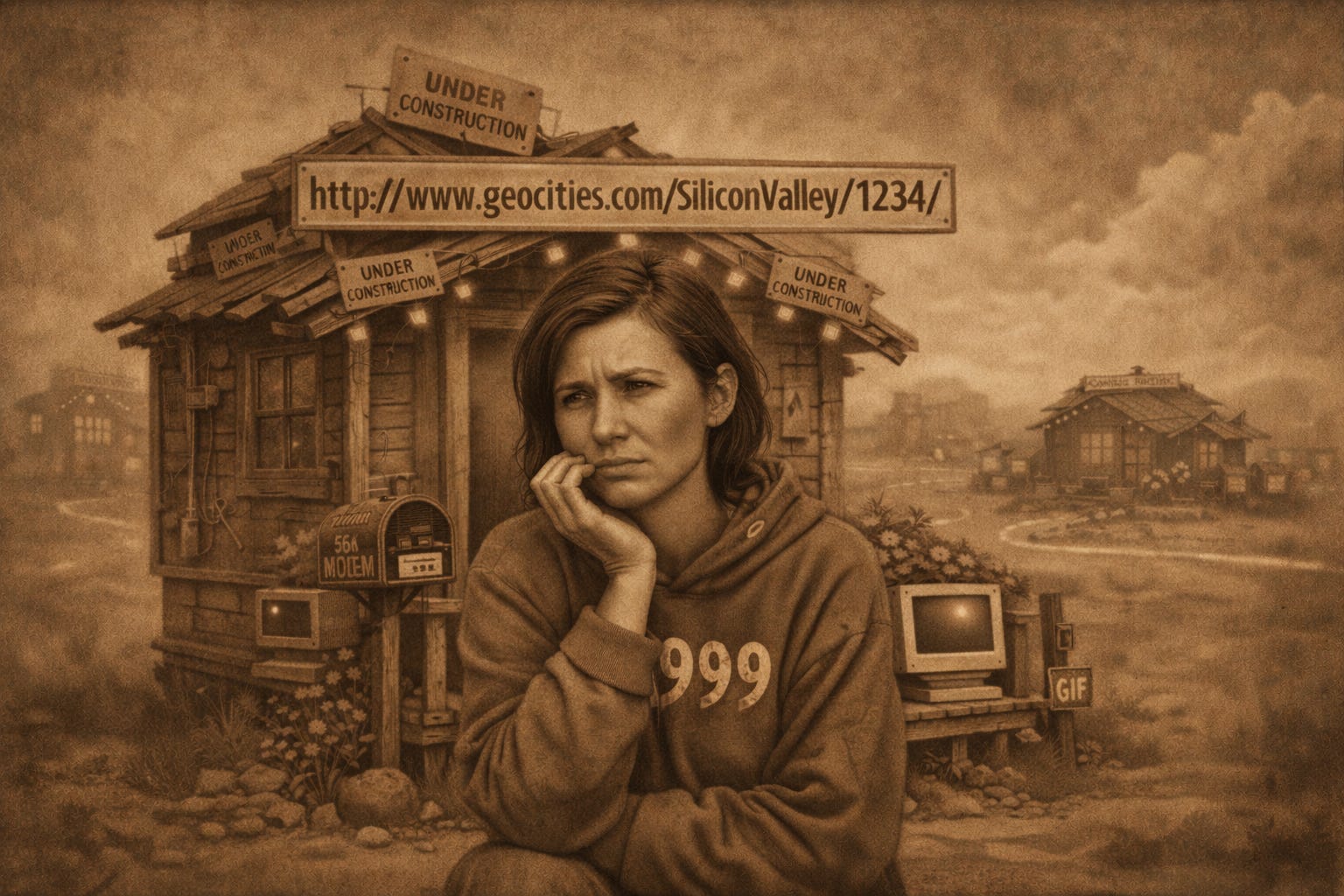
The web was less cluttered. Google was still learning to crawl (literally). You found websites through this quaint thing called “following links from other people’s sites.” Your other option was geocities.com, where URLs followed a neighborhood/street address thing that mimicked real-world addresses like http://www.geocities.com/SiliconValley/Heights/1234/.
Then you’d just visit each homepage one resident at a time, like whatever people went door to door for back in the days. Sell vacuum cleaners, I guess? Share the news of the gospel?
Since there were fewer weirdos online, we actually felt compelled to meet each other in real life. Early SXSW Interactive was full of us, and I have amazing memories of hanging out in Austin, Texas with my old and new internet friends. It all had that “let’s all be friends and change the world” energy before it all became a corporate networking hellscape.
2: People felt anonymous enough to overshare everything
My first few years of blogging were pure gold. Early LYD was essentially me documenting Asian family dynamics with the subtlety of a sledgehammer and the accuracy of a gossip columnist. I also wrote in public detail about how the CEO of Blogger.com swung by my 25th birthday party while I was high on Ecstasy. I don’t think I hit on him? Twenty-four years is a long time ago.
Then my uncle's girlfriend's cousin (okay, it was simpler than that) worked at this tiny startup called Google. She decided to play detective, searched our family names, found my blog, and—plot twist—used Google Translate to share my "hilarious" (read: probably racist and definitely slanderous) family observations with the actual family. Like my father. And his brothers.
Oh hey, here’s me writing about this in a little more detail:

Christmas 2004 was tense. Nothing says holiday cheer like your father reading your unfiltered thoughts about him in real time. That was the moment I learned that “writing in public” doesn’t mean “writing without consequences”—it means choosing and accepting which consequences you’re willing to live with.
3: The idea of making money from your blog was basically selling your soul
The 2000s were peak "don't sell out to the man" mentality. We wore our poverty like a badge of honor, as if starving for our art made us more authentic.
I recall attending an early South by Southwest event, where the topic of the moment was micropayments. Passionate hallway conversations about the pros and cons of whether you should be able to read about someone’s cheese sandwich for lunch and get charged for it the same way a taxi charges its passenger pennies on the dollar as it lurks in midtown Manhattan traffic. I think the biggest takeaway from that conversation was that the credit card fees would usurp the actual charges themselves; it was all not the right time, and when it was the right time, at that point, Tide was already paying your cousin to dance the Harlem shuffle and eat Tide pods and videotape the whole damn thing. (old person side note: do they still use the word videotape? Ironically?)
Looking back, I should have sold out early and often. Except "influencer" wasn't even a word yet—we were just called "people with too much time and opinions."
Now everyone’s got a Substack and a Patreon, and I’m over here trying to figure out if my midlife crisis can pay for itself. I guess this is what growing up online looks like: still writing, still oversharing—just with better boundaries and a Stripe account.
4: Now everyone’s a creator and nobody knows what the fuck they’re doing
Twenty-five years later, the internet figured out how to monetize everything we used to do for free. Substack emails land in inboxes the same way our RSS feeds used to. “Creator” replaced “blogger.” We’ve got analytics dashboards instead of site counters. Everyone’s got a content strategy and a lead magnet and probably a course they’re building. If, of course, it’s some or all of that content isn’t already written by a Large Language Model like ChatGPT or something.
Spam has been replaced by slop, and unlike spam, all the Hawaiians in the world can’t put slop on a palmful of rice, wrap nori around and make that delicious.
The spirit of “let’s all be friends and change the world” got replaced by “let’s all optimize our conversion funnels and change our click-through rates.”
And yet.
Here I am, still writing in public.
Still oversharing, just with better boundaries and lower expectations. Still figuring out how to make the numbers work while keeping the thing that made me want to write in the first place.
The tools changed. The business model changed. The consequences got real. But the impulse—the one that made nineteen-year-old me think “I should put this on the internet”—that’s still here. Just older, more tired, and now it has a Stripe account.
And honestly, I’m having thoughts about that too. But more on that later, I suppose.
I guess that’s what growing up online looks like. You don’t get to keep the innocence, but you get to keep going.
But what would we all do without your oversharing??