

It’s a Friday afternoon in May, and I’m at my mother’s kitchen table. My father has been dead for nine days. I’m here to talk about the service.
She says, before I can open the laptop: Name me any Christmas after we divorced where he came to us, wished us a Merry Christmas, took us out to dinner.
I don’t name one. There isn’t one.
She says: Name me any birthday.
There isn’t one of those either.
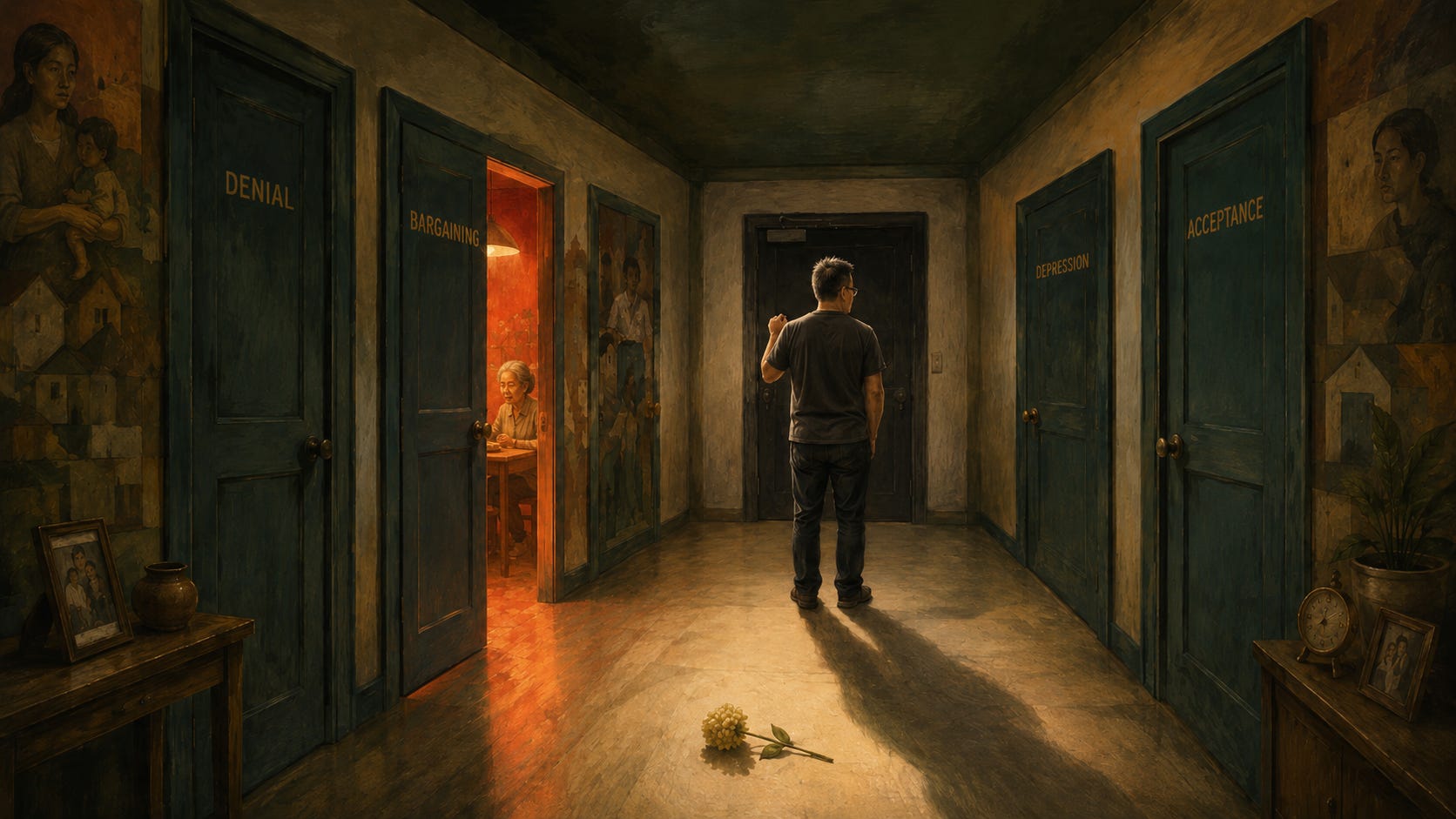
This is how my mother is grieving. If my mother has seven stages of grief, they’ve been rewritten with a new set of rules: anger, anger, anger, anger, anger, anger, anger. She’s been in the anger room for thirty years.
To be clear: she’s not wrong. He didn’t come to us at Christmas. He didn’t call on birthdays. The receipts are real. She is, in a very specific and well-organized way, telling me the truth.
She just doesn’t know that I have my own receipts.
In the second week of May, I’m organizing my father’s memorial service inside a project management tool called Asana. There are columns for “guest list” and “speakers” and a column for “what music.” I select-all and delete, because let’s be honest: Dad was 94. Dad’s lifelines were his naval buddies, also in their 90s. If they’re not dead, they’re not going to cross oceans on a day’s notice. There will be no phone calls to florists, no purchasing of hydrangeas. I have moved through grief, so far, the way I’ve moved through every other administrative task of my adult life — by pretending it is a project, and then completing the project.
Or at least, trying to complete the project. I literally don’t even know the church he attended post-divorce to notify the congregation. Which means I’m essentially the minister. Damn.
Somewhere in this column system is the truth that I’m the one who is doing this. Not Mom. She’s grieving in the way she’s earned the right to grieve, which is by being right. I’m grieving in the way I know how, which is by making a checklist for the hydrangea question.
When she lists what Dad didn’t do at Christmas, the answer she’s reaching for is: and so he doesn’t deserve to be missed, therefore we won’t miss him. I do not give her that answer. I also don’t contradict it. I just nod a little, like a man waiting for the tea to finish steeping. I’ve become, in middle age, very good at this nod.
There’s a thing my father did, in my early forties, that I hadn’t told anybody.
He told me he had married my mother out of obligation. His father had wanted the match. He had not. He told me this plainly, the way you tell somebody the weather. By then his senility was already underway, which means I get to wonder, for the rest of my life, whether it was true or whether it was the kind of thing a failing mind dredges up and hands to the wrong person.
I don’t get to ask him. I didn’t get to ask him.
It wasn’t the first time he had handed me something I wasn’t supposed to be holding; it was the latest time.
There’s a longer list. I’m not going to write it here. Some of it is somebody else’s story. Some of it I’m still deciding whether I have the right to tell.
What I’ll say is: my mother has her receipts, and I have mine, and mine are heavier. She’s mad about the Christmases he didn’t show up to. I’m holding the things he showed up to say. She got the absence. I got whatever the opposite of absence is when the presence is also a problem.
You would think that would be enough to cry about.
You would think.
I have not cried since my father died.
I mean at all. Not the heaving kind. Not even the kind that just happens to you, the way weather happens — the kind I cry at movies, at songs in the car, at the small absurd print of an unrelated invoice. I’ve felt sad at other things in the last nine days. I haven’t cried at this.
The last time I cried hard — the heaving, hyperventilating, can’t-catch-your-breath kind — I was nineteen years old. I won’t tell you what the situation was, because it doesn’t matter. Or maybe it does. I don’t know. What matters is how it ended: me in my bed, fetal, resolved that I wouldn’t cry like that ever again.
And I haven’t.
I thought this would do it. I really did.
I thought my father has died would be the thing. The thing that finally cracked the seal I made at nineteen. There is a version of me that’s been waiting thirty years to find out what could.
It turns out: not this. Not yet, anyway.
I don’t know what to do with this information. I’m sitting at my mother’s kitchen table watching her grieve in the only room she has — the anger room, the one she has decorated and hosted dinner parties in and is going to die in — and I can’t even do that.
I can’t find my room.
I’m not sure I have one.
The seven stages of grief are a popularization anyway; people don’t pass through grief in order. They live inside it, in whatever room they have built for it.
My mother has her anger room. I’m still looking for the door to mine.
It’s a Friday afternoon in May. Between us, we’ve drafted nothing about the service. Mom has named four Christmases he didn’t come to. I’ve nodded four times. I close the laptop. We sit there.
She doesn’t say anything else.
I don’t either.
Another beautiful and heartbreaking post. I think crying is over rated. I mean, my emotions are easily manipulated and I will cry at the end of the movie where I am supposed to cry. But my real life emotions? I'm not a crier. My father passed and I cried at the funeral. But not before or since. That's just how I am. Instead, I hear my late father in my head all the time. It's comforting.
Unfortunately, I have some experience in these things. What I can say is, there are no rules. As you noted, that stages of grief thing is a construct, not an actual rule.
Also, anger is a pretty natural, common reaction. Even before death, I've seen smart, compassionate loved ones get angry at their dearest loved ones for being sick. Mind you, not so much angry at life or the world or whatever for their loved one being sick but angry AT the loved one for being sick. At the same time, they'll say, "I know he doesn't want to be sick, but..."
It's just how we react sometimes. So this situation, where your mom is now angry at your dad for all those missed holidays and birthdays, isn't very surprising. It's just how she's processing her grief. And you've made clear to all of us, your friends and fans, over the years that he wasn't the easiest guy to deal with, so now she has a chance to get out a lot of the negative feelings. My hope--and it really does work this way many times--is that getting out those feelings will leave her with the better memories, and that will make it easier for her to move forward with the remainder of her life. She may even get to the point of speaking so well of him that you're thinking, "are you kidding me, mom?" If that day comes, just let it roll off you. You'll be remembering some of the crap she's then ignoring, but it's how she will have found peace.
As for your own grief, that big cry may come one day. Possibly when you least expect it. When my Dad died, I did the "be strong for the family" thing and didn't really let myself grieve as I should have. Then one day, about 6 months after he died, we were driving on the New York State Thruway (NOT a good time for this to happen, as I was the driver) when the Mike & the Mechanics song "The Living Years" came on the radio. There's a line in there, "I wasn't there that morning when my father passed away..." and that was it. I burst into tears. Big, messy crying. Hit me out of nowhere. But that’s when my brain, at some deep level, decided it was time. I didn’t even see it coming.
Try not to second-guess yourself in these circumstances. None of us is prepared for these things, even if we think we are. You’ll do your best, as you always have for your family, and it will be fine. Try to take good care of your own well-being while you’re at it! *hug*