

NOTE: This is an unpublished blog post initially written during the Miami-era, around 2013-2014.
The last time I visited my parents in California, I greeted my sister, kissed my mom, asked how everyone was, and then my mom started yelling at me.
“Your Chinese is beginning to be awful,” she said to me in Mandarin. “The longer you spend with those Spanish people, the more you won’t be able to talk to your mother.”
“You should move home,” she concluded, as she often did.
So, not-so-dirty secret: my first language was Mandarin. That’s what you get when your parents moved to the United States from Taiwan in the early seventies. My sister was eight when she moved here, so Mandarin was her first language too. I remember digging through her elementary language books as a kid, finding worksheets where she wrote out complex answers in bopomofo, a fake alphabet created for Chinese kids since they were too young to memorize every single character. Then our family moved, and thanks to a steady stream of children’s public television and a penchant for getting reference books instead of new toys, I was the four-year-old Kindergarten Christmas narrator, reading out the script when none of the other five-year-olds could.
Dad has always been able to speak broken English—Engineer’s English, he calls it. For twenty-five years, he wore a tie and dutifully studied corporate office building schematics and read engineering books while my mother tended to the children as a housewife. Known during the day as “Jimmy,” he spoke in heavily accented but passable English, more comfortable with terms related to flow systems and air conditioning than asking his co-workers if they wanted to go out for drinks afterward. At home, he was strictly Chi-Ming, his Chinese name. His home was his domain, and he ruled his family with an iron fist because, between the military and the way he was raised, that’s the only rule he knew.
Mom never really needed to speak. My mother used to take English lessons at the local adult school when I was a kid, and that’s where she met Mrs. Chen, Mrs. Chang, and her Japanese friend, Yoshiko, who would visit every so often. But she let her skills slip away after years at home as a housewife, speaking Chinese to family members and cashiers at the local Asian food market, Ranch 99.
So we have these moments where we speak to each other, but we don’t really communicate. Sometimes I hear my friends talking to their parents about things, and I wonder: Am I able to talk to my mom about that? And sometimes the answer is no. She asks if I get exercise and what I’ve eaten. I ask her if she’s gone on a daily walk. She asks me if I can help her burn some CDs. Other times, Angela acts out, and Mom tells me that she doesn’t feel good, that my sister gives her high blood pressure—nothing past that.
Do we talk about what will happen if she gets too old to care for herself? Do we talk about what will happen with Angela? I’m not sure we could have those conversations. I’m not even sure we’d want to, even if we could. It feels automatic now; she’s learned to use only certain words with me, almost like she can only speak to me as if I’m still a kid.
My parents enrolled me in weekend Chinese school, like all the other Chinese parents who had Americanized kids. The purpose was to keep up with their language and culture. It was also held at a local church, where the Chinese school headmaster was also the local minister.
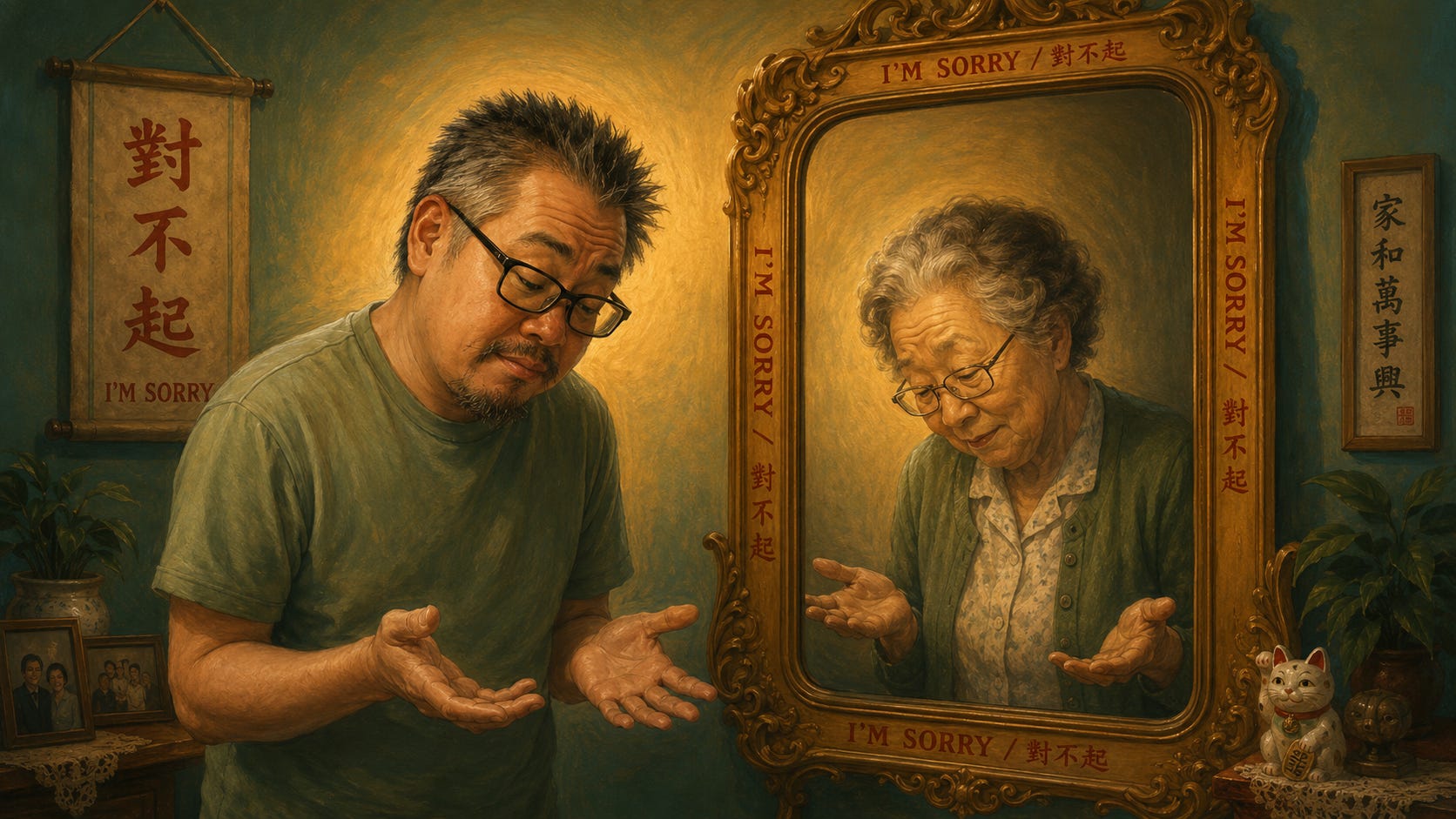
Before moving to Miami, my knowledge of Spanish was limited: two years of awkward high school Spanish, then I decided to refocus on relearning Chinese, because I thought it would be great if I could speak to my parents fluently in their language, like the ending of The Joy Luck Club, except with a little less estrogen. Also in high school, I went on a missionary trip to Mexicali, where I learned the phrase “lo siento” and a praise song we sang multiple times a day: “Yo tengo gozo, gozo, gozo, gozo, en mi corazón.” Which is great, because then I can go to Rodolfo, the handyman who works at the boyfriend’s theater, and tell him I have joy in my heart. And then he could ask “por qué,” and I would bow and shake my head and be all, “lo siento, lo siento.” I’m sorry, I’m sorry.
I shake my head a lot now, a thousand mini-bows like what my parents used to do whenever they didn’t understand that. I do that whenever I see there’s a family function and my boyfriend’s grandparents are there. “CHINO!” she screams at me from across the room before we go in for the standard besitos.
My sister-in-law turns to her and starts yelling. She is saying the word chino a lot, and she’s pointing at me, so I assume that she’s saying the word isn’t appropriate.
Abuela yells back, and my sister-in-law just turns to me and rolls her eyes. “She says she’s not being racist when she calls you chino. Because, you know, she knew a Chinese person back in Cuba.”
I turn to abuela and give a thumbs up. “Knowing Chinese people, AOK,” I telepathically communicate with her.
Which makes me uncomfortable because that’s exactly what my mom does when she talks in English to people she doesn’t know: she shakes her head and apologizes all the time. And I’m all holy fuck, I am turning into my mom.
So now I’m trying to learn Spanish, or at least get started with it.
Now I have an app, some flashcards, a boyfriend who helps me with pronunciation, and an Abuela who calls me chino, which I’m told is meant with love. I can order food. I can tell Rodolfo I have joy in my heart. At family gatherings, I can mostly keep up, nodding at the right moments and laughing just after everyone else, so it seems like I got the joke.
Mostly, I just shake my head and smile.
Which, yeah. I know.
Thirty years ago, I went through my sister’s bopomofo worksheets because I wanted to speak to my parents in their language, fluently, like the Joy Luck Club ending but with less estrogen. I never made it. My Chinese got good enough to argue about heart medication, but not good enough to stop my mom from yelling at me every visit that the Spanish people are stealing it from me. The longer you spend with them, the less you will be able to talk to your mother.
She’s not wrong. She just has the wrong language.
Here’s the thing: I crossed an ocean of vocabulary to get to Miami, but I ended up in the same place. I’m a grown man in a room full of people who love me, head bowed, hands a bit helpless, apologizing for words I don’t have: lo siento, lo siento. Mrs. Chen, Mrs. Chang, and Yoshiko—except now it’s all in Spanish, and I’m the housewife letting it slip.
The only thing I ever got fluent in was apologizing.
Lo siento, Ma. I’m sorry, I’m sorry.