

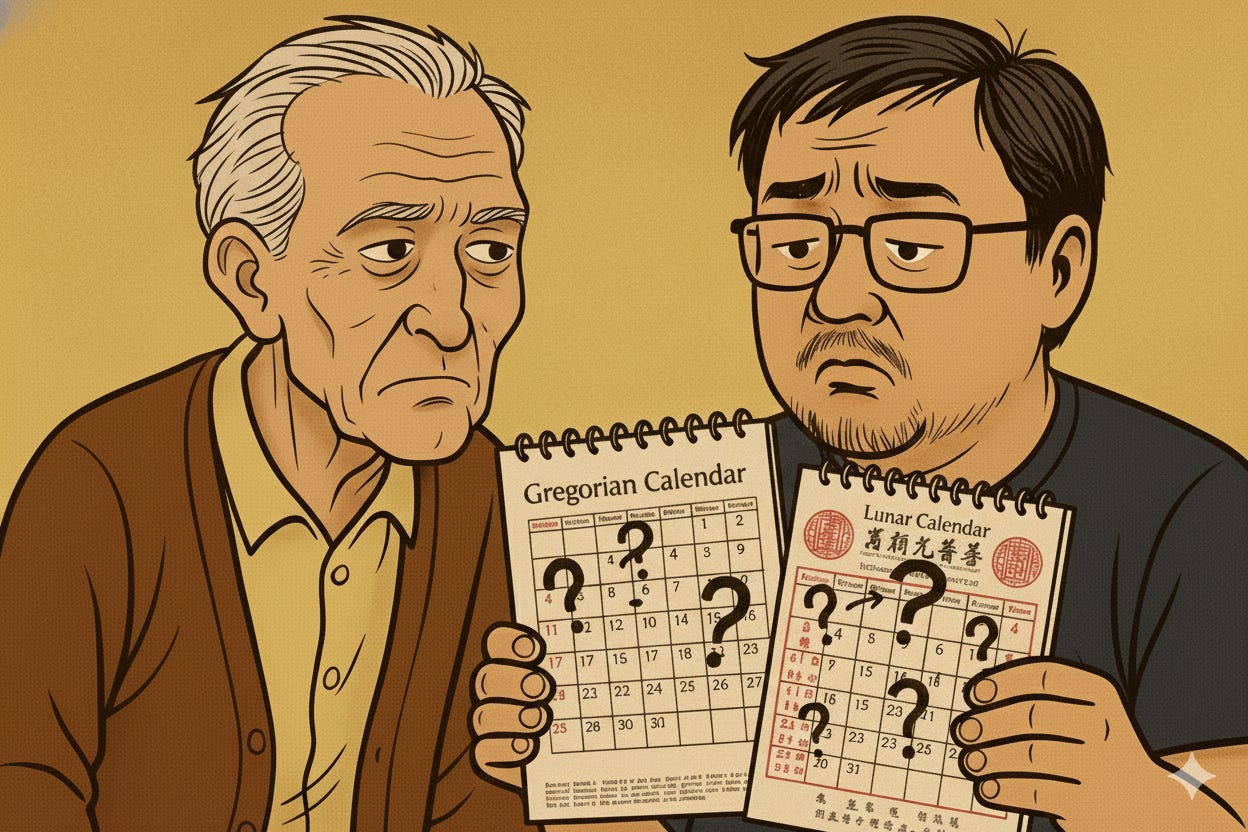
Your 93-year-old father is glaring at you like a stranger who sat too close on BART. The receptionist wants to confirm his birthday—Lunar or Western calendar, you can’t remember which is on file.
Of course, they don’t match.
(They never matched. He’d tell anyone who’d listen about this, like it was some kind of flex. You see, I was born on the fourteenth day of the ninth month... of the LUNAR calendar. And then some sort of wink and nudge, like he was giving a giant middle finger to Western Society or something.)
To the Urgent Care Center of Sutter Health Fremont Center, this matters. Apparently. God forbid the wrong moon phase voids your insurance coverage.
The receptionist asks for his Medicare number, and you give it to her before she shoots you a puzzled look. “For some reason,” you say, “my dad listed his name as Jimmy Hsiung. Just for Medicare.”
“Actually, it’s not that either,” she says. “It’s listed on here as Chi Ming.” You both shrug that one off.
The receptionist asks about the phone number on record. You give your number. Wait—do they have his old cell? Your mom’s landline? His house line that nobody’s answered since 2019? You’re the person who can debug a React component at 2 a.m. but cannot, for the life of you, remember which phone number is attached to your father’s medical history.
He makes a sound. Not words—just this repetitive grunt-groan that might mean “I’m uncomfortable,” or “who the fuck are you,” or “I need to poop.” Possibly all three. You look at him, hoping for a flash of recognition, even if it’s moderate disappointment, the last emotion he had for you on the record.
What you get is more glaring—the kind he perfected when you were twelve and brought home a B+.
Except now there’s no anger behind it—just that faint hum of static where a person used to be.
The doctor—you’re going to call her Dr. Zero Bedside Manner because that’s easier than remembering Dr. Le, and also more accurate—explains the situation with the enthusiasm of someone reading Terms and Conditions out loud. Your dad has a skin tear on his buttock. Not an infection (that’s the ER). Not an ulcer (that’s primary care). Just a thing.
A thing that is now your problem.
“The family usually handles this,” she says.
“Right,” you say. “Except I’ve never done this before.” That’s why he lives in an assisted living facility.
She blinks. This does not compute. Asian families are supposed to know how to do this—it’s in the DNA somewhere between MSG tolerance and weaponized guilt.
“I don’t think you can safely transport him,” she announces, like you showed up on a skateboard.
“I have a car. I can move him.”
“You’ll need to take him to the ER.”
“For a skin tear.”
“Or arrange primary care.”
“Which requires what, exactly?” you want to say to her. “A phone call? A blood sacrifice? My firstborn child?” You don’t have a firstborn child. You don’t have any children. The joke, as always, is on you.
She’s already waved you off. “There’s nothing I can do here.”
You roll your eyes and wheel Dad out of the examination room. You don’t thank her. She doesn’t wish you a nice day. You’re sure she’s writing about you on her Substack right now—probably something about entitled millennials who can’t handle basic caregiving—and honestly, you could not give less of a fuck.
Here’s what you’re thinking, sitting there with your father who doesn’t know you anymore:
He didn’t plan for this.
Not because he was irresponsible. Your dad was the most meticulous person you knew—spreadsheets before Excel existed, files organized by date and category, everything labeled in his precise engineering handwriting. But elder care? Decline? That wasn’t in the filing system. That was for other people. Weaker people. White people who didn’t understand that if you just worked hard enough, ate right, stayed sharp, you could outrun aging itself.
And now you’re sitting here, the reluctant heir to a system that was never supposed to exist, trying to remember his birthday while he grunts at you like you’re the nurse who gave him the wrong flavor of Jell-O.
The doctor’s assumption—that you should just know what to do—is where it all collides. American bureaucracy says: fill out the forms, make the calls, transport safely, document everything. Asian immigrant culture says: family takes care of family, no questions asked, no instructions needed, you just do it.
What neither system accounts for: What if Dad never told you how? What if he were so convinced he’d never need care that he left you with nothing but Medicare under the wrong name and a mother in denial and a skin tear you’re not qualified to assess?
You have Obsidian on your phone—of course you fucking do—so you’re documenting this in the waiting room, because that’s what you do. You write things down. You create systems. You build second brains. As if enough documentation will somehow make you competent at a job you never applied for.
It won’t. But you do it anyway. Systems are the only way you know to survive chaos.
But maybe when you’re seventy and sitting in your own Urgent Care waiting room, glaring at your 2069 Synthia™ or whoever has to deal with your shit, at least they’ll have these notes. Maybe they’ll know you had no idea what you were doing either.
Maybe that’s the only inheritance that ever really passes down.
Your posts can bring such mixed feelings. There were a number of laugh-out-loud moments in this post, but then I feel a little guilty, because I recognize the headaches these things bring you. *hug*
Feel for you - have had similarly fun experiences with elderly parents at Washington hospital.