

Hey there.
So, my father died on May 6. In the five months since, I have picked up a stack of certified death certificates, notarized a California small estate affidavit, filed my mom’s income change report with Medi-Cal, and gotten her PG&E survivor pension to arrive as an actual check.
Here’s what five months of paperwork taught me. Some of it might save you an afternoon. Some of it I wish I’d learned years ago.
Truth 1:
It is slightly easier to dig out your spleen with a plastic spoon than to get Blue Cross on the phone

At some point you’ll have to call Dad’s health insurer, and you will put it off.
Don’t. Write everything down first, then dial, and keep dialing.
There are approximately 7.9 million companies called Blue Cross or Blue Shield, and most of them aren’t the same company. Dad’s was Anthem Blue Cross Life and Health. Call the wrong one, and a very polite person will tell you after about 45 minutes of hearing a rep re-typing his Social Security number and every possible permutation of how to spell the name CHI-MING, and you’ll have used up your nerve for the day on a company that never heard of him.
Once you FIND the right Blue Whatever organization, you’ll encounter a different problem: their automated systems have apparently been designed with exactly two kinds of callers in mind. You will find this especially ironic because you yourself build automated voice systems, and suddenly you feel the acute anguish of how people feel using the things you build. Except the agent you built tells people where to park at a movie theater, and the agent they built will keep you from reaching a human being until the next inevitable nuclear winter.
Actually, it’ll probably still be answering calls after that.
“‘Nuclear winter’ isn’t a valid option,” the automated phone system says. “Please say if you are a patient or a provider.”
“For the last fucking time, none of the fucking above,” you groan. “Caregiver. Next of kin.” Which sucks, because you know how this works. And there you are, trapped in someone else’s assumptions about who should be allowed to call. You make a mental note to revisit your own phone agent’s assumptions the next time you work on it. Right now, though, you’d settle for a human being answering the goddamn phone.
“We’re sorry, this line is for patients and providers only.” And they hang up again.
I was neither. I was calling because my father was dead.
Truth 2:
Mom getting half of Dad’s pension is good news

Mom gets half of Dad’s pension for the rest of her life. That’s good news. Enjoy the good news for the afternoon you get it.
I didn’t realize one benefit could shrink another.
I’d spent seven months navigating IHSS, the program that pays people to care for elderly or disabled family members. Then I discovered that Mom’s new income might make the whole arrangement financially impractical.
So here’s what that involved: Mom’s Medi-Cal was approved in March. IHSS approved her for 21 hours and 41 minutes of care a week. I sat through the four-hour provider orientation in August. There was the interview with the IHSS representative, which meant preparing Mom to answer the questions accurately. There were the background checks and fingerprint scans, which cost me $77.
Not to mention the amount of time it took for me to mentally accept that I would be my mom’s official part-time paid caregiver.
Here’s the brutal truth:
When someone dies, the spouse gets whichever Social Security check is larger: their own or their spouse’s.
Medi-Cal counts the pension and the bigger Social Security check as her income, minus certain deductions. In 2026, the income limit for no-cost Medi-Cal under the Aged, Blind, and Disabled program is $1,836 a month for one person. She was way below that number before my father passed. To my surprise and Mom’s, she’s well over it now.
Going over that limit doesn’t necessarily mean losing Medi-Cal. But it can mean having a monthly share of cost—an amount she has to cover in qualifying medical expenses before Medi-Cal starts paying.
By my math, her monthly share of cost could be more than I’d earn taking care of her through IHSS. Other medical expenses might count toward it, and the county hasn’t given me an official number yet. But fatigue is setting in, and I’m now trying to figure out whether getting paid to care for Mom would actually leave us any better off.
What matters is what she can count on. The pension pays her every month for the rest of her life.
It’s tempting to add up the hours I lost. I’m trying to be glad about the checks.
Truth 3:
I didn’t understand my parents’ marriage as well as I thought
My parents were codependent, and they complained bitterly about each other right up to the end.
At Dad’s funeral, Mom didn’t really grieve so much as she loudly exclaimed it was too hot to have an outdoor funeral in the middle of me giving my eulogy. (In her defense, she’s hard of hearing, and it was a really warm day.)
They bitterly blamed the other for everything. One parent would blame the other as to the reason why I was gay, why my sister developed schizophrenia, why I was supposed to have three older brothers – always brothers – before they were tragically miscarried, always because of the other person. I heard some version of that for most of my adult life and believed every word. They separated in 2005, then remarried in Oakland in 2019. Mom made it clear it was because of finances, and I inferred it was so Dad wouldn’t die alone. After the civil ceremony, we ate at the only Chinese restaurant open at 3 p.m., and everyone was miserable because they didn’t serve soup.
It was a remarriage which made absolutely no logical sense to me.
But look at what he left behind instead: a pension for Mom, and a house that still had both their names on it.
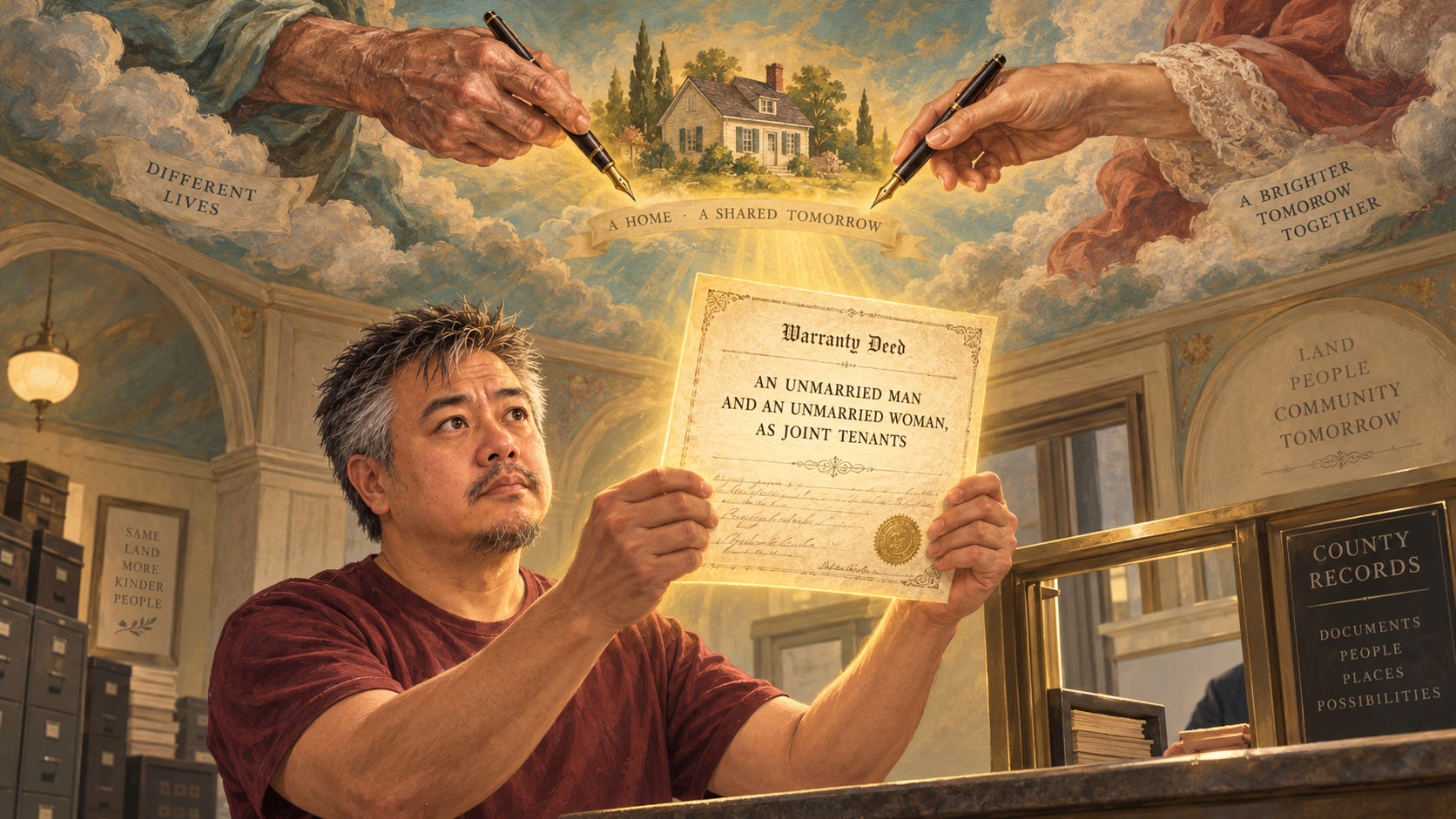
I went to Alameda County to get the official deeds to Mom’s house. A 2002 deed described them as “Husband and Wife.” But a 2015 deed, signed ten years after they separated, described them as “an unmarried man and an unmarried woman, as joint tenants.”
Both of them signed it.
They couldn’t stand each other, they weren’t married anymore, and yet there they were, signing another document that put both of their names on the same house.
I don’t know what that meant to either of them. Maybe it was financial. Maybe it was obligation. Maybe it was something neither of them would have admitted out loud.
I thought I understood their marriage. Apparently, I didn’t understand it all.
And sometimes, what little I have to go on is just enough to keep my sanity.
The forms still have his name on them. Mom’s name is on them too.
This sounds pretty tough. There’s a lot of work in there and I hope you are able to keep your spirits up, because you are doing a really fucking good job in a situation in which the primary people who should be thanking you have instead been pretty much assholes (or you know, dying without a single kind word first). So, I am in awe of your steadfast dedication here.
The other thing I’d like to say is that while it may have felt like the title document was Having Opinions about the relationship between your parents, it really likely wasn’t. Holding title in California only has so many permutations: if they’re not legally married at the time, their joint tenancy was likely a way of ensuring that the property goes to your mom, even when your dad died. In other words, because they weren’t married, at the time, they only had two ways both of them could be on the deed, and one of those provided the right for your mom to hold the title after your dad died. FMI: https://www.oldrepublictitle.com/media/afhjrkbn/california__common_ways_to_hold_title.pdf