

LYD Classic. Original publish date: April 28, 2014 (37, Miami)
Editor’s Note 2026: I wrote this in April 2014, when I was 37 and had recently moved to Miami and was still in the phase where I thought “doing culturally enriching things with my boyfriend on a holiday weekend” was a personality I could maintain.” It was not. I’m reposting it now because Shen Yun still exists, still plasters bus stops with the same girl with the silk sleeves, and still has not mentioned the Falun Dafa thing anywhere on the bus stop, and I find that impressive in a way I cannot fully endorse.
On Easter Sunday, the day Christ rose from the dead, coinciding with a weeklong festival that commemorated the emancipation of the Israelites from slavery, I had the opportunity to attend a cultural performance about a Buddhist-based spiritual doctrine under persecution by communists.
America!
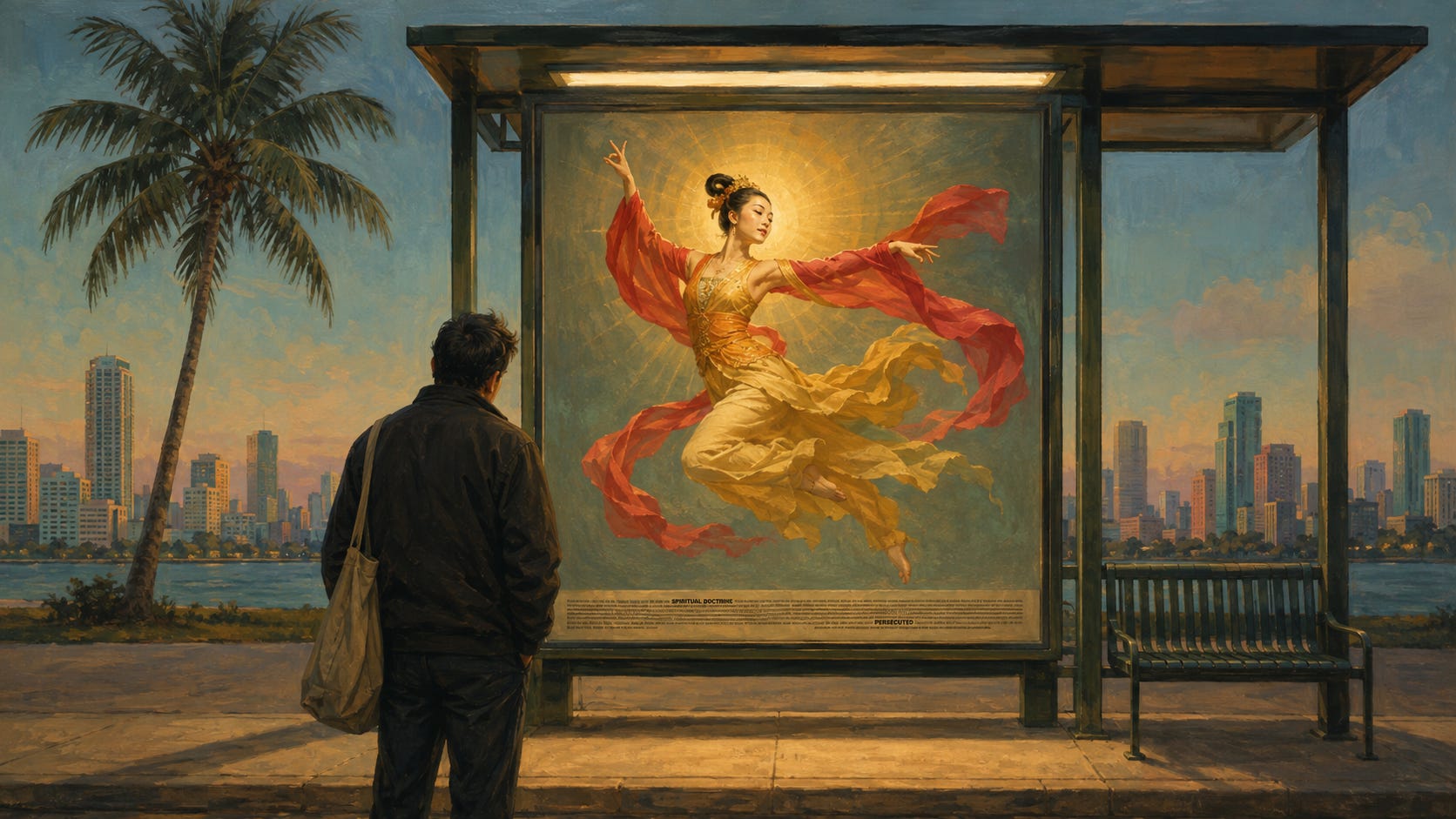
Most likely, you have heard of Shen Yun. In San Francisco and New York, you see their ads plastered on bus stops and billboards, banners of a brightly colored Chinese girl dressed in bright colors and holding a ribbon or a fan or something, ethnic, prancing through the air. When I lived in San Francisco, I always saw ensemble members handing out fliers in full ethnic costume by the BART turnstiles, on the way home from work. Cirque du Soleil wouldn’t go through all that effort, right? Still, I never went; if I wanted Asian culture, I could always take the train back to the suburbs and have my parents lecture me for a couple of hours.
By the time I moved to Miami and saw the same media blitz on freeway billboards here, I gave in and rallied a group of friends to watch a matinee performance. Mostly because the last time I tried to do something culturally Asian here in South Florida, we drove an hour north to a Bangladeshi trade fair that shared buildings with a gun show.
Also, it helped that the boyfriend likes colorful costumes, singing, and dancing. I wrote various notes on the experience.
Absolutely, Positively No Photography Allowed
No photography allowed. Seriously, they meant it. We were reminded by no less than four ushers on the way to our seats, broadcast on the curtain, and reminded before and after the show in English, Spanish, and Chinese. There was a staff member standing in the upper wings scanning the audience, and I could tell she was from Shen Yun because “Chinese theater usher in Miami” might as well be “leprechaun on a unicorn sliding down a double rainbow.”
Whether the strict enforcement was for copyright reasons (because honestly, that’s how our people roll) or political ones (which you’ll read about later), it certainly didn’t stop the Russian couple next to us from secretly taping the performance anyway with their cellphone. Rules are really just suggestions when you live in Miami, yes?
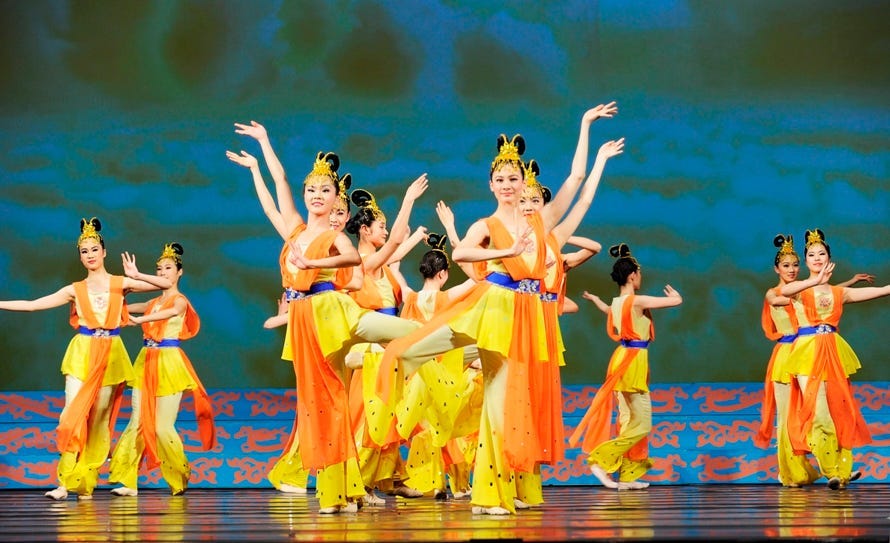
The singing and dancing actually isn’t too bad…
The show consists of multiple songs and dances — the cultural and folklore stuff you expect to see for a show about Chinese culture, all set to a full orchestra of both eastern and western instruments. There is ribbon dancing and Mongolian dances with chopsticks, pirouettes, and front flips, as well as the retelling of classical novels in front of an image-projecting backdrop. (In case you are wondering: there are no dragon dances or kung-fu fighting because they are practitioners of dance and not martial artists, you stereotyping assholes.)
But really, this show is a mouthpiece for the Falun Gong
But just when you find yourself charmed by the thirty dancers in unison, out pops an interpretative dance about how a mother is killed in front of her daughter by goons in black and red shirts with the hammer and sickle symbol upside down, the most unsubtle reference to the Chinese government ever. The daughter ascends to nirvana and is reunited with her mother, holding a bunch of scrolls: Falun Dafa manifestos. (I would include a photo as text doesn’t convey the majesty of this moment, but, you know, photography strictly prohibited.)
Which feels out of place after twenty men do a synchronized dance using ancient drums, right? It turns out the production company is a group of exiled Falun Dafa practitioners based in New York City. They’ve been exiled because one man’s pathway to enlightenment is another man’s evil cult. After all, Shen Yun is not allowed to perform in China, which they remind you about by the emcees, in programs, and in their finale, which I’ll get to later.
None of this is advertised, as a person meditating on a bus stop with large text saying “COME LEARN ABOUT HOW OUR BUDDHIST-BASED DOCTRINE IS OPPRESSED” will not bring as many old people through the doors as, say, a pretty girl with silk sleeves leaping through the air.
Later, an operatic soprano sang about life and death and Falun Dafa’s joy of spreading peace. Not that this bothered the Brazilian woman behind us one bit, who started clapping and shouting “Bravo!” at the end of the song and I briefly contemplated turning around to tell her this wasn’t the Chinese version of Ave Maria or anything because it’s literally about the Falun Dafa and did she not understand the translated English lyrics?
After some more dancing, the finale opens with goons killing a peaceful Falun Dafa gathering through modern dance in front of a digital background of Shanghai. It is a gathering because they are all wearing polo t-shirts that say “FALUN DAFA IS GOOD” in Chinese, and the sky darkens as they are all beaten. But then, a giant CGI Buddha rises from the horizon and destroys the skyline like that one scene from Independence Day. The remaining practitioners fly through the air to Buddhist heaven, and everyone is reunited with their loved ones. The end!
“The hell was that?” my boyfriend whispered to me as the cast took their bows.
“I don’t know,” I shrugged. “I grew up Presbyterian.”
Listen, by no means am I pro-government crackdown: my dad’s side of the family escaped to Taiwan from Mainland China to escape the Communists. While I’ve always been a typical liberal San Franciscan, I now live in a city actively waiting for Fidel Castro to die so we can all drive down to Versailles Cuban Restaurant and have a spur-of-the-moment block party. It’s amazingly easy to find anti-Falun Gong doctrine from a website conveniently called facts.org.cn, and it makes my eyes roll as much as the next guy.
On the other hand, I also grew up sitting through enough religious doctrine to realize that folks often battle crazy with crazy. Thankfully, I was warned about how weird it gets, but if I had come to the show blind, I would have felt misled. Kind of like when you are invited to dinner by your cool new married couple friends, and it turns out it’s a ploy to join a pyramid scheme.
All (Four of) the Asians Here
Maybe I had hoped that Shen Yun would be a rallying point for all the Asian people in Miami to meet up beforehand and have cocktails. I don’t know where we got that idea; the programs, the announcements, and the emcees — a Chinese lady and a delightfully camp man named Jared — spoke interchangeably English and Mandarin, and back in California, the fliers were very clearly targeted for someone like my Mom, who doesn’t speak English at all.
Nope. With some exceptions — the Vietnamese family sitting behind us, the older Asian lady speaking Cuban Spanish to her friends, the Latin guy really excited to wear his oriental shirt — good for him! — it was mostly a bunch of “the regulars,” season ticket holders to the Arscht looking to spend Easter morning not doing anything related to a place of worship, the irony.
“I suppose I’m having an alright time,” I heard an older gay man say loudly during intermission to his friend while waiting in line for a cocktail, “but I’d much rather be at the ballet.”
At which point I wanted to turn to him and hiss, “Well, I’m sorry our people can’t sing and dance to your expectations,” but because I’m Asian American, I’m passive-aggressive, so I’m just writing this out instead. (Also, note my hypocrisy referring to Shen Yun performers as “them” until a drunk queen spending his last weekend in Florida before he spends his summer season in Provincetown comments, to which it becomes “our people.” I have no explanation for this.)
No Seriously, No Photography
Overall, Shen Yun promotes Chinese culture through dance, music, and singing. There is definitely dancing, music, and singing, and the dancing, music, and singing are technically quite good.
But all that culture comes with a heaping serving of preachiness, which can be off-putting even if you believe most of it. Maybe it’s one of those things where you don’t have to feel the dogma to appreciate the art that comes from it, like the Mormon temples in Salt Lake City or the Mass Games in North Korea.
As we were walking out, we heard an argument at the back of the auditorium; event staff had caught an older couple recording video, and demanded the woman hand over her cellphone to check. The woman started to raise her voice and, in a Spanish accent, demanded to talk to the manager, that no one can take her property, that she will call the police if need be. I looked up in the wings to see if the Chinese lady was still there scanning the theater floor, but the audience had been ushered out into the lobby too quickly to give anything a second thought.