

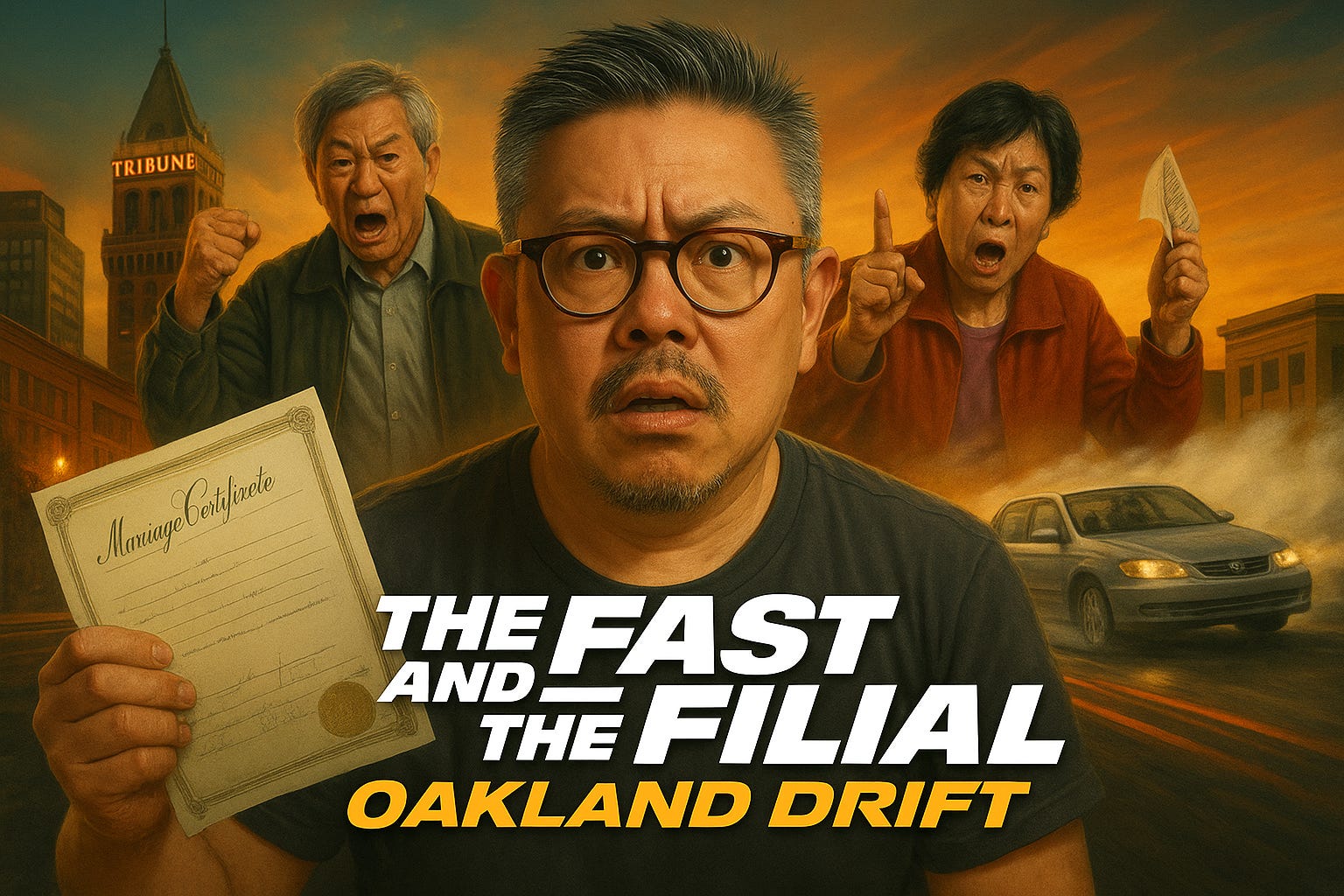
Editor’s Note, 2025:
This was written in 2019, back when I was ping-ponging between coasts—wrangling aging parents, legal documents, and my failing grip on adulthood. My dad had dementia. My mom had Opinions. And somehow, against all logic and several decades of documented incompatibility, they got remarried.
It’s a story about filial duty, family absurdity, and how love sometimes shows up dressed like junk mail.
I'm resurfacing it because some parts still haunt me, like how my dad, for the entirety of our thirteen-year relationship, never once acknowledged him by name. And some parts still make me laugh out loud at the ceiling fan.
I.
Ring ring.
“Hi, Mom,” I answer.
“ER-NIEEEEEE,” she sing-songs in English before switching to Mandarin, like always. “Your father is moving into your room today.”
“Okay,” I say, hoisting my swollen foot onto a chair, switching to speakerphone, and mouthing fuck me to the ceiling fan. This will not be a short call.
“What am I going to do? He hired some Chinese people, and now I have to park the car outside. I don’t like parking outside.”
“It’ll be fine, Mom.”
“And just because your father is here now doesn’t mean you shouldn't visit when you come home.”
“I'm not going to stop visiting just because he's there,” I mutter, staring at a crack in the ceiling like it owes me money.
A week or two ago, I made the catastrophic suggestion that when I visit, I could, you know, stay at a hotel or with friends. You could practically hear my mom recoil over the phone—what kind of Asian mother does she think she is, not hosting her son? The sound barrier cracked. Distant car alarms went off. Somewhere, a bald eagle shed a single tear. None of this is said out loud, but when she lets out an emphatic NO in English that makes my eyes roll so far back I can see my own childhood trauma, we drop the subject like it's radioactive.
“I will simply sleep in the den,” she proclaims. “And you will sleep in my bed.”
吃苦, I remind myself. Eat bitterness. She’s mainlining it like it’s a Vegas buffet.
“Let me come first, and then we'll work something out.” I love how she's freaking out over the detailed logistics of plans that exist only in the quantum realm of possibility. It's something I do, too. (The acorn never falls far from the anxiety tree.)
“You have no energy,” she says—her way of clocking that I'm cranky. “Make sure you sleep more.”
"Okay, Ma."
“Oh, and give your friend my regards.” Translation: That person you've lived with for thirteen years, whose name I refuse to learn or acknowledge.
"Okay."
II.
So. They moved back in together.
Did I mention they got remarried a couple of months ago? Dad is 88. Mom is 80. There's so much to unpack here that U-Haul should sponsor this post. Basically:
After the divorce, Mom kept the house. Dad bought a condo a mile and a half away—close enough to maintain familial obligations but far enough to avoid kitchen knife incidents.
Dad visited often—someone had to drive Angela to her monthly check-ups. But Angela eventually moved to a care facility, and as Dad aged, it became obvious he was coming over more for food and company than out of any sense of duty. Mom didn't mind, so long as they didn't fight. (Narrator: They fought.)
But Dad was slipping. At that point, we didn't say Dad had dementia. Instead, we noted that he was getting senile. Senility, the softer side of dementia. And it was creeping in like a slow Wi-Fi connection.
One of many examples: Mom was struggling to pay the mortgage because Dad kept forgetting to send his share. Since we're Asian (read: we'd rather set ourselves on fire than have a direct conversation about money), I quietly covered Mom's lease for a few months until it became clear Dad wasn't paying because in his mind, he'd already paid—sixteen times, to various Nigerian princes.
Around that time, I got a message on WeChat from my aunt: Come home. Your father's having memory issues. He bought three phones. He's writing incoherent letters to the AARP because he thinks the junk mail is a threat.
So I put on my dutiful Asian son's hat (it's a snapback with “FILIAL PIETY” embroidered on the band) and flew back to California twice—once in February and once in July—both times wondering if adulthood was just an elaborate prank everyone was playing on me.
I came up with a plan: After extensive interviews and research, I decided to get him to sign a Transfer on Death Deed, a power of attorney, and a healthcare directive—the Greatest Hits of Adult Son Paperwork, now available on vinyl.
I didn't know how senility worked. But I swear on a stack of Bibles, he remembered way more after my February trip. Still confused, still paranoid, but with moments of startling clarity—like watching a 1950s TV through static, occasionally getting a perfect picture before snow fills the screen again. I convinced him not to storm an AT&T store with his engineering credentials to demand respect. (His plan: “I'll show them my business card from 1982 and they'll give me the executive treatment!”) I spent the whole day sorting through piles of forms and junk mail scattered across every flat surface like the world's most depressing confetti.
“Don't touch that,” he snapped. “It's important.”
Everything was important.
A pizza coupon from 2017? Important. A magazine subscription offer addressed to someone who died in the Nixon administration? CRITICAL.
I confronted him about the unpaid mortgage. That led to a 45-minute rant about how Mom can't function and how every person in her life is untrustworthy, especially the few friends she actually had. By the end, he was out of breath. But at least Mom stopped panicking about the mortgage.
Dad refused to sign the Transfer of Deed on Death form. He thought my partner, whom he's never met (but has crafted an elaborate villainous backstory for), was a “bad influence” trying to steal his property. I was “no longer Chinese,” corrupted by evil homosexual American forces, who apparently recruit by, I don’t know, offering excellent brunch options and superior design aesthetics.
Nothing got signed. Nothing got notarized. I even had his realtor explain what the forms meant in Chinese. He still refused. “Why does he want my property so badly? I'm not dead.” (NOTE: I refrained from adding “yet” but thought about it really hard.)
He did show me an old signed healthcare directive… naming my uncle and aunt instead of me.
Why my aunt and uncle and not my mother and I?
"You live in Florida," he explained, as if I might have forgotten the swamp I call home. He was lying. "That's fine," I said, mentally canceling the "World's Best Son" mug I was planning to buy myself. I was lying too.
Dad clearly had a better idea. His ultimate solution?
Get remarried. To Mom.
It would stabilize her finances and ensure he wouldn't die alone.
Romantic!
Mom hated the idea, naturally. She wanted co-ownership of the house, not a reissued marriage certificate. There were daily screaming matches the entire time I stayed there, the kind that make neighbors reconsider their position on noise ordinances.
They tried to schedule the wedding three times. Each attempt exploded dramatically. You haven’t known true dread until you’ve watched two elderly people call off their wedding with the energy of a season finale cliffhanger.
I told him it was a terrible idea. Living together wasn't working. He should go back to China or Taiwan, depending on which country was less politically on fire at the moment. "So, who's going to take care of your mother?" he asked, dropping the responsibility grenade in my lap. "What, she's going to move in with you? In Florida?"
Sir. I was just trying to get a Transfer on Death deed signed. Not apply for full-time eldercare coordinator. But here we were.
A few weeks passed. Then he asked me to drive them to an office in Oakland Chinatown that helps Chinese immigrants with official paperwork. I assumed it was for property management stuff. They kept using the Chinese phrase 管事 — “handling business,” and let’s be honest, in our family, that could mean anything from paying taxes to obtaining restraining orders.
I assumed it was a property thing. It was not.
I only realized it was a wedding when the lady behind the desk asked if I was the witness.
I sat there in stunned silence while my parents argued about the hometowns of my grandparents, which was required on one of the forms. It was a plot twist worthy of M. Night Shyamalan, if M. Night Shyamalan made movies about middle-aged men being tricked into attending their parents' second wedding to each other.
We filed all the paperwork. A Mandarin-speaking officiant married them in a little chapel at Oakland City Hall. As we took the elevator to the chapel, my mother turned to the officiant. She remarked how interesting it was that they let women conduct these marriage ceremonies, and I briefly debated whether to hurl myself through a window or not out of sheer embarrassment.
The ceremony itself was fifteen minutes.
No eye contact.
My dad was so confused during the vows that I had to lean in his direction and whisper loudly, “She wants you to repeat after her.” The officiant turned to me and said, "Oh, does your father not speak Chinese?"
Ma’am. No, he's just lived in America for so long that he's forgotten how wedding ceremonies work in any language.
As we exited City Hall, Mom suddenly switched to full-volume mode—her voice reverberating through the marble hallway like a foghorn in a library. “NOW I GET MY PROPERTY!” she bellowed in rapid-fire Mandarin, waving her newly signed marriage certificate like she'd just won the lottery. “EVERYONE HERE IS A WITNESS! IT'S ALL ON RECORD NOW!” She gestured wildly at bewildered government employees who smiled politely while understanding exactly none of what was happening. Dad nodded along, though I'm fairly certain he thought he was at the DMV renewing his license. A security guard approached, clearly concerned about the tiny Chinese woman shouting and gesticulating at terrified bureaucrats, but I mouthed "just married" and he backed away slowly, the way one retreats from an agitated raccoon.
Afterward, we walked five blocks to find food, but everything was closed for the staff meal break. Dad's legs were giving out, and Mom was still periodically announcing her property rights to random pedestrians. We landed at a Cantonese dim sum spot. Dad complained the food was too fatty, and Mom was furious she couldn't get the soup she wanted. I couldn't even tell you which stage of grief I was in—probably the secret sixth stage: eating pork buns while dissociating.
I drove them back to Fremont.
Dropped Dad off at his place.
Nothing changed—except now, they were married, and I had front-row tickets to the world's most confusing rom-com.
III.
So basically, I failed every task I gave myself.
I wanted to be the noble adult child taking care of his parents. Instead, it all got aikido'd, and I became the son mindlessly following orders from a parent I love but don't like—less Bruce Wayne taking care of Alfred, more Charlie Brown trying to kick the football. I hate how much of a pushover I am—and how much that trait has shaped my life. I tell myself it's not my fault. Then, the whole thing plays back in my head, on repeat, like the world's most depressing GIF.
Eventually, I gave myself a timeout. Sabbatical. Writing. Travel.
But one thing hasn’t changed: as long as the sun rises and everyone is still breathing, Mom will call.
We’ll talk about everything and nothing, like when I first left for college. Except now I remind her to take her heart meds, the ones that slow her heart down.
She asks when I'm coming home. I promise I'll visit again.
Yes, even with Dad in the house.
I say it enough times that eventually, I almost believe it.
A version of this was originally published on 8/5/2019.
If you've ever tried to manage aging parents, survived a dysfunctional family reunion, or just quietly eaten bitterness for breakfast, drop a comment or send this to someone who gets it. Misery loves good company.