

Present Frame (Why Now)
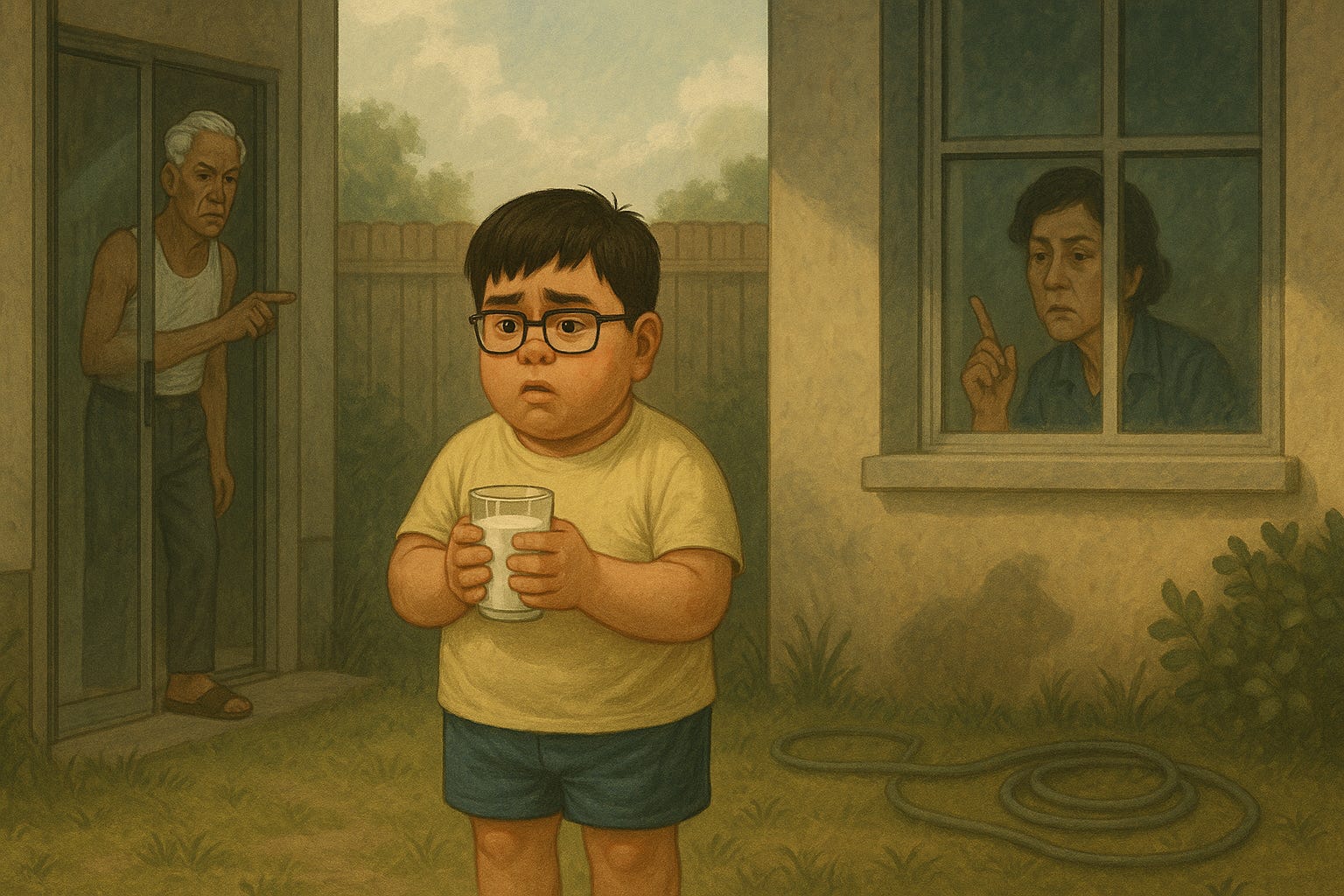
Editor's Note, 2025: Every time I think about the version of myself I used to be, I don’t think about breakups or awkward AIM chats or tech jobs I flamed out of—I think about the fat kid holding a glass of milk in a backyard in El Cerrito, California, paralyzed by the silent standoff between his parents.
I'm reposting this not because I've had some big “body journey” or because I'm suddenly reckoning with self-image — although, let's be real, some days I still turn 90 degrees in the mirror and flinch like I'm dodging a fucking sniper — I'm resurfacing it because it's always been one of those early pieces that felt like me. You know: emotional but funny, honest but ridiculous. Sad clown shit with a strong Asian-American flavor, like if Charlie Chaplin grew up eating congee and getting lectured about his posture.
The Milk Story (2013)
I was a chubby kid. This is a story about it.
If you were to take a photograph of my immediate family, which there wouldn’t be, because - you would see the following: my mom and dad looking like the standard elderly Asian parents of average weight. You would see this because my dad, who's in his 80s, is an ex-military dad with perfect posture and white silver fox hair and his impeccable dietary habits of savory oatmeal and cold tofu and bitter melon he’s had for the thirty or so years I’ve known him.
My mother, standing next to him in this imaginary picture, could hold her own, as well. At seventy-five, thanks to her two-mile walks around the local man-made lake by her house, as well as her stylist dying her hair jet black every six weeks.
Then your eyes would scan to my sister and me, looking like Asian blueberries.
Unlike my sister, who is overweight due to her medication, I've always enjoyed a little too much junk food, and chose to stay in a little too often. Fat shows in my face first, so the entire world knows if I’ve had a stressful month and ate my feelings or if it’s the weekend after Thanksgiving. As an eight-year-old, my mother knew I was chubbier than the other kids, but it wouldn’t stop her from feeding me. She told me I was a growing boy, and growing boys needed to eat. But I wondered if Mom saw me as one of those Ethiopian kids I saw on the television commercials, the ones all the pop stars are singing about, lying in the fetal position on the ground with bloated stomachs and flies buzzing around them.
And I was quick to point out to her things delicious to an Americanized eight-year-old kid, things like tater tots and bagel pizzas from a toaster oven. When we drove by McDonald's after church, I would always squeal out, “Hamburger, fries, and a Coke!” (my favorite meal). My dad would always furrow his brow.
“No, is sugar water,” he would say in English, passing it by. And my mom would always turn to me and wink at me, because I could always go with her later.
“Don’t forget to exercise!” my mom would tell me as she would put her hands on her hips and rock left and right, left and right. “One hundred times before you go to bed!” she would say to me, as if I could literally rock the weight away.
My father was a little more blunt, saying, “Listen to how you sound breathing,” and then he would imitate me as if my chest and lungs were made out of fat, trying to gasp for air as if he was trapped in an iron lung like one of those black and white photos from the fifties. I always assumed he was mocking me, and held my breath every time we were in the same room together, so he wouldn’t hear me breathe in and out.
The one time my parents tried to sign me up for anything physical was Chinese wushu classes taught by a man my parents had met in church. It was super clandestine, and we practiced in an abandoned schoolyard in Berkeley. After warming up and running laps, our instructor — a middle-aged Chinese man wearing a tissue-thin V-neck t-shirt and sweat pants—would begin his fighting routine, and only then did we realize what we were doing, because we only knew this as the American term, kung fu.
We halfheartedly tried to copy him. But we were all awkward kids, kids who loved cookies and Nintendo and were scared to sweat. But there we were, flailing our arms and legs, punching and kicking the air as homeless folk stared at us behind the chain-linked fences.
“Look at all those tiny fighting Buddhas,” I imagined them to say.
It didn’t last long. After practice each week, I marched to my parents and declared I would never be happy again; I was bogged down between piano lessons and weekend Chinese school, and thanks to them, I would die with a scowl on my face. By the fourth week, they agreed, if only to stop my nagging.
---
We were having a standard weekday breakfast of toast and scrambled eggs. There is a jar of mayonnaise, which is how I like my scrambled egg sandwiches in the morning, accompanied by a couple of strips of bacon, toast folded in half, and a side of milk tea with two tablespoons of brown sugar.
Mom just started using brown sugar in her milk tea, instead of regular table sugar. We all convinced ourselves that it was somehow healthier.
I heard them argue again. Even though Mandarin was the first language I was exposed to, it had all been undone thanks to English and a steady stream of elementary school and Sesame Street. But they were arguing, and I knew this because of the rhythms of the way they would shout at each other.
“You’re stuffing him like a pig!” Dad said. A pig on the table, with an apple in its mouth, just like the cartoons I used to watch, when the bad guy got too close to the TNT - up, up, up he went with a loud kaboom, and down he would land, all the dinner settings in place. That was me, I thought.
“But he needs that! He needs that to grow taller!” My mother responds in Mandarin.
And I knew then, even as a little kid, that this is where everything gets really bad. My dad yells and he screams and throws a bowl to the ground, and then it’s out of his system. But my mother is the exact opposite — non-confrontational but able to work herself into a frothy anger and unrelenting. She brings in other topics, like my dad’s mother and, most recently, his girlfriend. She’s the first one to take a chef’s knife to the bed he’s sleeping in the room over, or a broomstick to the hood of his running car, and when the police are called, my mom stands at the doorway, trying her best to wave them away. No officer. Nothing’s wrong.
“That’s fine,” she says. “You don’t want my son to eat? THEN HE WILL NOT EAT AT ALL!”
So, this is what I do next, which is what a fat kid does when his mother tells him he won’t be fed and is similar to what a regular kid does when his parents get into a screaming match over his eating habits: I burst into tears and run into the backyard, because I’m not quite sure where else to go.
Dad follows me into the backyard. He hands me the glass of nonfat milk that his mom poured at dinner, and then goes back into the house, standing behind the sliding door in the family room. He points to the glass I’m holding, half full. “Drink your milk,” he says to me in Chinese. “It’s for your health.”
I take both hands and bring the watery liquid up to my lips. That’s when I notice, in the corner of my eye, my mom looking back at me. She’s sitting in the bathroom, staring at me through the window, and she’s shaking her head. Don’t drink the milk, she seems to be telling me.
I glance right at my dad. Drink the milk.
I look back at my mom. Don’t drink the milk.
Drink the milk. Don’t drink the milk. Drink the milk. Don’t drink the milk.
I stayed there in the backyard, frozen, for what seemed to be hours in my eight-year-old mind, but it could have just been a couple of minutes, too. And I wish something dramatic could have happened for the sake of the story - I wish I could have fainted, and both of my parents would rush to my collapsed body at the same moment and realize the error of their ways, like the ending of the movie The Parent Trap, maybe. Or someone could have come in through the door in our backyard fence, pick me up like a football, and carry me away from all the fighting.
But what probably happened — and I say probably, because I don’t really remember, because it was thirty years ago — was that my dad probably got tired of waiting, probably left his post to go into the house. Perhaps because he was exhausted, or maybe the situation was just so pathetic. And Mom, sensing that Dad was no longer at his post, probably grew tired of watching me not drink any milk and disappeared from her position at the bathroom window. And I probably realized I was alone in a backyard, holding a glass of non-fat milk, and because I don’t remember at all, probably shuffled back in the house, sniffling on my shirt. And Mom would have probably told me it was time for me to eat, as she always did, and I would have pulled myself a chair and taken bites from my mayonnaise and egg sandwich, while she washed the dishes and Dad filled out checks from his office desk, the door shutting behind him.
---
When I visit my dad in California for lunch, every couple of times a year, whenever I’m back, he serves me carefully measured half-portions of pickled vegetables and tofu as punishment until I tell the voice in my head, "No, that is what his girlfriend cooks for him. This is how he’s going to live forever." As Dad tells me about the upcoming trips he’s about to take, I imagine my belly button pressing against my spine and hold my breath. I do this by instinct now, even though my weight is no longer a topic allowed at the dining table.
After lunch, I travel to my mom’s, where she prepares dinner. She spends the afternoon cooking a six-course meal of pork belly, steamed fish, vegetables, and bowls of white rice. She tells me to eat up, because it’s a special occasion, because I’m home, and it’s not like we’re going to McDonald's, and when am I going to have the chance to eat Chinese food in Miami? And as my sister is helping herself to another serving, I realize this is our childhood we’re living over again: two kids in our thirties and forties, being fed by our mom.
Weight fluctuates, I have learned. I had lost some weight living in San Francisco, through exercise and careful eating habits. Now that I live in a city with a car-centric culture and date someone with equally bad eating habits, I’ve sunk back to old habits, although I’m reminded this is a bad decision. Photos of friends from college taking before and after photos of themselves, shirtless, on P90X. Instead of inspiring me, it exhausts me. Stupid vanity. Stupid health.
Weight fluctuates, but the fat kid is still there inside. I see him when I'm not careful, when I look in the mirror, and I try to put on one of my old shirts, and I turn 90 degrees. And he’s still standing in the backyard holding his glass, and he’s looking around, for guidance, for a friend, for anyone at all, and he’s desperately trying to figure out if he should drink the milk or not.
Looking Back in 2025
Archive Setup: This was initially written in 2001, revised in 2012, and published on my blog shortly thereafter.
Blogs felt personal back then, like secret trapdoors you left open for strangers who might actually give a damn. I wasn't thinking about virality or shareability or "content" (god, even typing that word makes me feel dirty)—I was trying to write things down before they disappeared into the black hole of memory. This one stuck with me like that one friend who always shows up uninvited but somehow makes the party better.
Cultural/Emotional Analysis: Growing up, my body wasn't just my body—it was a proxy war between my parents’ ideologies about food and health and America; a chubby little DMZ they wouldn't stop fighting over, even decades later.
My mom, who grew up one of thirteen (or was it fourteen? honestly, the exact number changed depending on which relative was telling the story) in post-war Taiwan, knew what it meant to go hungry. Her instinct was to feed—to love through food, to show affection by making sure your bowl was never empty and your cheeks were never hollow. Food was safety. Food was survival. Food was “I love you” in a language that didn't require translation, because even when she was unimpressed with any gifts I gave her as a child, there was never any doubt she had ever stopped loving me.
My dad, an ex-military man with binders — actual fucking binders — full of clippings about health, longevity, cancers, and raw garlic, saw my weight as a threat. Not to my self-esteem — lol, he couldn't have cared less about that touchy-feely bullshit — but to my survival. And in some twisted, deeply ironic way, he was probably projecting his fears about his body turning against him. Which, as fate would have it, it eventually did—though not in the way he expected. Cancer never came for him; instead, it's Alzheimer's that's slowly stealing him away, one memory at a time. The man who obsessed over every health article, who could recite cholesterol numbers like all of his diversified investments, who probably believed he could think his way out of mortality—his mind was the thing that was betraying him.
If that's not the universe's idea of a cosmic joke, I don't know what is.
Then vs. Now: At the time, I thought this was a story about being fat. And in the most literal sense, sure—it is. But now I see it more as a story about being caught between two kinds of love: the kind that feeds you too much and the kind that critiques your breathing patterns.
I also realize I wasn't just frozen because of the milk (though that glass felt heavier than a fucking anvil in my tiny, chubby fingers). I was frozen because I didn't want to disappoint either of them. I wanted both of them to be proud of me, and I didn't know how to do that when their definitions of “good” were completely contradictory.
I still don’t, if I'm being honest. But I'm less haunted by it now—more like, occasionally visited by a ghost who's learned better manners.
Universal Takeaway: Most of us grow up with some version of the milk standoff—those childhood moments where you're asked to choose sides before you're old enough to understand the rules, let alone the consequences. And if you're Asian American (or just grew up in a house with intense food politics), you know how often love and nourishment get tangled up in guilt, shame, and performance anxiety.
I'm not here to teach a lesson or drop some profound wisdom; I'm barely qualified to teach someone how to use a coffee maker. I'm just here to say: If you were the fat kid, or the anxious kid, or the kid who tried to make both your parents happy and failed spectacularly—this one's for you.
We're all just holding glasses of non-fat milk, waiting for someone to tell us it's okay to put them down.