

This is the second of a series exploring the current job market, the emotional toll of searching, and the lessons I’ve learned along the way.
9:00 AM: Ask AI to optimize my resume
9:30 AM: Use different AI to check if my first AI made-up experience
10:00 AM: Actually message real humans on LinkedIn
10:30 AM: Wonder if those humans are actually AI
This is not a parody of modern job hunting; this is literally my Tuesday morning.
And here's the most mind-bending part: the more AI tools we use, the more human we need to be.
Let me explain why I spent last week teaching a robot to write like me so I could convince other robots to let actual humans talk to me. (If that sentence made perfect sense to you, congratulations – you're officially living in the future.)
We're all stuck in this delicious irony where automation has made authentic human connection more valuable than ever. It's like the more robots we add to the process, the more your ability to sound like a real person matters.
The Power of Networking in 2024: When Robots Make Human Connections Matter More
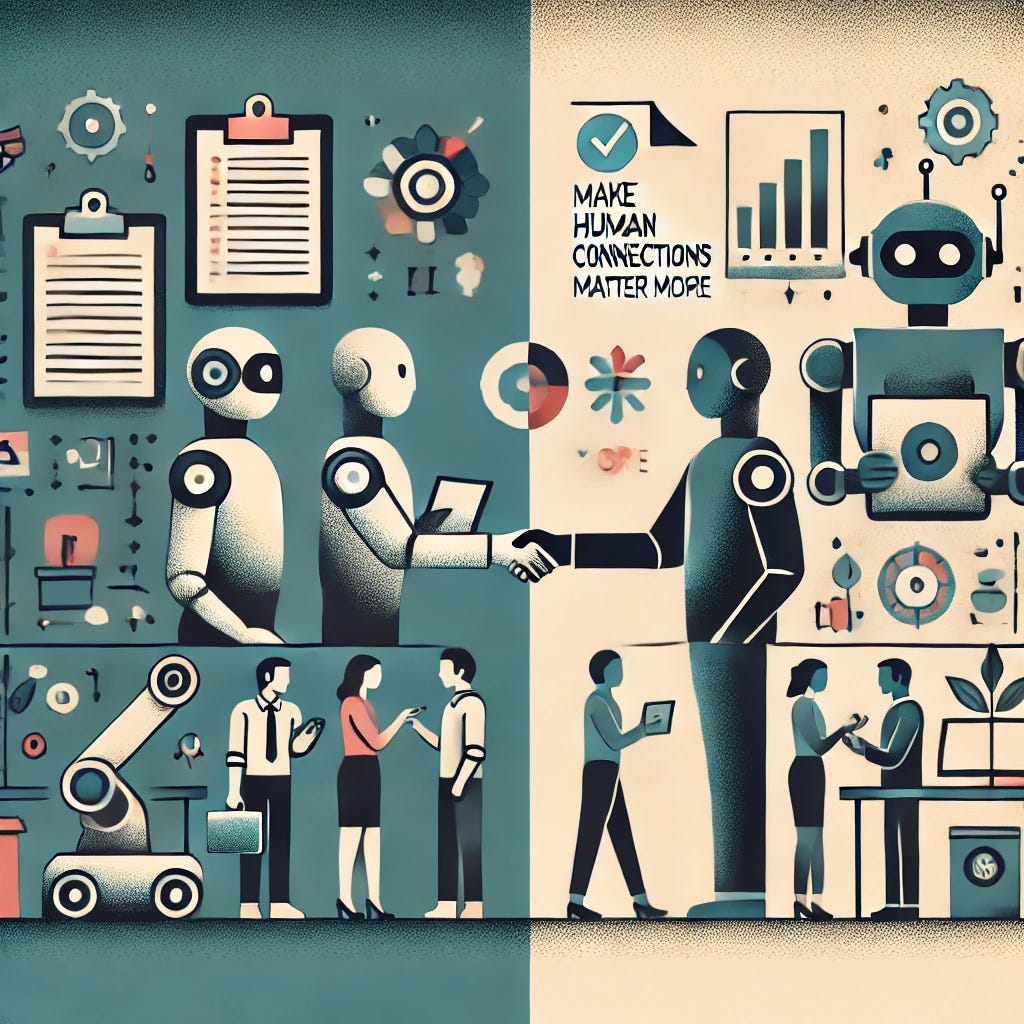
Remember when we thought job hunting was just about having a killer resume?
These days, that resume might help you pass the AI guardians, but it's your network that gets you past the final boss. Think less "spray and pray" with applications and more "Indiana Jones carefully excavating LinkedIn connections."
My career coach, Amy (who I'm pretty sure moonlights as a networking guru), gave me a task that initially made me want to crawl under my desk: “Make a list of 50 people who could potentially help your job search.” These are not random connections, mind you, but actual humans who…
…might know about specific roles you're eyeing
…work at your dream companies
…have insights or referrals to share
…or, you know, just wanna stay connected
Is this a grind? Oh, absolutely. My introvert battery is perpetually at 2%.
But here's what happened when I actually did it:
First 10 people: Easy. These were my work buddies, my old managers, and that one colleague who always brought amazing cookies to meetings.
Next 20: Harder but doable. I had to dig into my LinkedIn history like a digital archaeologist. "Oh right, Sarah! We survived that impossible product launch together!"
Last 20: This is where it got interesting. Some of them were second-degree connections, sure. But a few of those connections were people I knew from the early 2000s blogging scene—folks who went on to become bona fide millionaires and even appeared on Oprah or graced the covers of magazines. (Did they actually take the time to respond to me? Not really. But that's okay.)
But here's the real magic: Out of those 50 people, I actually reached out to 30. Not with some copy-pasted "I'm job hunting" message, but with genuine "Hey, remember that time..." conversations. The results? Some people immediately offered to refer me to their company's lead recruiters. A couple of folks introduced me to other people in their network. Most of them just had great catch-up calls that reminded me I'm not alone in this journey.
The secret sauce? Every message was a story, not a request. “Remember when we pulled that all-nighter trying to get that stupid site live?” hits differently than “Hope you're well, I'm looking for opportunities.”
Is this more time-consuming than hurling your resume into the AI void? Yes. Do I think it works better? Also yes. Because while AI might control the front door, humans still control the side entrances – and they're much more likely to open them for someone they remember sharing battle stories with.
This is the Part Where I Use AI (Again)
Look, there's this beautiful irony happening right now: while companies use AI to screen us out, we're using AI to sneak back in. It's like a high-tech game of cat and mouse, except everyone's a cat and also a mouse simultaneously.
Here's what I've learned from my own AI adventures in job hunting: Your resume needs multiple personalities now - one for the robots, one for the humans. I keep a master copy in Claude or ChatGPT (my digital resume therapists), and we have regular sessions where I paste in job descriptions and ask, “What am I missing here?” Sometimes, it tells me I need to quantify my achievements more. Sometimes, it gently suggests that maybe, just maybe, “excellent communication skills” isn't the compelling qualifier I think it is. (That’s an exaggeration, of course. I actually wrote “nice smile.”)
The cover letter game has changed, too. I’ll start with the standard “write me a cover letter based on the newly created resume” prompt, but then maybe I’ll ask it to rewrite it in my voice. (You may wanna search for “echo writing” if you wanna go down that rabbit hole.) The most important thing is that instead of just rehashing my resume, I used AI to help me tell better stories. For the job positions, I really wanted to get an interview for, I took the time to really go over the structure of the cover letter, but as if I were explaining it in person, like the way I would describe this to you, the person reading this content. And that, so far, has worked for me.
But here's where it gets tricky - you know you've gone too far when:
Your resume starts sounding like it was written by someone who only speaks in LinkedIn
You can't actually explain one of your fancy bullet points in an interview
That story about your "cross-functional team leadership initiative" was technically about ordering pizza for a meeting
The sweet spot? Use AI as your personal editor and hype person, not your ghostwriter. Think of it as having a really smart friend who's terrible at telling your stories but great at helping you structure them. Feed it some of your actual writing, let it learn your voice, and then have it help you polish things up without losing your personality.
The future isn't about humans vs. AI - it's about humans using AI to sound more human.
If that makes your head hurt, congratulations: you understand modern job hunting perfectly.
P.S. Full disclosure: I used AI to help write this article about using AI to help write things. The layers of irony are so dense they're practically a geological formation at this point.
I appreciate this post, especially as I took a severance package and am now starting my own job hunt. We should get together some time and commiserate.
Thanks for writing these, Ernie. This week, I started my job hunt in earnest and have found this new world daunting. It's nice not to feel so alone.
Also, I need to work on my networking. This was the nudge to set aside some time for that (tomorrow).