

Okay, project explanation incoming.
I took more than 25 years of public writing — blog posts, Substack essays, Usenet posts from 1999 when that was a thing people did, an old interview of me published in a book about growing up as a gay young adult — and fed all of it into an AI for analysis, organized by era. Six of them:
Era 1 - The Newsgroup President (1998–1999)
Era 2 - The Dot-Com Blogger (2000–2007)
Era 3 - The Quiet Years (2007–2011)
Era 4 - The Miami & Civic Tech Chapter (2012–2018)
Era 5 - The Reckoning (2019–2023)
Era 6 - The Substack Second Life (2024–present)
The logistics were, let’s say, a journey. Hunting for posts you wrote “somewhere” in the late-90s Usenet is exactly as fun as it sounds. I was reminded that I had even been interviewed by someone about my experiences in paper-and-ink form. Taking camphone shots of book pages seems so... barbaric.
NotebookLM turns your source material into a podcast. Two AI hosts, weirdly calm, discussing your life like they’ve done their research. The first time I heard them narrate my own story back to me, I thought: this is deeply strange and I will absolutely keep doing it.
The strangest moment came when a Claude conversation failed to load directly into NotebookLM. Just said “Loading...” The hosts looked at the document titles and kept going anyway. Twenty-eight years of personal data, one of them said. Then riffed on what that might mean. Didn’t flag an error. Went to give some pretty insightful thoughts on what it actually means to literally upload twenty-eight years’ worth of memories. (for example: certain subjects have more weight than others. The LLM may not know that.) Didn’t miss a beat.
I thought: yeah. I get that.
I went into this expecting to be surprised. I asked the obvious questions first: You have analyzed multiple eras of the same person’s journals. What patterns persisted across all versions of the author? What changed? What did the author repeatedly attempt but struggle to resolve? What is the most consistent internal conflict across decades?
The AI answered like a very thorough, very competent grad student. Accurate. Well-organized. Completely unsurprising.
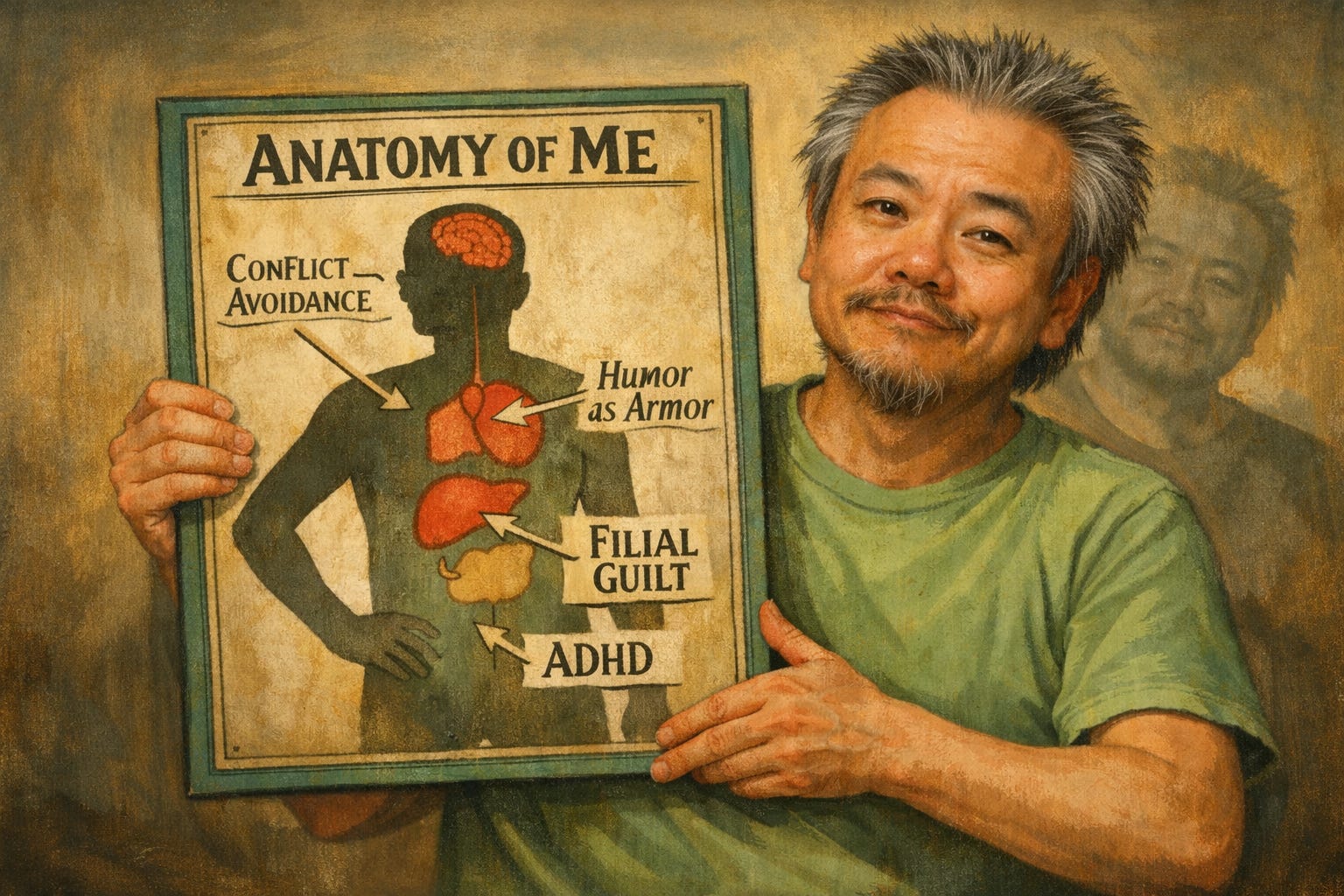
The most surprising thing it found, it said, was that I could diagnose every single one of my own patterns with precision — the conflict avoidance, the humor as armor, the ADHD, the filial guilt, all of it — and was doing every single one of them just as much as before I understood them. The vocabulary got better. The behavior didn’t move.
Also, yeah. I know. That’s the problem.
The AI didn’t tell me anything I didn’t know. But it asked me things I’d never thought to ask myself. So I asked it different questions.
What do I complain about over and over but never actually change? Where do I lie to myself, and does it show up in a particular type of writing? What version of myself do I seem to miss the most? If a stranger read all of this, what would they think my life was about — and does that match what I think my life is about?
Those answers I’m not ready to share yet.
What I’ll say is: I asked them, expecting insight. Be careful what you ask for.
That’s what this series is. One era at a time. Starting with 1999, which is already out there — I published it before I wrote this, because of course I did.
More coming. I don’t know yet what it adds up to.
That’s kind of the point.