

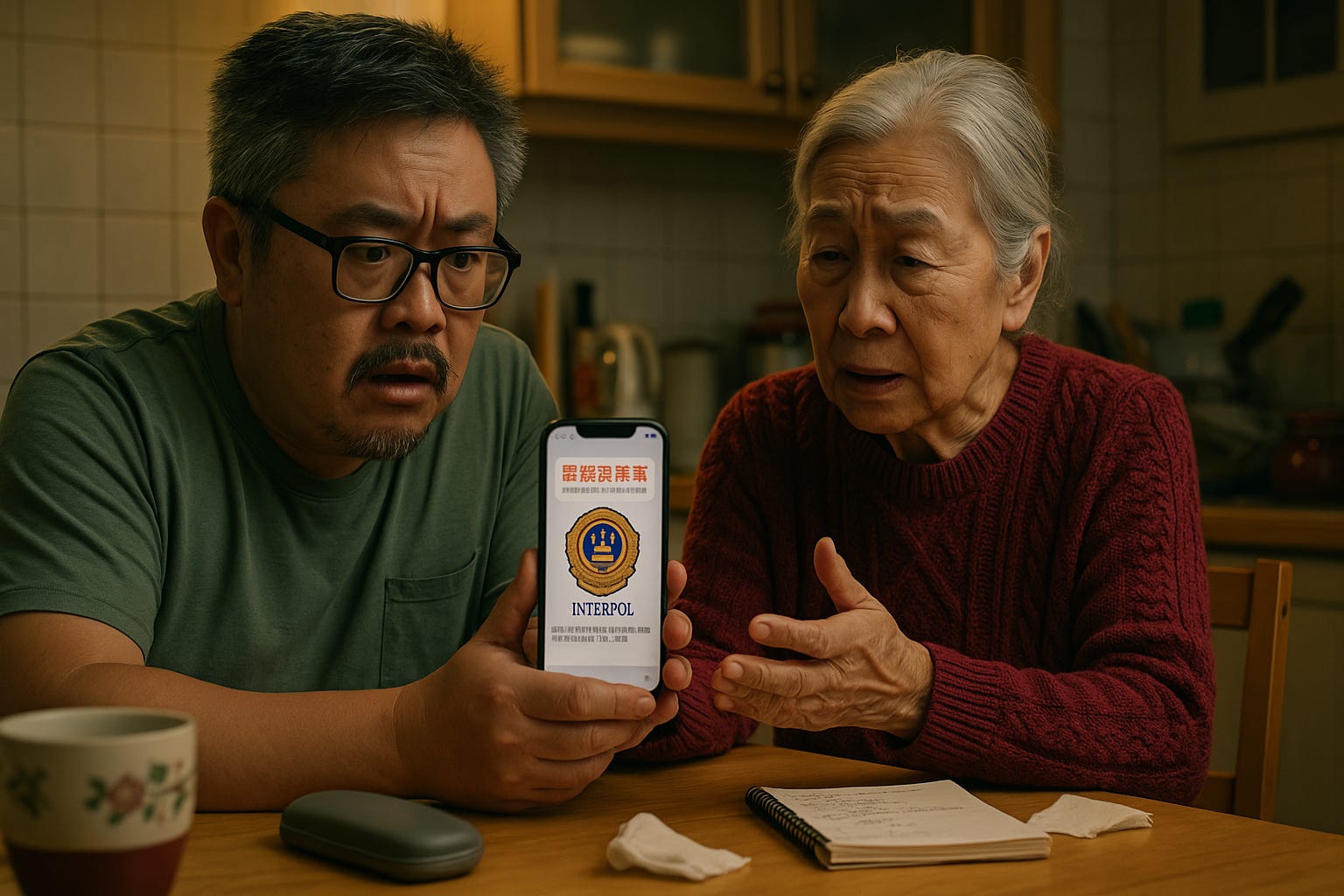
Previously: My mom had been terrorized for over a week by sophisticated scammers pretending to be Chinese police. They'd isolated her, scared her, and convinced her that contacting me would only make things worse. She'd disconnected from the internet entirely rather than risk getting her family in trouble. Now I had to figure out how to reach someone who'd been psychologically trained not to trust anyone, including me.
問題出現了 - The Problem
Every time I tried to talk to Mom about the scam over the phone, she immediately went on the defensive. I wasn't the son trying to help—I was the enemy trying to get her in more trouble. The scammers had done their job too well.
Ernie: Ma, these people are lying to you.
Mom: You don't understand how serious this is.
E: MOM, SERIOUSLY, MARCO RUBIO DOESN’T SIGN INTERPOL ORDERS.
M: WHO MARCO RUBIO?
…Fair point, actually.
But every conversation followed the same pattern: I’d try to explain why the documents were fake, she’d get more defensive, and we’d both hang up frustrated. The scammers had trained her not to trust outside input, especially from family members who “didn't understand” the gravity of her situation.
I needed backup—someone who could speak to her in her language—literally.
解決之道 - The Solution
So I did what any tech-savvy son in 2025 would do: I fired up ChatGPT.
Here’s the thing—I read Chinese at, like, a fourth-grade level. Explaining complex scam tactics requires precision I don't have. What can I say? Saturday Chinese School back in the fifth grade didn’t really stick.
So I went to ChatGPT with this:
So my mom is calling me panicking saying her identity has been compromised, saying that stolen money from china has been stolen under her identity. it looks to be some sort of scam involving scammers from mainland chinese intimidating elderly chinese people in america. she is terrified of even telling me this saying that all the blame would put onto me instead. does this even sound remotely familiar?
Surprise: it DID sound familiar. ChatGPT immediately recognized the scam pattern and responded with detailed information. But then it did something that floored me:
“Want help writing something in Chinese to reassure her?” asked the AI.
Why yes, ChatGPT. Yes, I do.
We worked together to create a clear explanation in Traditional Chinese about these specific scams. I went so far as to take screenshots of her conversations and attachments. The AI covered everything: how these operations target immigrants, why they exploit cultural fears about authority, how they create fake documents, and most importantly, why falling for these tactics doesn't make someone stupid—it makes them human.
But here’s the crucial part: delivery.
I couldn't just send her a text in Chinese that I couldn't even read myself. She needed to hear it from someone who wasn't me.
So I used ElevenLabs, a company known for its text-to-speech (TTS) and voice cloning technology. But what voice should explain everything to Mom?
Not a man's voice—too much like the authority figures who had been terrorizing her.
Even though I did have a clone of my own voice, I decided that’d be a bad idea to use a voice clone—she'd just argue with me on the spot and wish that I spoke half as good as my AI-generated clone. (I know this because this happened two weeks ago.) So I went with Anna Su: a “casual & friendly” Chinese voice, described as youthful and bright. Hopefully, that could cut through some of Mom’s panic.
The whole process took about an hour. Modern technology is wild, but using it to deprogram your mom from a psychological operation feels like some next-level cyberpunk adult-parenting.
突破時刻 - The Breakthrough
This was serious enough that I wouldn’t do it over the phone anymore. I drove to her house—because some conversations require being in the same room, especially when you're trying to deprogram someone who’s been psychologically manipulated for over a week.
I sat down next to her on the couch and played the audio file. AI voice Anna Su started her cheerful monologue, addressing Mom directly as Mama. And Mama, for what its worth, listened intently, nodding occasionally. Then she asked me to play it again. And then a third time.
But the real breakthrough came when the Anna explained, in perfect Mandarin, that Marco Rubio wasn’t an INTERPOL official but a senator from Florida.
Mom: WHAT? He's a WHAT from WHERE?
Ernie: A senator. From Florida.
Mom: …?
Ernie: MOM. FLORIDA. WHERE I LIVED FOR TWELVE YEARS.
Trust me, having lived in Miami for over a decade, I felt the same way about Rubio's involvement in anything important.
For the first time in over a week, I could see the tension leaving her face. The AI explanation had done what I couldn’t—it gave her permission to stop being afraid and start being angry.
M: They made me feel so stupid.
E: They're professionals, Ma. This is what they do for a living. They study people like you and figure out exactly which buttons to push.
We spent the next hour going through all the red flags she'd missed. Every detail that had seemed threatening in her panicked state now looked ridiculous in daylight.
M: I feel so dumb.
E: You feel dumb because you're not scared anymore. Fear makes smart people do things that seem dumb later. That's the whole point.
M: Why did you say that in English? Who are you talking to?
E: No one. No one at all. (turns to you, newsletter reader, and gives a wink and a thumbs up)
展開反擊 - The Counterattack
After we got her back online and she understood what had happened, I had one more message to send. I opened up that iMessage thread to police1221@icloud.com and typed out a response in English:
"Hey there. I just wanted to say: THANK YOU for the fake Interpol document with Marco Rubin's signature. Mom really enjoyed the plot twist. I enjoyed the bad font you used for his signature. Hope you scam better next time. Actually, don't. ❤️"They never responded. Shocking, I know.
But it felt good to reclaim that conversation thread. They’d spent over a week making my mother feel powerless and alone. The least I could do was let them know that their operation had been blown by a middle-aged unemployed guy with at least two AI subscriptions and too much time on his hands.
事後 - The Aftermath
Mom’s back online now.
Landline reconnected, internet restored, cable subscription reactivated. Her Chinese soap operas have returned to volume 11, and she calls me every day to complain about how the characters make foolish decisions.
But something’s different. She asks more questions now. When she gets suspicious emails or calls, she screenshots them and sends them to me instead of trying to handle them herself.
Mom: Next time someone calls saying they're the police, I'm going to ask them for their badge number and tell them my son wants to speak with them.
Ernie: Atta girl!
Mom: WHO IS ATTA, IS SHE YOUR NEW GIRLFRIEND?!
The hardest part wasn't explaining the technology or the scam tactics. It was convincing her that seeking help isn't a weakness. That the same protective instinct that made her want to shield me from this mess is exactly why she should have called me first.
Mom: Well, I didn't want to burden you. You have your own problems.
Ernie: Ma, this is my problem. You're my problem.
…In the best possible way, I added. She laughed at that.
Then, she immediately started telling me about how her microwave is too complicated and black paint was beginning to peel from the inside? And why do they make the buttons so small, and did I know that F-A-R-B-E-R-W-A-R-E makes water filters because she needs me to call someone to fix it and also, stop sighing so much because no wonder I'm not getting a job.
Some things never change. And honestly? I'm grateful for that.
放眼全局 - The Bigger Picture
Our parents taught us how to navigate the physical world—how to look both ways before crossing, how to lock doors, how to spot danger. Now we have to teach them how to survive the digital one. The threats are less visible but just as real.
The scammers are counting on our parents' isolation, their pride, and their reluctance to ask for help. They're counting on cultural dynamics that make admitting confusion feel like losing face.
But here’s what they didn't count on: once you help your parents understand that they're not the first to face these threats, that being targeted doesn’t make them foolish, and that asking for help makes them smart, they become the most motivated students you'll ever have.
The AI tools I used aren't magic. ChatGPT and ElevenLabs are merely tools for translating and delivering information. But sometimes, the medium really is the message. When your parent has been psychologically conditioned not to trust you, finding another voice—even an artificial one—can break through in ways that direct confrontation can't.
Mom still doesn’t trust every email, every phone call, every pop-up that appears on her screen. But now, instead of going dark, she forwards them to me with a single text: “Scam?”
Usually, the answer is yes. But now we're handling it together.
And that makes all the difference.
Have you had to help your parents navigate digital scams? What worked (or didn't work) for you? Share your experiences in the comments—these stories help other families recognize the warning signs and know they're not alone.
And if this helped you think differently about protecting your parents online, please share it. The scammers win when families stay isolated and ashamed. Let's prove them wrong.
My parents are long gone but my 80+ year old aunt sends me stuff regularly and asks if it’s real or a scam and every time it’s a scam
You're a good son Ernie. What a relief it all ended well. Hugs to your mom 💘