

We are going to take a moment to go meta, inspired by a couple of emails from people who have been sitting on stories they want to tell but keep convincing themselves they're “not interesting enough” or “too weird” to write about.
Most people think they can't write compelling personal stories because they haven't lived through anything “interesting enough.”
That's complete bullshit, and I'm about to prove it to you.
Here's what actually happens: You sit down to write about that time your mom embarrassed you at the grocery store, or when you got fired, or when you realized your dad was getting old. You start typing, and somehow it comes out reading like a police report written by someone who’s never felt an emotion. The story has all the right facts, but none of the life. Your friends who were there go "yeah, that happened" instead of "holy shit, I felt that in my chest."
This happens because you’re doing what everyone does—you’re trying to document what happened instead of exploring what it meant. You're being a court stenographer when you should be a fucking archaeologist, digging through the emotional rubble to find the thing that makes people lean forward and say, “Wait, tell me more about that part.”
The Real Problem is that You're Writing Like a Stranger to Yourself
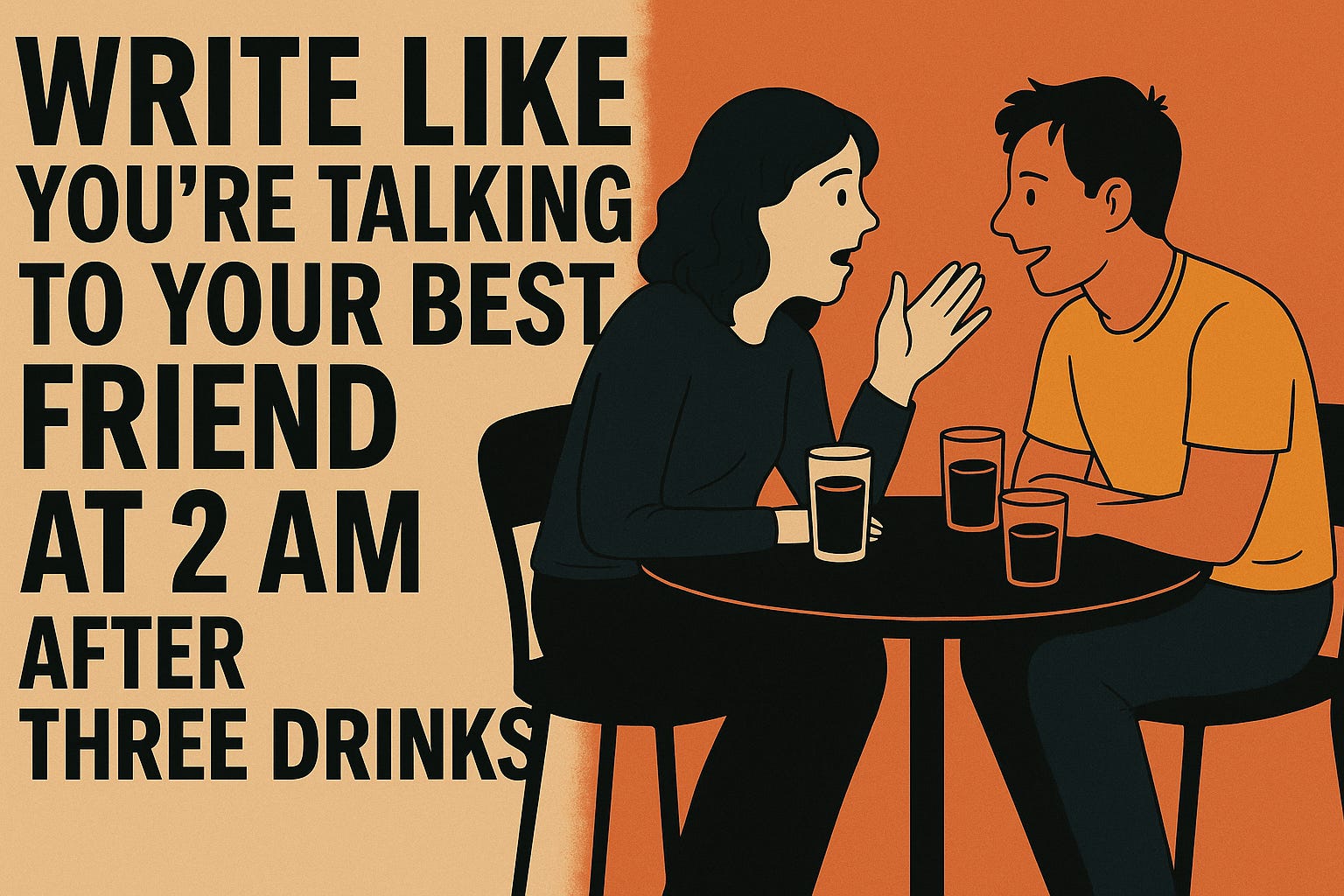
The secret that separates writers who make you ugly-cry in Target parking lots from those who make you check your phone mid-story isn't talent or trauma inventory. It's this: they write like they’re talking to their best friend at 2 AM after three drinks, not like they’re giving a presentation to their high school English teacher.
Think about it like this—when you're telling someone about the worst date of your life, you don't start with “On Tuesday, October 15th, I arrived at the restaurant at precisely 7:30 PM.” You start with “So this fucking guy shows up twenty minutes late wearing a fedora. A fedora, okay?" You give them the detail that makes them go “oh no, we're in for a ride.”
Most personal storytelling advice treats your life like a museum exhibit—preserve everything, explain everything, make sure people understand the historical context. But the best individual stories work like a house party where someone corners you in the kitchen and downloads their entire existential crisis while you're both pretending to look for ice.
Here's What Actually Works Instead
The most compelling personal stories follow what I’m going to call the “Emotional Archaeology Method” — you dig through the surface facts to uncover the buried feelings, then you build your story around those feelings instead of the events.
And then you call it a “framework,” because everyone is building a fucking framework these days.
This approach works because readers don’t connect with what happened to you; they connect with how what happened to you made you feel, and how that feeling relates to their own unprocessed shit.
Let me show you exactly how this works.
Step 1: Find the Feeling Underneath the Facts
Start with the basic facts of your story, then ask yourself: “What was I actually afraid of in this moment?” or “What did this make me realize about myself that I didn't want to admit?” The real story is always hiding in the answer to those questions.
For example, let’s say you’re writing about getting laid off. The facts are: the boss called you in, delivered the news, you cleaned out your desk, and you went home.
Boring as fuck, right?
But the feeling might be: “I realized that despite all my talk about work-life balance, I had no idea who I was without my job title.”
Now that’s a story worth reading.
Don’t skip this step because you think it’s too touchy-feely. The feeling is the foundation—everything else you build will be shaky without it.
Step 2: Choose Your Emotional Tour Guide
Pick one specific emotion to be your tour guide through the story—anger, embarrassment, relief, whatever. Let that emotion determine which details you include and which you skip. If embarrassment is your tour guide, focus on the moments that made you want to disappear. If it’s rage, focus on the details that made your blood pressure spike.
Here's what this looks like in practice: I once wrote about the time seagulls shit on my head in front of my high school crush. I could have written about the logistics of bird droppings or the social dynamics of teenage hierarchies. Instead, I let embarrassment be my tour guide, so I focused on the specific moment I realized everyone was laughing at me, not with me—and how that moment defined how I saw myself for years afterward.
The key is to trust your emotional tour guide completely, even when it takes you to places that feel too raw or too weird.
Step 3: Write Like You're Talking to Someone Who Gets It
Here's where most people fuck it up—they start writing like they’re addressing a general audience instead of writing like they’re talking to the one person who would totally understand why this story matters. Choose a specific person (real or imaginary) who would get why this experience wrecked/changed/delighted you, then write directly to them.
This person isn’t your mom, your boss, or some hypothetical “professional contact” who might judge you. This is the person you’d trust with your 3 AM existential spiral. Write like they’re sitting across from you, going “wait, what happened next?” and genuinely giving a shit about your answer.
When you write to someone specific, you automatically start including the right details—the ones that make them lean in closer instead of checking their watch.
The Advanced Move: Embrace the Contradictions
The difference between good personal stories and great ones is that great ones include the parts that don't make you look good or don’t fit the neat narrative arc you want to tell. The moment you thought, “This is hilarious,” right after something terrible happened. The fact that you were secretly relieved when the relationship ended, even though you're supposed to be heartbroken.
Real humans are walking contradictions, and the best personal stories reflect that messiness. Don't sand off the rough edges to make yourself more likable—those edges are where the truth lives.
Here's a concrete example: When I wrote about my sister’s legal troubles, I could have focused purely on family loyalty and concern. But the more honest story included my anger at being the “responsible one” again, my resentment at having to be the adult when I felt like a mess myself. Those contradictory feelings made the story more human, not less.
What This Actually Gets You
When you write personal stories this way, something shifts. Instead of getting polite “thanks for sharing” responses, people start saying things like “I felt this in my bones” or “I've never seen anyone put that feeling into words.” They start sharing their own stories in response because you've permitted them to be honest about their messy, contradictory human experience.
I know this works because I’ve been doing it for over twenty years, writing about everything from family drama to career imposter syndrome to the weird grief of watching your parents age. The stories that get the strongest responses aren't the ones where I had the most dramatic experiences—they’re the ones where I was most honest about the feelings underneath the experiences.
Oh my fucking God, it’s scary as hell to write this way.
But here's the thing: the alternative is writing stories that no one remembers reading.
Start With This One Thing
Right now, think of one story you’ve been wanting to write but haven't because it feels too small, too embarrassing, or too weird. Write down what happened in two sentences.
Now write down what you were afraid of in that moment, or what it made you realize about yourself.
That second part? That's your real story. The events are just the vehicle.
Don't overthink it, don't wait until you have more time or better words.
Just start with that feeling and see where it takes you.
The worst that can happen is you write something actually true instead of just factually accurate.
The Real Truth About Personal Storytelling
Here’s what I wish someone had told me when I started: personal storytelling isn’t about having an interesting life, it’s about being interested in your own inner experience. The magic happens when you stop trying to convince people your story matters and start trusting that your honest exploration of it will resonate with anyone who’s ever been, you know, human.
Your stories don’t suck because nothing interesting happens to you. They suck because you’re not letting us see how those things changed you, scared you, or made you question everything you thought you knew about yourself.
Fix that, and everything else falls into place.
Look, I'm not going to end this with some bullshit about “your story matters” because that's not the point. Your story doesn’t matter because you lived it—it matters because of what you do with it. And right now, you’re probably doing nothing with it, which is honestly a waste of perfectly good human experience.
So here’s what we’re going to do: You're going to pick one story—just one—that you’ve been sitting on because it feels too small or too weird or too whatever. Maybe it’s the time your mom said that thing at Thanksgiving that made you realize she sees you completely differently than you see yourself. Maybe it’s that moment in your boss’s office when you understood that you’d been lying to yourself about what you actually wanted. I don’t know what it is, but you do.
Write it down.
Not the whole thing—just the moment that still makes your stomach do that little flip when you think about it. Write it like you’re texting your most brutally honest friend at 2 AM. No setup, no context, just the thing that happened and how it made you feel like an exposed nerve.
Then—and this is the important part—send it to me. Seriously. Comment on this thread while the article is still public, or find me on Substack and just dump it in my inbox. I read everything, and I promise I won't try to fix it or workshop it or turn it into a fucking TED talk. I just want to see what happens when you stop editing yourself before you even start.
Because here’s the thing: the story you’re most afraid to tell is probably the one someone else needs to read. And yeah, that's terrifying. But the alternative is letting all that good material just... sit there, collecting dust in your head while you write about productivity hacks or viral Substack notes or whatever safe shit you think people want to hear.
Your choice. But if you’re still reading this, we both know which choice you want to make.
So I’ll just say that I’m so glad I found this renewed passion and throwback to your old blog with some new insights and digs into your mind. And this one for me was the most interesting. Thanks for the great morning read to start the day and think of ways to tell better stories to grip versus explain
This is useful; I've been blogging for almost a quarter century (I think that's how we met back in the day), and it always helps to think for of the people you hope to write for rather than the ones you're afraid might read it. This is one reason I'm thinking of rewriting my army book (the publisher's gone rogue so it's not like I'm risking anything).