

NOTE: This piece was originally posted in October 2020 but was taken down due to the case's active status at the time. I've since re-uploaded it as a creative writing exercise. While based on real events, some dialogues have been fictionalized for narrative purposes.
You will steel yourself up.
You will steel yourself up.
What does that sentence even mean? You say it enough times, and it doesn't even make sense anymore. Why are you steeling yourself up? Why can't one just steel themselves?
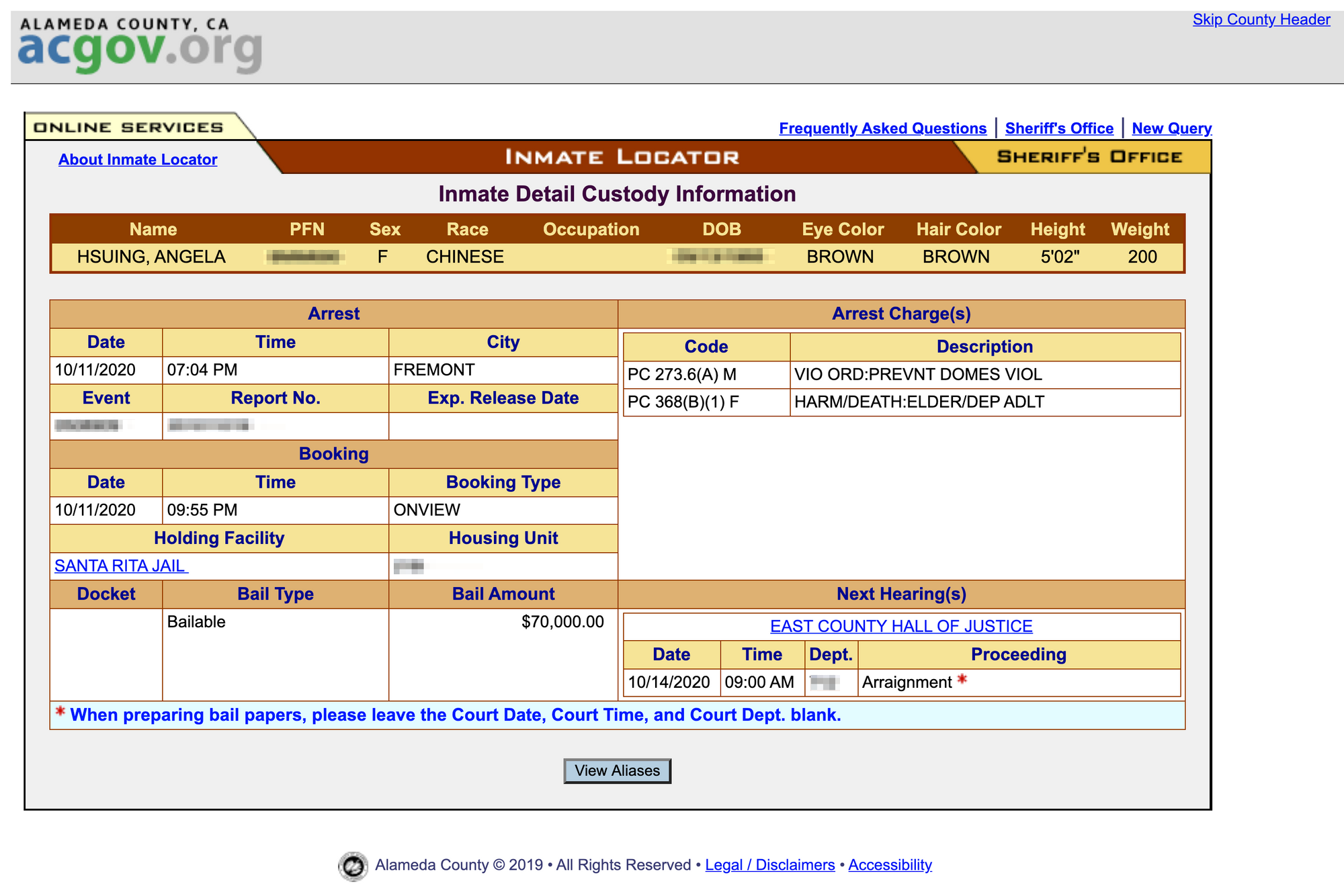
Your now ex-boyfriend was able to find your sister's name on the Inmate Locator page pretty quickly. "You had to choose the phonetic search option," he says. There is a checkbox on the bottom left. The policeman on duty spelled her name wrong."
Of course, they did. They always do. S before H, U before I, forget the G, and add letters that don't even make sense to a Chinese name. You remember seeing that phonetic option, but no one would even bother trying to phonetically spell your name as "HSIUNG," so you didn't even bother trying.
You look at the screen. It takes some time to translate the abbreviations and shorthand into something you can comprehend, and your mind jumps to how this data was entered: some officer typing in his terminal in one hand, McDonald's coffee in the other. That's how they do it in Florida, anyway. It's been so long that you no longer remember how they would do it in the Bay Area. Maybe they use Siri or Alexa.
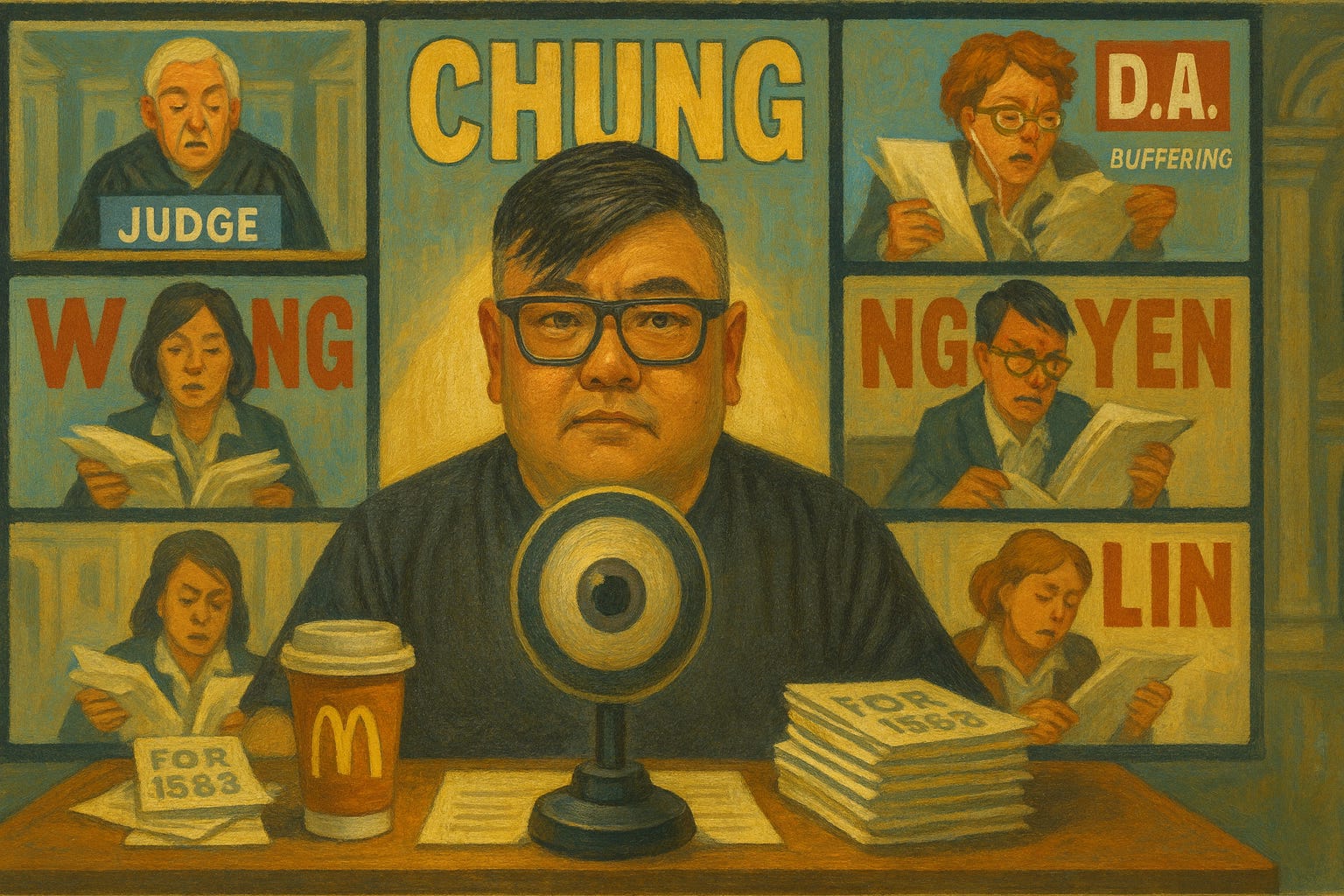
A couple of days ago, you witnessed your sister in court. COVID has made everything virtual, which means that even though the courtroom is in California, you can now log onto the Alameda County Courtroom's video platform of choice, BlueJeans. The only other place you used BlueJeans was when you were doing a Fellowship with Code for America a couple of years ago, and you wonder if it's the go-to platform for government-related stuff.
Not that any of it matters, of course.
Kareem will send you a draft to go over. It's a carefully drafted email forwarded to the Alameda County Deputy District Attorney and the Public Defender, chronicling your sister's mental illness. A bullet-pointed, unordered list of things you've written about countless times over the past twenty-five years.
There are a couple of new bullet points on that list, though.
The uninvited move home last year, when the people at her boarding and care facility told her she was moving home “because they were trying to kill her.”
Her refusal to get medication and the laughing and screaming fits that have caused your mother to lock herself in her room.
The offhand comments from your mother that Angela has also struck your father, but can’t really tell you many details past that now that his dementia has gotten pretty bad.
There was also “the first one,” which resulted in nothing because your mother called 611, not 911, and when the police came over, Angela was what they called "non-presenting" — she can hide it if she needs to. So your mom tells you that the police share a laugh with Angela — a fucking laugh, for fucks sake.
Your mother stops trusting all American police officers. Naturally.
But Mom calls 911 this time around. And when the cops come, there are lacerations. The skin was broken; she drew blood. While Mom is taken to the hospital, they ask if Angela is willing to come along to seek a psychiatric evaluation.
"No," I imagine her saying softly. She mouths the word the first time, as if she's silently assuring the others she won't go down quietly.
So they arrest her.
And that's why you're watching your sister getting indicted on a webcam, you guess.
Your friend Ted, your raving friend from the post-college days that you may still associate with perfectly coiffed hair and plastic angel wings, helped with some of the key phrases to use now that he's a social worker. “Persistent and severe mental abuse.” “Diversion mental health programs.”
Ted and Kareem have both helped a ton. Since COVID, your day mostly consists of looking into a webcam, energy level eleven, and shouting like someone from a Disney Teen movie about JavaScript closures for ten hours a day. In between moments of boundless enthusiasm, you are trying to write an updated curriculum about React hooks. A survey gets sent to all students on Friday evening, ranking you and the other instructors on a scale of 1 to 10, and then the Director of Operations tells you everything you did wrong the next Monday.
Repeat until you burn out.
Angela's trial is on a webcam. This should be no different, you think to yourself. All I have to do is stare into another fucking camera while I wear this sport jacket and explain to a judge how my sister isn't fit to reenter society.
Hours before the hearing, your overactive imagination kicks in: You imagine seeing your shackled sister in the corner of a webcam, an orange jumpsuit in an isolated room, the kind you see on late-night documentaries about prisons. In your mind, she is looking into the courtroom camera -- looking at you -- and screaming at you at the top of her lungs while you sentence her to death: You're a liar, Ernie. You're so full of shit, Ernie. Ernie, you're a Judas. Do you know what that means? You didn't love the Lord like I did, and you deserve to die, you faggot.
You snap out of your daydream the second she says the word "faggot." She would never say that. Would she?
Would you, 姐?
The actual trial is nothing that dramatic; it's more everything cliched about awkward Zoom calls but in a court of law. A judge is handling the arraignments of 50 to 100 cases at once; clerks and lawyers shuffle papers around while mispronouncing every last name in existence wrong every which way possible.
When you see your sister ninety minutes in, she is sitting with the police officer in the holding cell, her big glasses and matted gray hair framed against her COVID mask. Her jumpsuit is navy blue, not orange, with the words “SANTA RITA JAIL” splayed in giant Impact font.
The District Attorney asks for bail; it's set at $70,000. The Public Defender doesn't fight it. The judge is about to go to the next case when your partner is about to speak up. The DA jumps in. “Your Honor, we have some family members who would like to make a statement regarding the defendant. Would you like them to give testimony?”
The judge doesn't bother looking up. "Not necessary," he says. By the time you wrinkle your forehead in confusion, it's over.
You didn't even have to turn on the camera.
Obviously, the calls to Mom have started again. They are still about everything and nothing at all.
“Who talked to you today this time, Ma?” Your phone is on speaker, so Kareem can hear it, but never mind that the conversation is in Chinese.
“Some person. They spoke Mandarin to me, so that was nice.”
“Mm. I need you to give me the names and organizations of those you've talked with,” you say to her.
“I didn't get their name. They spoke too fast, and they gave me a card.”
Kareem is looking over from the kitchen. You shake your head, and he frowns. “How do you spell it, Mom?”
“ELL. OH. DEE. PEE.”
"Ma, that doesn't even make sense."
She starts shouting numbers at you in Chinese before you realize the numbers belong to a phone call. You've since learned to Google the phone number your mother gives you. It turns out this one is a website for a legal elder assistance program in Oakland—a SOCIAL WORKER, she says, in English. Well, technically, no, but you're too tired to argue. You’ve been too tired to do anything, honestly, and besides, she's the one with lacerations, after all.
There's a pause on the phone.
"Have you bought it yet," she asks?
"Bought what, Mom?"
"The dryer has stopped working. I've been hanging the clothes on a clothesline, and it hurts my back when I dry them."
"Kay, Mom, you'll get the drier." You hang up the phone.
You stare at the phone.
You don't tell her about the court date.
You don't tell her that your sister will, most likely, declare herself innocent, that this will most likely become a full-blown trial with a jury.
You don't tell her that you'll most likely fly to California soon to help her testify against her daughter and help set up more interpreters. You'll probably testify as well. You'll look at her in the eye and tell a judge, unflinching, that your mother feels physically unsafe, so long as your sister is a free person. You will steel yourself up, enough for both you and your mother. You will steel yourself up, you say.
You will steel yourself up. You will repeat this over and over again until you convince yourself of the words you say out loud. You will steel yourself up.