

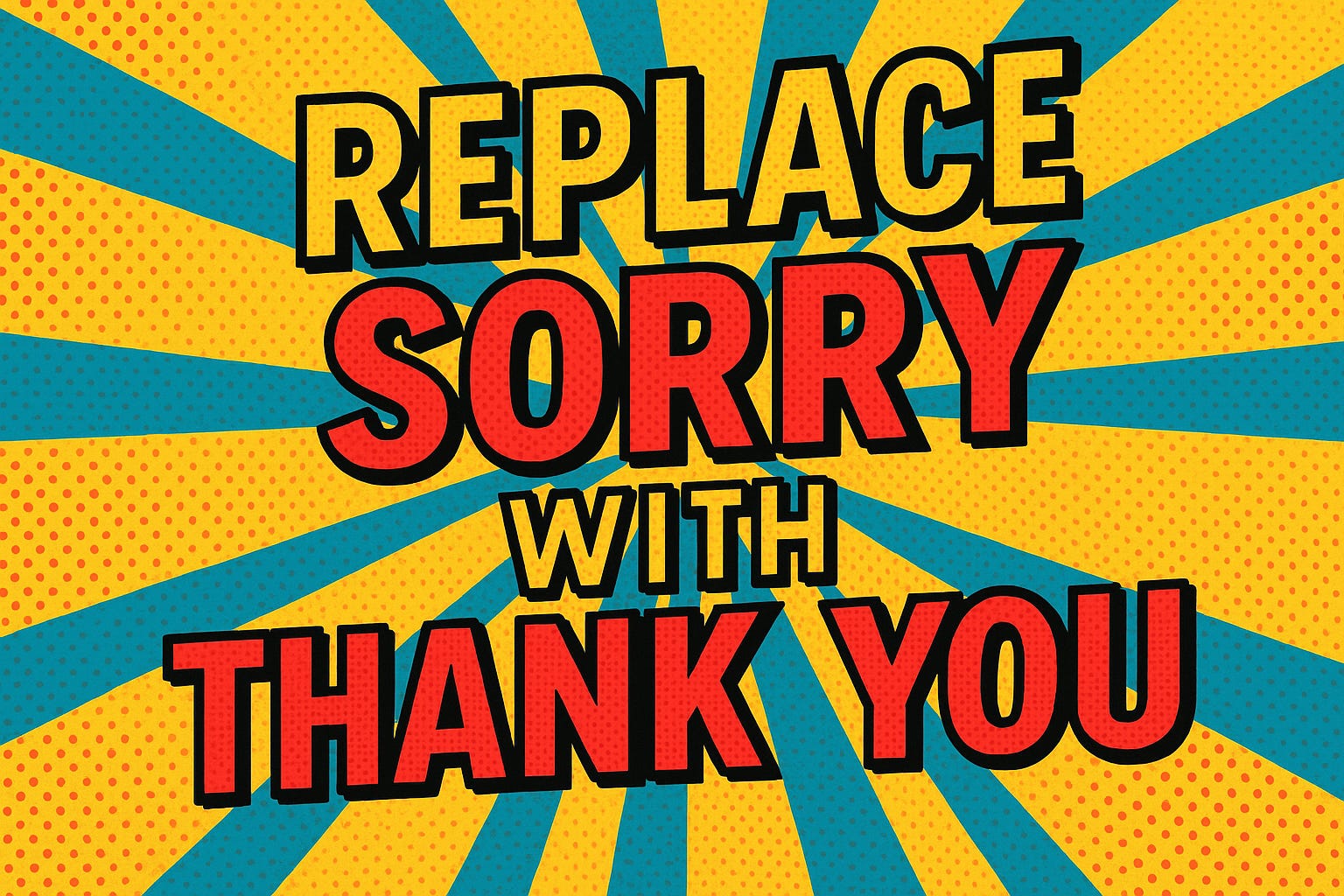
Last month, I tracked every single “sorry” that came out of my mouth for two weeks straight. The final tally? 127 apologies. That's roughly nine per day for things like existing in an elevator, asking a question in a meeting, or having the audacity to order food at a restaurant. (Apparently, I thought the server needed an apology for me wanting to eat. Real solid logic there.) By the end of those fourteen days, I decided to conduct an experiment: replace “sorry” with “thank you” whenever possible.
I’m sharing the three most counterintuitive lessons I learned from this simple language swap because it fundamentally changed how people respond to me (and how I see myself). What I learned wasn’t some bullshit about loving yourself more or finding your inner goddess. Think: more practical stuff about rewiring decades of conditioning that runs so deep I didn't even know it was there.
Here are the three lessons that hit me the hardest.
Lesson 1: Confidence Isn’t Something You’re Born With—It’s Something You Practice Daily
Most people think confidence comes naturally to some lucky few. You know the type: they walk into rooms like they own the place, speak up in meetings without that voice in their head screaming “shut up, you idiot,” and somehow never apologize for taking up space even though they should apologize for existing, ugh.
The truth is that confidence develops through repetition, not revelation. Every time you choose different words, you're training your brain to think differently about your worth.
When I started saying “thank you for your patience” instead of “sorry I'm late,” something weird happened. People responded better. Instead of rolling their eyes at another apology, they'd nod and move on. More importantly, I stopped reinforcing the idea that my presence was an inconvenience. Three weeks into this experiment, I noticed myself walking into rooms differently. Not because I suddenly became a different person, but because I'd practiced being one hundreds of times through tiny language choices.
The shift happens in your mouth first, then your mind catches up.
Lesson 2: Your Words Don't Just Communicate—They Program How Others See You
Here’s what nobody tells you about excessive apologizing: it doesn’t make you seem polite or considerate. It makes you seem unreliable and uncertain. When you constantly apologize for normal human behavior, you're essentially training everyone around you to see you as someone who makes mistakes.
This programming happens fast, and it sticks around long after you stop talking. People start treating you like someone who needs to apologize because that’s the dynamic you've established. They interrupt you more. They dismiss your ideas faster. They assume you're probably wrong before you even finish your sentence.
The brutal truth about sorry-speak is this:
You're not being humble—you're being self-sabotaging
You're not showing respect—you're showing insecurity
You're not making others comfortable—you're making them doubt your competence
Language shapes perception in real time. When you say “thank you for listening” instead of “sorry for rambling,” you frame your contribution as valuable rather than burdensome. When you say “thank you for the feedback” instead of “sorry for messing up,” you position yourself as someone who grows from input rather than someone who just screws things up. Because, you know, you just apologized for it, like, seconds ago?
The switch from apology to gratitude changes the entire energy of the interaction, and trust me, everyone feels it.
Lesson 3: The People Who Don't Care About Your Constant Apologizing Are Exactly Why You Need to Stop
The biggest mistake I made was thinking that since my friends and family never called out my excessive apologizing, it wasn't actually a problem. If the people closest to me didn't care, why should I bother changing?
This logic is completely backwards, but it made perfect sense to my Asian-American brain. Growing up, we— that’s right, I am going to speak on behalf of a group of people now, like we’re lock step in thought— were taught to keep our heads down, not rock the boat, and apologize preemptively to avoid any possibility of conflict. Of course, our parents never explicitly told us, "Say sorry for existing," but the message was clear: blend in, don't cause trouble, be agreeable, even if it means you fade into the background—classic Asian family conditioning mixed with being a minority kid who just wanted to fit in.
The people who love you will tolerate your self-defeating habits because they see past them. But the rest of the world—your boss, potential clients, new acquaintances, literally everyone else you’ll ever meet—won’t extend that same grace. They’ll take your words at face value and form impressions accordingly.
I learned this the hard way during a work presentation last year. I opened with “Sorry, I might be rambling a little bit,” and spent the next twenty minutes watching my colleagues’ attention drift. (Yeah, I had a job back then. Plot twist: I don't anymore. Thanks, layoffs!) When I practiced pitching the same concept to my mirror two months later—because that's what unemployed people do for fun—I used “thank you for your time, I think you'll find this interesting.” Even my reflection seemed more engaged.
Your inner circle accepts your flaws, but they shouldn't be your benchmark for growth. The world doesn't owe you the patience your mom has for your self-deprecation.
Now, let me remind you what we just covered: Confidence builds through practice, not personality. Your language programs how others perceive your competence. And the people who tolerate your bad habits aren't the ones whose opinions will shape your opportunities.
Here's your final takeaway: Every time you catch yourself about to apologize for existing, pause and ask if gratitude makes more sense.1 Thank people for their patience instead of apologizing for needing it. Thank them for their time instead of apologizing for taking it. Thank them for listening instead of apologizing for speaking.
It's a simple swap, but it rewrites the entire story you're telling about your worth.
What's your most ridiculous "sorry" moment? I'm talking about the time you apologized to a door for walking into it, or said sorry to the grocery store self-checkout machine for scanning too slowly. Drop it in the comments—I need to know I'm not the only person who's ever apologized to an inanimate object for existing near it.
Obviously, if you actually fuck up—like you spill coffee on someone's laptop, accidentally send a text about your hemorrhoids to your boss instead of your best friend, or somehow manage to set a public microwave on fire while heating up leftover pad thai — don't ask how I know this is possible — then yes, apologize immediately and profusely. Maybe throw in some groveling. Perhaps offer your firstborn child as tribute. I'm talking about the chronic sorry-for-breathing habit, not, you know, actual human decency when you've committed legitimate crimes against humanity, office equipment, or innocent Thai food.