

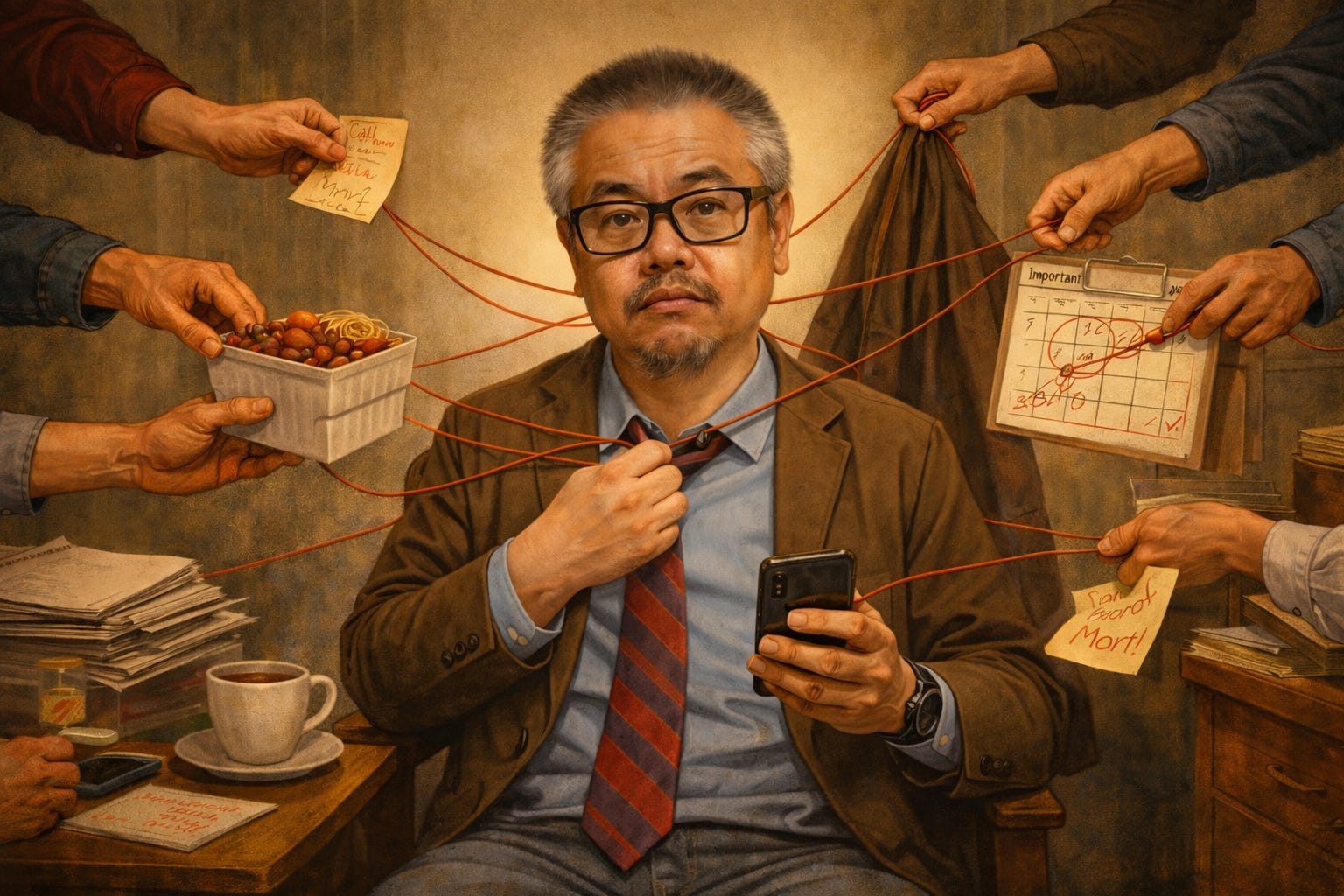
I’m 49 years old, and my mother still asks if I’ve eaten lunch yet, like I’m going to forget and accidentally starve myself to death on a Tuesday afternoon. I’ve been managing my own meals for three decades, running my own business, and keeping myself alive through a 600-day stretch of unemployment—and yet she remains convinced I can’t be trusted with basic human survival tasks.
I want to share five things my Asian parents never verbalized but made crystal clear through everything they did instead. If you grew up in a similar household, maybe this will help you feel less alone in trying to translate silence into meaning.
Here are the five lessons that shaped me. Whether I wanted them to or not.
Lesson 1: “We Believe in Feng Shui” (So We’ll Act Completely Unhinged About Clocks)
You know when your parents reject a perfectly reasonable gift and refuse to explain why?
The solution is to just ask them directly what the hell is going on, except that never works with immigrant parents who’ve been trained to keep cultural explanations locked down like state secrets.
When someone gives you a clock, you politely accept it, say thank you, and everyone moves on with their lives. That’s what normal people do.
My Mom would freeze up like someone had just handed her a box of live scorpions. She’d refuse the gift with this barely concealed panic, offer no explanation, and leave the gift-giver standing there thinking they’d somehow committed an unforgivable social crime.
I watched this happen for years before I finally learned that giving a clock in Chinese sounds like attending a funeral. So instead of just explaining it’s a feng shui thing to people like a rational human being, my parents chose to look completely deranged at every birthday party and holiday gathering. (And why all the care about feng shui if we all grew up Chinese Baptist? I’ll never understand.)
But at least the clock thing was relatively harmless compared to what came next.
Lesson 2: “I Grew Up With Internalized Food Scarcity” (So I’m Going to Make Sure You’re Uncomfortably Full Forever)
A lot of people think food issues are about control or love languages or whatever pop psychology explanation makes it easier to swallow.
They think that if they just eat the extra portions or accept the endless offerings, eventually their parents will feel secure enough to stop. They won’t.
Accept that your mother’s relationship with food was formed during circumstances you’ll never fully understand and can’t fix by being a good eater.
So many children of immigrants grow up with pantries that look like doomsday prep facilities. Here’s what my mom never said but showed me through decades of compulsive stockpiling:
She probably experienced real hunger as a child in ways she’ll never describe to me—likely due to war, being the youngest daughter of thirteen (!!) siblings, or both
Having a freezer stuffed with food meant safety in a way that overrode any logic about expiration dates or portion sizes
Feeding us until we were uncomfortable was how she proved she’d escaped whatever scarcity haunted her
The thing about trauma is it doesn’t care about your current bank balance or your fully stocked grocery store down the street. It lives in your body and makes you hoard frozen dumplings like the apocalypse is coming next Tuesday.
I get it now, but it took me decades to stop being annoyed at her for pushing food I didn’t want. And I still get annoyed, but now it’s just, I don’t know, annoyed with sadness.
Which brings me to something way darker.
Lesson 3: “Our Own Parents Were Toxic Too” (So We’ll Just Pretend They Don’t Exist)
Here’s a mistake many people make: they assume family silence means family harmony.
This assumption keeps you from asking the questions that might actually explain why your family tree has these weird blank spaces where grandparents should be. You accept the absence as normal because nobody’s giving you permission to interrogate it, and asking questions in immigrant households often feels like prodding a wound that everyone’s agreed to ignore.
What you should do instead is recognize that sometimes the most protective thing parents can do is cut off their own parents entirely.
I never met my maternal grandmother. Not once. I went to Taiwan when I was ten and somehow never visited her, as if she lived in an alternate dimension that overlapped with ours but never touched. My mom would deflect any questions with practiced vagueness, making it clear the conversation was over before it started. Years later, I pieced together that her mother had—man, how do I say this—a strong preference for sons over daughters that was so damaging that my mother made the radical choice to protect us by severing that connection, along with some of her older siblings, completely. She never said, “People in my family were abusive, and I’m not letting them near you.” She just quietly built a wall between generations and let us grow up safely on one side of it.
Yes, my mother is an unreliable narrator. Yes, I’m aware there may be a side I am completely unaware of, so I only have 60% confidence that this is what happened. But sometimes, love looks like the relationships you refuse to maintain, not the ones you do.
You just learned that silence can be protective, but it can also be destructive, which brings me to the worst one.
Lesson 4: “I Don’t Accept Your Homosexuality” (So I’ll Burn Everything Down Instead)
My dad never said, “I don’t accept that you’re gay,” because saying it out loud would have required him to acknowledge reality. To his credit, he also did not disown me, the common narrative about what would happen if a coming-out went really badly. So yay, I guess.
Instead, he found a nice girl from mainland China and aggressively convinced her family that I wanted to marry her. He called PFLAG support lines to angrily debate them and hung up when they wouldn’t validate his position. He refused to acknowledge my partner of 13 years by name and accused him of sabotaging my Asian culture at the beginning of his dementia. He wrote actual postal letters (in 2015!) telling me I was being selfish and to just stop and change my mind, as if homosexuality was a hobby I’d picked up to annoy him.
The silence around the actual words “I don’t accept you” gave him plausible deniability, as if he never said it explicitly; it didn’t count as rejection.
Your parents can love you and still do unforgivable things to you because they can’t reconcile who you are with who they needed you to be.
Lesson 5: “I Trust You to Handle Your Own Life” (Just Kidding, I’ll Micromanage You Until I Die)
Here’s a mistake a lot of people make: they think helicopter parenting stops when you turn 18, or 25, or whenever you’re supposed to officially become an adult.
This assumption keeps you infantilized well into middle age because your parents never developed the ability to see you as capable. My sister’s cognitive decline due to mental illness meant the interventions my parents made were drastic, scary, and absolutely necessary. But it meant my parents spent so many years managing every detail of our lives that they literally don’t know how to stop, and you don’t know how to make them.
What you should do instead is recognize that some family dynamics are so entrenched they’ll never change, and decide how much energy you want to spend fighting them.
My mother will still check in on whether I’ve eaten, whether I’m dressed warmly enough, and whether I’m making good decisions about my career (I’m not, but that’s my business). I’m pushing 50, and they call to remind me about things I’ve been handling independently since before they got their first cell phones. At my dad’s funeral planning meeting last year, my mom was still trying to manage how I was sitting in the chair. Not an Asian thing. A Hsiung thing. A specific flavor of anxiety and control that got passed down and reinforced until it became the family operating system.
You can spend your whole life trying to prove you’re competent, or you can accept that they’re going to worry and micromanage until they’re physically unable to do so. Neither option feels great, but one of them requires less energy.
You just learned that the things your parents couldn’t say out loud often caused more damage than the things they did say.
The silences, the erasures, the control disguised as care—these were their ways of coping with conflicts they didn’t have the tools or language to resolve. We’re left to translate their actions into meaning, to guess at the fears and traumas that drove them, to decide which patterns to break and which to forgive.
“sometimes, love looks like the relationships you refuse to maintain”
dropping bars! (is that what the kids say?)
It's so revealing to realize that, while our parents might be trying to avoid passing down to us their own family trauma, they're (probably subconsciously) using the same trauma-inducing methods to do so. Kudos to you for hanging on, exploring it and dealing with it instead of just putting up a retaining wall like so many of us do.