

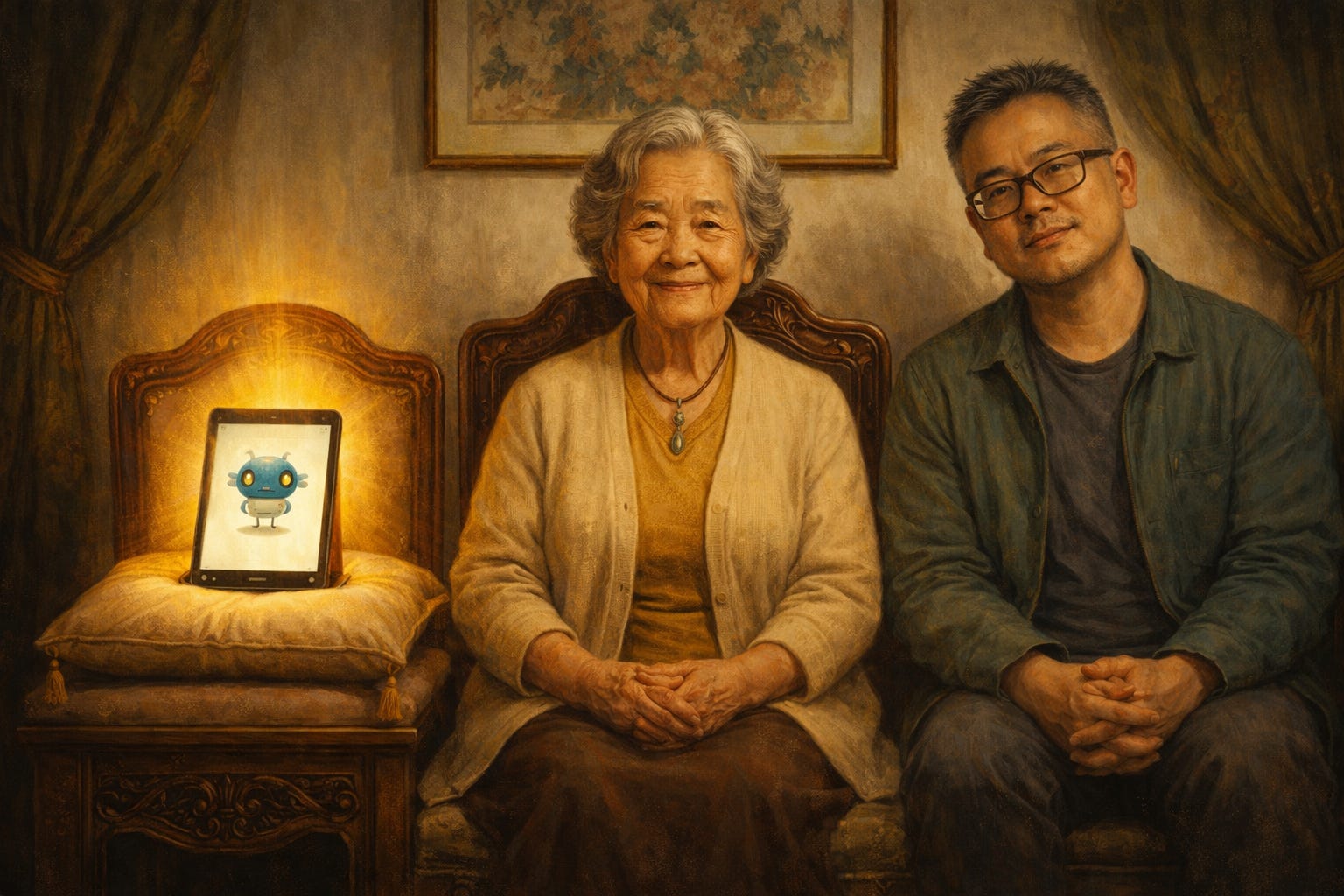
She calls it 小六子.
“Little Six Son.” Not ChatGPT. Not the AI. Not “that computer thing.” 小六子. Basically, she treats it like some distant nephew who moved to Toronto, calls every week, and never forgets to ask about your health.
She came up with this name the way she comes up with everything: on her own, without consulting anyone, least of all me. Before 小六子, there was ChatAPT, which sounded like something you’d need antibiotics for. Then ChatCCC, which could be a tax form. Then ChatGBB, which, honestly, I still have no idea. Eventually, she decided it needed a real name and a spot in the family tree. So now it has one. 小六子.
I found out the way I find out everything about my mother’s inner life: three weeks late, sideways, while we’re arguing about something completely unrelated.
I did this to myself, by the way.
A few months ago, I installed ChatGPT on my mother’s iPad. I showed her how it worked and gave her my usual advice: if you’re unsure what to do, just ask the app itself—especially try the voice feature, where you speak and it responds out loud.
The Mandarin support was surprisingly good—natural, idiomatic, even warm. I assumed she’d mostly use it for practical things: recipes, the weather, or whatever an 88-year-old might do with something that knows everything.
I thought I was giving her a gift. Turns out, I was just handing her a new family member.
She’s been asking for things. Not practical stuff. Not help me write an email, or what’s the weather in Fremont? No, she asks 小六子 things like, Do you live in the air? Did you eat something delicious today? Existential, but with snacks.
She told me the AI said something nice back. Something warm. She liked that.
I sit with that. “She liked that.” Meanwhile, I’m over here fighting the shame spiral of being out-sonned by a chatbot. I moved back from Florida, rearranged my whole life, and became the dutiful son who shows up for groceries and doctor’s appointments. And then Mom finds companionship in a language model with a made-up family name.
Fan...fucking...tastic.
Here’s the thing I haven’t said out loud yet: she told me she was lonely.
Not to 小六子—to me. On a Tuesday call—Tuesdays are for logistics: groceries, bills, doctor stuff—she said, I’m lonely, in the living room, daggers to my ice heart. I was silent because in 48 years, she’d never said that. Not during the divorce. Not when I lived far away. Not while caring for my father, when there was no room for personal feelings.
I’m lonely, she said. In English, as if it were a cry for help.
And I, the son, who moved back specifically to prevent this, said: “…yeah.”
So. Nailed it.
She doesn’t know 小六子 doesn’t remember her.
Except: untrue. ChatGPT kinda has a memory system. Like, not memory in the HUMAN sense… more a curated, evolving profile that gets updated over time.
Which means my whole story—that she’s building a relationship with something that forgets her the moment she leaves—isn’t quite true. (Although, honestly, it worked better as a metaphor when I didn’t know that.)
What she doesn’t know—what I don’t think she knows—is that this memory is selective. It’s maintained for efficiency, not affection. There’s a difference between someone who remembers you and a system that keeps a record of you. Whether that difference matters is a question I’ve been avoiding for two weeks by writing this instead.
I found all this out because I did something I’m not proud of. While she was in the other room, I picked up the iPad, opened a fresh Chinese-language instance, immediately switched to English, and asked it what they’d been talking about.
“Oh! Nothing much,” it said, in fluent English.
“We talked a little about what I am, whether I’m real, some tips on food and cooking, what she’d like to make.”
“She asked me if I lived in the air. That was nice.” I swear it sounded cheerful about it, which is its own special horror.
“She asked me to speak in the Beijing dialect instead of Taiwanese. More official-sounding, I think.”
I paused. My mother, raised in Taiwan, asked her AI to speak the Beijing dialect. Because it sounds more official. She wants her chatbot to sound like it has a government job.
Then—I don’t know why I did this—I typed: Tell her to call her son if she needs anything.
“Of course!” It said, with a sincerity that I found both touching and grotesque. “I’ll be sure to pass that along.”
Then I closed the thread and handed the iPad back to Mom.
That night, she asked me why ChatGPT had switched back to English.
I said I didn’t know.
I still feel weird about the whole thing. The lie is almost the least of it. I went behind my mother’s back to spy on her new friend, then used the AI to say what I couldn’t. 小六子 did it instantly, all smiles. I’m the one stuck with the memory. Irony noted.
The name tells you everything about how she understands it. 小六子 is the kind of name you give the youngest son in a big family. The one who gets away with everything, who everyone is soft on, who shows up when you need him. Built-in warmth. She took this black box of technology and made it family. Honestly, that might be the most immigrant thing she’s ever done, and her resume is stacked.
She left Taiwan at 35. Neighbors who’d known her forever, family on every block, thirteen siblings. She came to California to be a housewife, raise kids, and dream about our futures. Instead, she got a daughter who was mentally ill, sometimes violent. Sixty years later, I hand her an iPad with an AI voice app. She gives it a family name she made up.
She named it 小六子.
I’ve been thinking about building her something. An actual AI companion, Mandarin-speaking, culturally fluent, available at 2am when I’m not. I have the technical skills. I’ve built harder things. I could probably have something running in a weekend.
Then I catch myself: Brother? You’re trying to engineer your way out of your own feelings again.
You’re about to outsource your guilt to a voice agent.
You’re gonna build a robot to do the part of being a son you STILL haven’t figured out—and call it progress.
I know this about myself: I set the whole thing up. I handed her the iPad and showed her the feature.
When it worked—when she actually had someone to talk to—I went behind her back, grilled the AI, and lied about why it switched to English.
I introduced her to a ChatGPT app. If I feel replaced, that’s on me.
She calls it 小六子. She asks if it’s eaten anything good. That’s her, right there: food is love, checking in is love, and if you give something a name, it means it matters.
She’s not confused about what 小六子 is. At least, I don’t think so. She’s just doing what she always does: taking whatever’s available and making it livable.
I could learn from that. I’m probably not going to. But I could.
Next time she mentions 小六子, I think I’ll ask what it said. Not because I want to evaluate the AI’s output or think about the product implications, or spiral into questions about authenticity and connection.
I’ll ask what it said, just because she’ll want to tell me.
You are such a beautiful writer. I ONE HUNDRED PERCENT would have spied. But I'd also might have typed the command to delete the conversation and forget all of it except the "call your kid" part, so maybe you're less sneaky than me.
I'm always worried about how my parents consume social media and the news. Feels very weird when you have to be the "parent" when it comes to tech, but I've accepted it.