


Sixteen months ago, I wrote about using Obsidian with adult ADHD:
Note-Taking for the Chronically Distracted: An ADHD Guide to Obsidian

When I was diagnosed with ADHD as an adult, everything clicked. The constant tab-switching, the ideas vanishing like smoke, and notebooks filled with brilliant thoughts that never saw the light of day—all made sense. It was like realizing my brain was a browser with 47 tabs open, each playing its own tune.
This is usually where I would tell you about the exciting new system I replaced it with. There would be screenshots. There would be acronyms of clever-sounding frameworks. There would be some poor app sitting in my Applications folder that I had declared, three weeks earlier, to be the answer to everything.
Instead: I’m still using Obsidian.
What the fuck.
This is not normal for me. I have spent most of my adult life cycling through productivity systems with the commitment level of a man wandering Costco samples. Evernote. Notion. Roam. Apple Notes. Paper notebooks (Bullet Journals, bay-bee!) Random Markdown files. Things I no longer remember well enough to insult properly.
Obsidian itself had already survived a couple of false starts when I wrote that first post. Sixteen months later, it appears to have broken the curse.
Mostly. There was Amplenote. Then Tana. Tana was very pretty. I wandered over and imagined an alternate life with her voice-enabled AI that auto-generated morning sketches. Then Tana’s attention shifted toward AI meetings, and I quietly came home.
But the weird part is that I kept coming back.
I’m still making daily notes. Hundreds of them now. Still dumping thoughts into the vault. Still using it for projects, people, writing, family logistics, and the giant administrative pile generated by being an adult whose parents got old.
The system did not stay the same. And that may be why it survived.
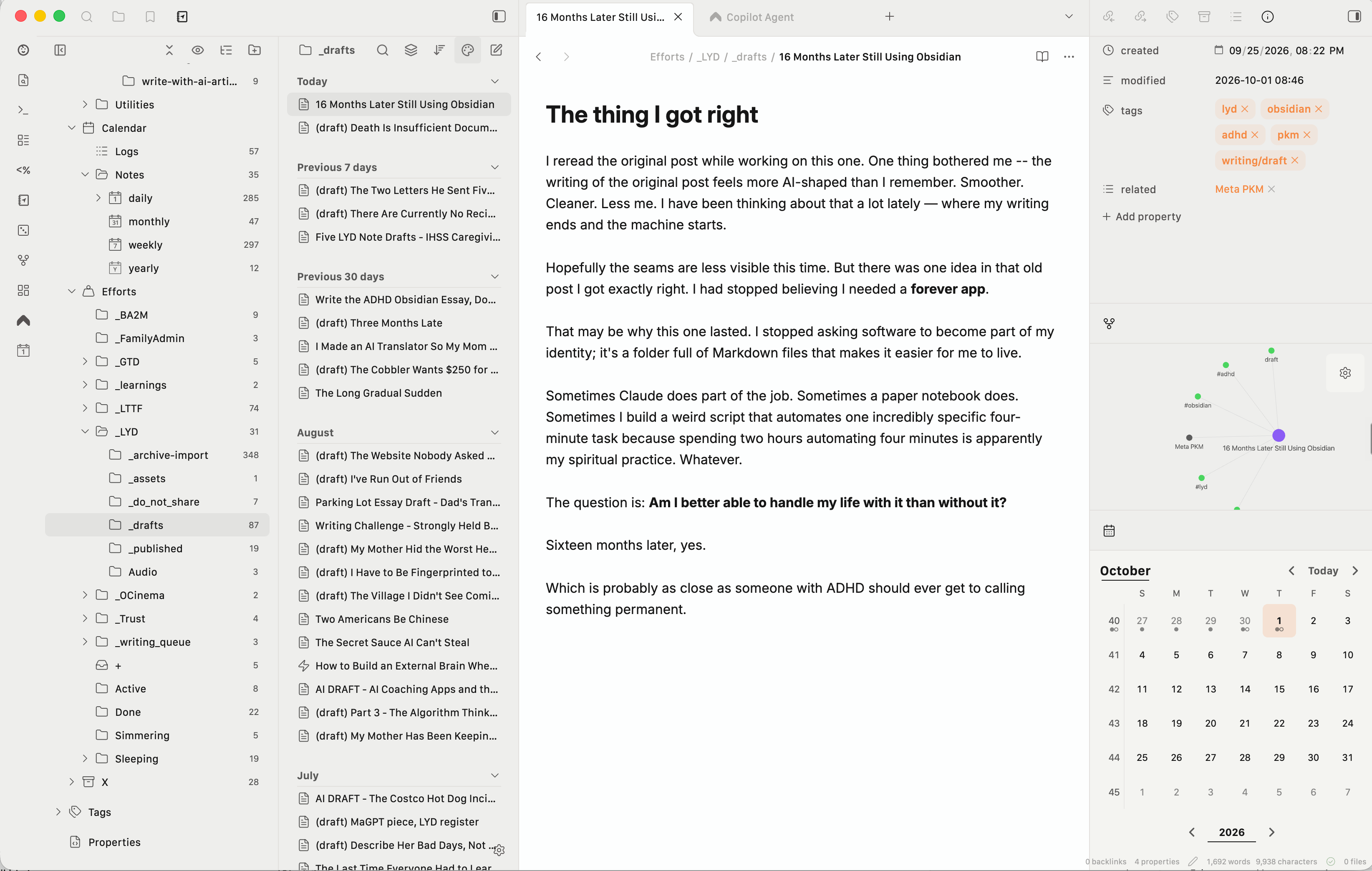
The daily note is still the center of everything. It started as somewhere between a diary and a junk drawer.
And honestly, that description has held up. Most days, I open Obsidian and start there. My template has gradually turned into a tiny chief-of-staff briefing for my life: what is going on, what needs attention, what I am working on, whatever my brain has decided to throw against the windshield that morning.
I use it religiously, partly because Obsidian opens there automatically. This turns out to be a pretty important ADHD rule: If a system requires me to remember to use the system, the system is already fucked.
A stray thought becomes a blank note. A script throws it into my catch-all folder. No taxonomy decision. No “is this a resource or an area?” No tiny committee meeting inside my skull. Thought → note. Done.
Most of my clever templates died. The original setup had templates for everything: Meeting notes. Book notes. Project ideas. People. Tasks. Monthly reviews. And apparently, an “I’m overwhelmed” brain-dump template.
I say “apparently” because I learned this while rereading my own post. I have absolutely no memory of it. Which may be the most ADHD follow-up possible.
The funny thing is, I still do the thing the template was supposed to make me do—when I’m overwhelmed, I dump everything into a note. I just don’t need a special ceremony around it anymore.
And that became a pattern: The behaviors survived; the scaffolding didn’t.
I still keep notes about people. I still use structured templates for things I capture with the Obsidian Web Clipper. I still do reviews.
Using Obsidian to handle tasks, admittedly, got messier. It is easy to imagine a task as something like: “Email accountant.” But what life hands you is something like “Handle Dad’s estate.”
And yeah, handling Dad’s estate is technically a task, much like “construct airport”; inside it are twenty projects, each containing another twenty sub-tasks I don’t want to do.
Somehow, they get done. So the system got looser. Less elegant. More useful.
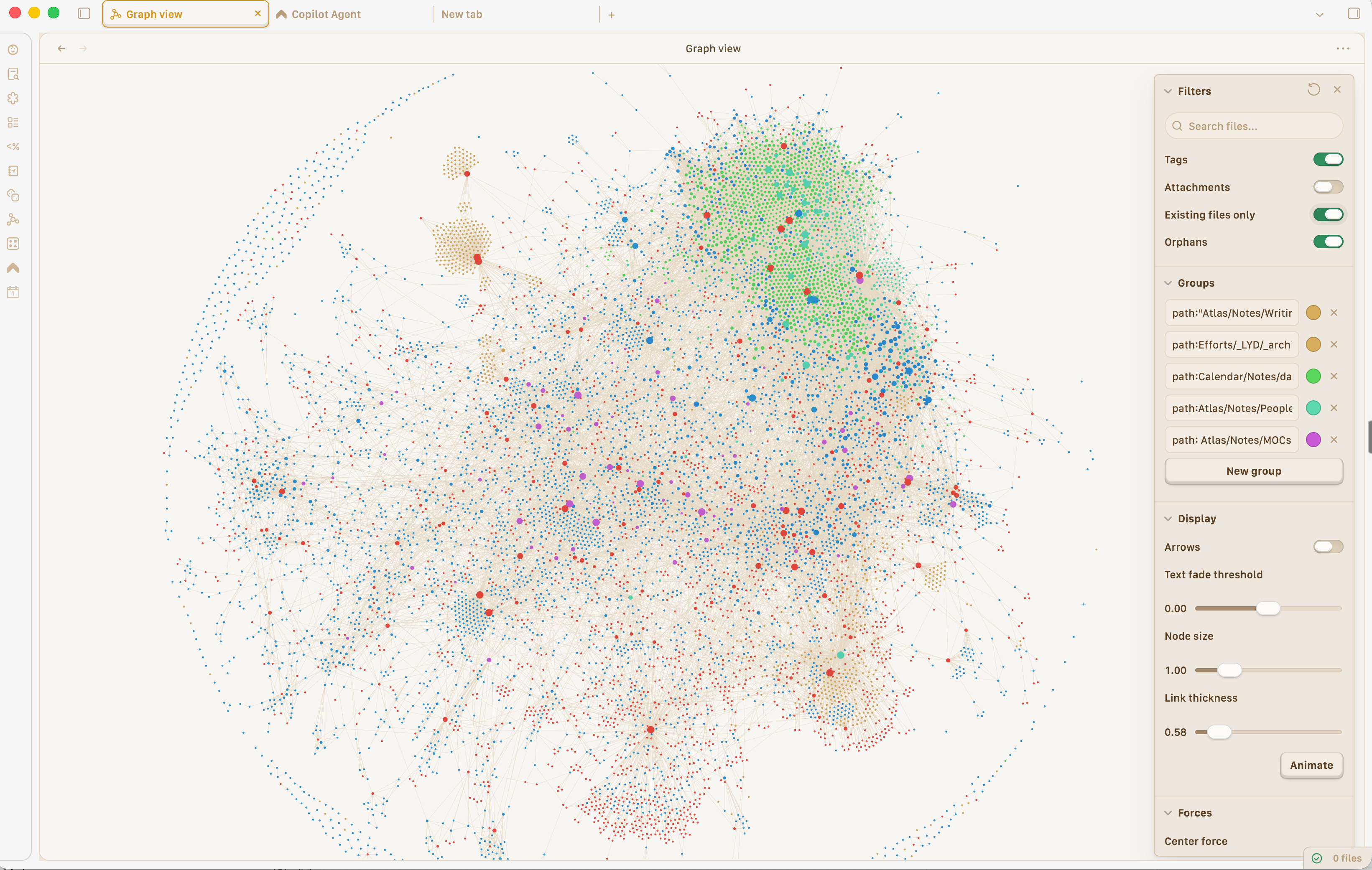
A quick aside: I would like to formally apologize to anyone I argued with about Obsidian’s Knowledge Graph.
I looked at mine a day or two ago. It is gorgeous. Thousands of little dots. Lines everywhere. My entire intellectual life rendered as the Death Star plans.
Did I learn anything? No.
There are useful bits hiding in there. Local graphs can show connections around one note. Seeing what is linked and what is floating alone tells me something about the shape of the vault. But the giant galaxy view?
Mostly a circle jerk.
A very pretty circle jerk, mind you, but I stand corrected.
This is where the real test happened.
My life changed a lot after that first post. I started doing much more caregiving.
My work became less like the usual 9-5 job and more like freelancing, writing, consulting, and whatever currently pays the electric bill.
And then my dad died.
Death, it turns out, produces paperwork. A spectacular amount of paperwork.
I built Maps of Content (MOCs) around my dad. Funeral stuff. Financial stuff. Administrative stuff. Things I had done. Things I had not done. Which institution wants another copy of the death certificate because apparently seven previous copies were insufficient. Things I had completely forgotten existed until some envelope arrived and ruined lunch.
Then there was Mom: Caregiving. Medi-Cal. IHSS. Income rules. Government bureaucracy operating under the assumption that a normal person can keep twelve overlapping programs in working memory.
Having a system to handle all of this didn’t make it easier; it made it possible.
And that feels like a better test than whether my notes collection looks prettier with folders or tags.
The other thing that affected my usage of Obsidian is AI. A lot.
Some Obsidian people very intentionally want their vault to remain an AI-free cabin in the woods. I respect that. Just know that by those delightful AI-free cabins, I’m building a giant Westfield Shopping mall by the Interstate. I might be the bad guy, but I also have an Orange Julius, so who wins now?
Claude and other models have absolutely eaten part of Obsidian’s job.
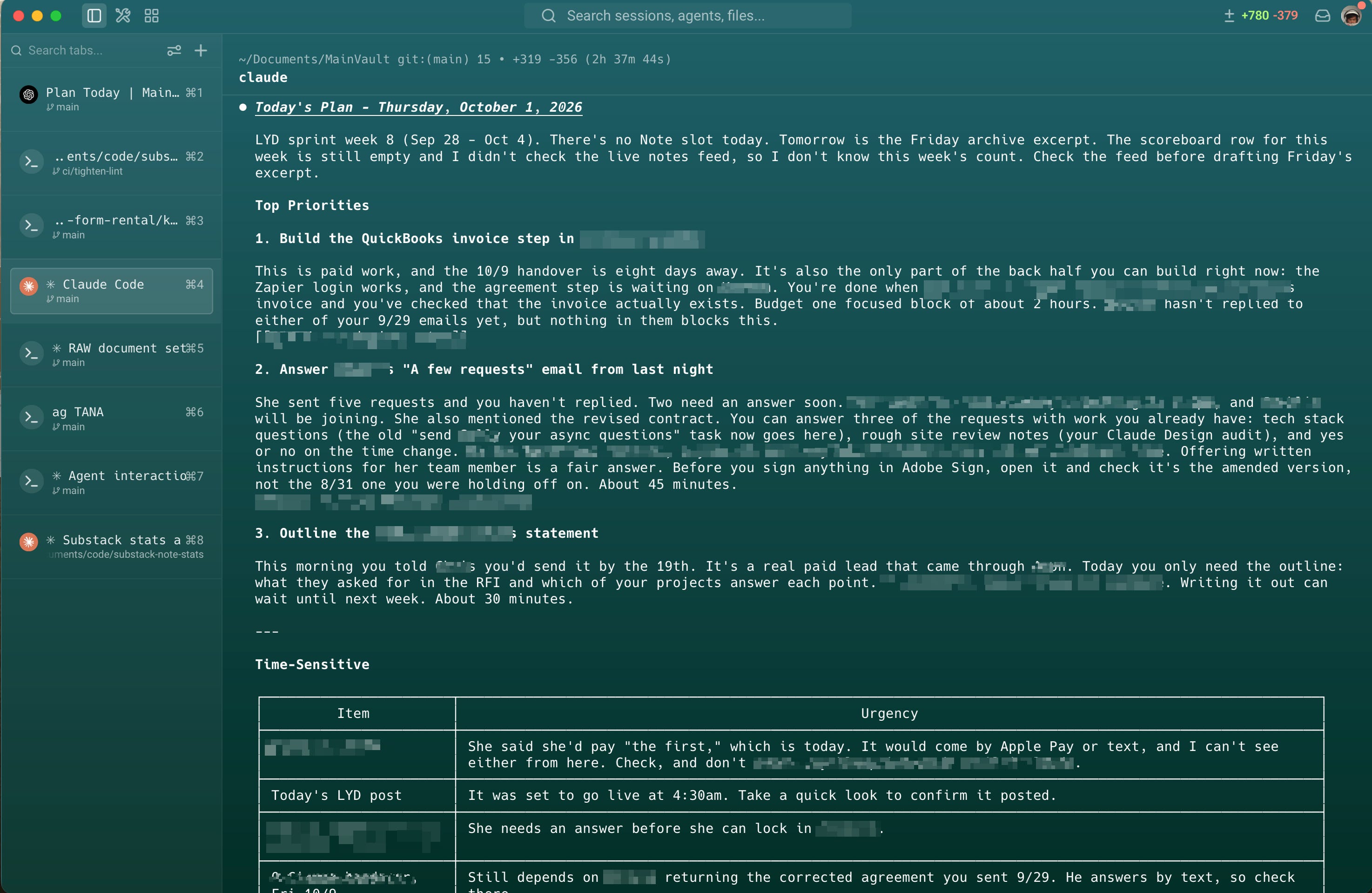
My Obsidian vault is a folder full of files. I point Claude Code at it and ask what I was working on, like consulting an oracle that has access to my junk drawer. I use it to reconstruct parts of my day because my short-term memory is bad. I ask what I have already written about an idea. I use it to remind myself that the brilliant thought I just had at 2:14 PM is something I apparently also had in 2022. (And 2019. And 2016.)
The AI can go spelunking. For someone with ADHD, that feels less like cheating and more like installing a wheelchair ramp for executive function. I already feel like I am doing half of adulthood with one hand tied behind my back; I will take the shortcuts.
Not everything in my vault is noble. The dumb stuff survived, too.
I am reminded that sometimes I am petty as fuck. I’ve kept vents about arguments.
Things Mom did that irritated me. Things I did that irritated Mom.
I’ve recorded nights so salacious that when I fed them into an LLM, its guardrails kicked in so ridiculously hard I had to make a Suno song out of the response message (although the night wasn’t THAT scandalous, I swear.)
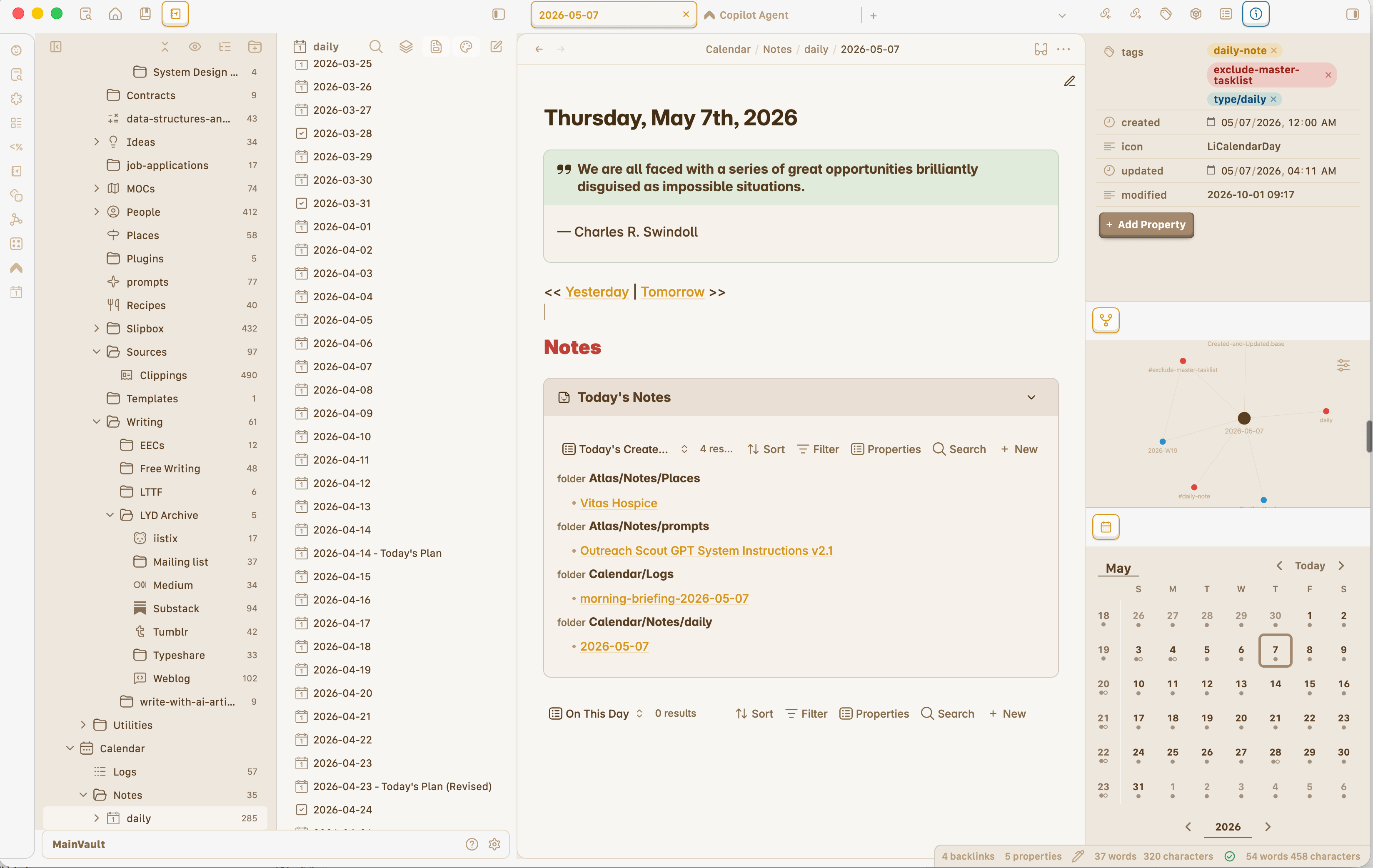
And every once in a while I get bored with how Obsidian looks and make the whole thing obscenely colorful for a day. Different font. Different theme. Something visually offensive.
Then I go back to minimal. This helps more than it should.
People sometimes treat customization like procrastination, and sometimes it absolutely is.
But sometimes my brain just needs the room rearranged. Move the couch. Paint the wall.
And once I’m sated, well, okay; now we can work again.
What did I abandon?
The earliest casualties were anything that felt like homework. At one point I created earnest self-reflection questions for myself. They had thoughtful questions. Healthy ones, designed to make me a better person.
I answered them exactly once.
Then I cheerfully fucking ignored them for months.
Anything where the system starts wagging its finger at me dies quickly. Daily gratitude prompts are especially good at this.
I am not saying gratitude is bad! I am saying that if a template asks WHAT ARE THREE THINGS YOU ARE GRATEFUL FOR TODAY? my brain immediately becomes a teenager being asked to unload the dishwasher.
Probably useful abandoned systems are buried all over my vault. That used to bother me. Now I think the graveyard is part of the point: Ideas I tried. Templates I stopped using. Projects that went nowhere.
Folders whose meaning has been lost to history. I used to think this meant I had failed to maintain the system. Now I think this is the system.
I reread the original post while working on this one. I put a lot of high expectations for what was, essentially, a folder full of Markdown files.
Somewhere along the way, I stopped believing I needed a forever app.
That may be why this one lasted. I stopped asking software to become part of my identity; it’s a folder full of Markdown files that makes life easier.
Sometimes Claude does part of the job. Sometimes a paper notebook does. Sometimes I build a weird script that automates one incredibly specific four-minute task because spending two hours automating four minutes is apparently my spiritual practice. Whatever.
The question is: Can I handle my life better with it than without it?
Sixteen months later, I can say: yeah, I can.
Which is probably as close as I’ll ever get.