

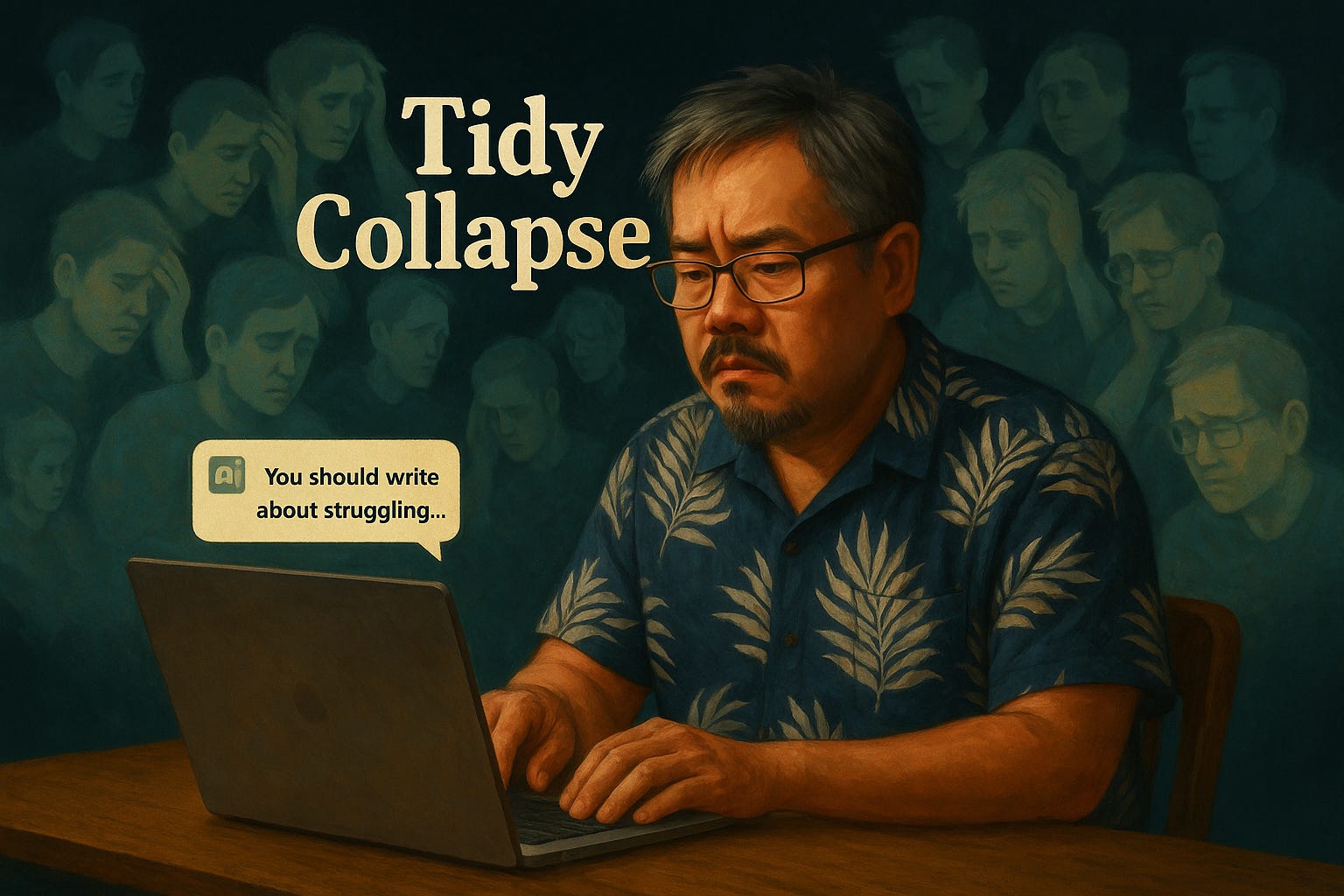
I asked the artificial intelligence what I should write about this week,
and it said: “You should write about how your writing accidentally hides how much you’re struggling—even when you’re writing about struggling.”
Which is either a compliment, a therapy prompt, an insult dressed in empathy, or the AI just crashed; I haven’t decided yet.
The irony isn’t lost on me: vulnerability is kind of my whole thing.
If this newsletter were a brand, it’d be soft disclosure with a twist of emotional elegance.
I write, “I’m unraveling,” but the sentence still has rhythm.
The pacing works. There’s usually a joke nearby to clean up the mess.
It’s weird—how effortful honesty can come off like composure.
Like there’s such a thing as a tidy collapse.
Sometimes I wonder if I’m cosplaying as messy.
Or worse: that someone is reading this and thinking,
“If that’s what struggling looks like,
I must be doing it wrong.”
If you’ve ever had a classmate complain about bombing a test and then getting an A-, you know the feeling.
The truth is: I don’t always say everything. I can’t.
There are sentences I type and delete—
details I don’t include.
Real things—
sharp things—
that feel a little too radioactive for a Thursday inbox drop.
There’s one about drugs.
I won’t tell you what it is. Not today.
But it exists.
And not writing it feels both like protection and omission, like withholding from myself, too.
Sometimes I wonder what would happen if I wrote without the polish. If I let the ache show up before the cleverness.
But then I think: to what end?
So someone can decide they no longer respect me?
So someone can project onto the mess and call it a personality?
Being judged is bad, but being reduced is worse.
Not being seen—but being decoded by someone who stopped reading halfway through.
So here I am again, trying to thread the needle: write something honest, just not too exposing.
To say I’m struggling, but don’t need you to fix it.
To be vulnerable—but still loyal to myself.
This is me trying.
And maybe this week, you don’t need the clean ending either.
I've been having health issues. Lots of people do, but I'm a natural over-sharer. I would love to be the person who can look slightly grumpy or tired and just muddle through, but I'm somehow mentally not able to answer "Hi, how are you?" With an innocent, "oh, ok" instead of, "ugh, it's hard.". Even to acquaintances or people on the street.
So, everyone asks very kindly what's wrong, and more and more I wish I had a stronger self-edit in conversations. Just to be able to lie my way out of how things are feeling worse and worse and I can't seem to do much to stop it, except wait for more specialist appointments.
Your situation resonates, but in conversations there isn't a delete/back button, just a, "Tell me, how are you? How are the kids? How's that project?" ... IE, please talk about you -- please I don't want to think about the brutally awful situation I'm in any longer. Let's change the subject. You aren't going to like the mess over here.
I hope you are able to find something in life that is so exciting, you don't have an opportunity to show how hard it has been, and that you're just excited about whatever it is.
Sometimes (for me) hiding the truth from myself by not writing the words or speaking them aloud feels like the only thing holding back the darkness. And yet, not feeling seen cuts so deeply, and being misunderstood or judged in moments of unfiltered vulnerability can feel like trying to tend a wound with bleach.
We are all messy, we are all misunderstood, and yet practicing honest vulnerability is the most frustrating act of resilience, as it often can be met with initial resistance, anger, or trauma pile-ons. Remember that your AI buddy is not empathetic to your struggles, nor to what makes you human. And for we human readers, we see strength in the tightrope you are walking.