

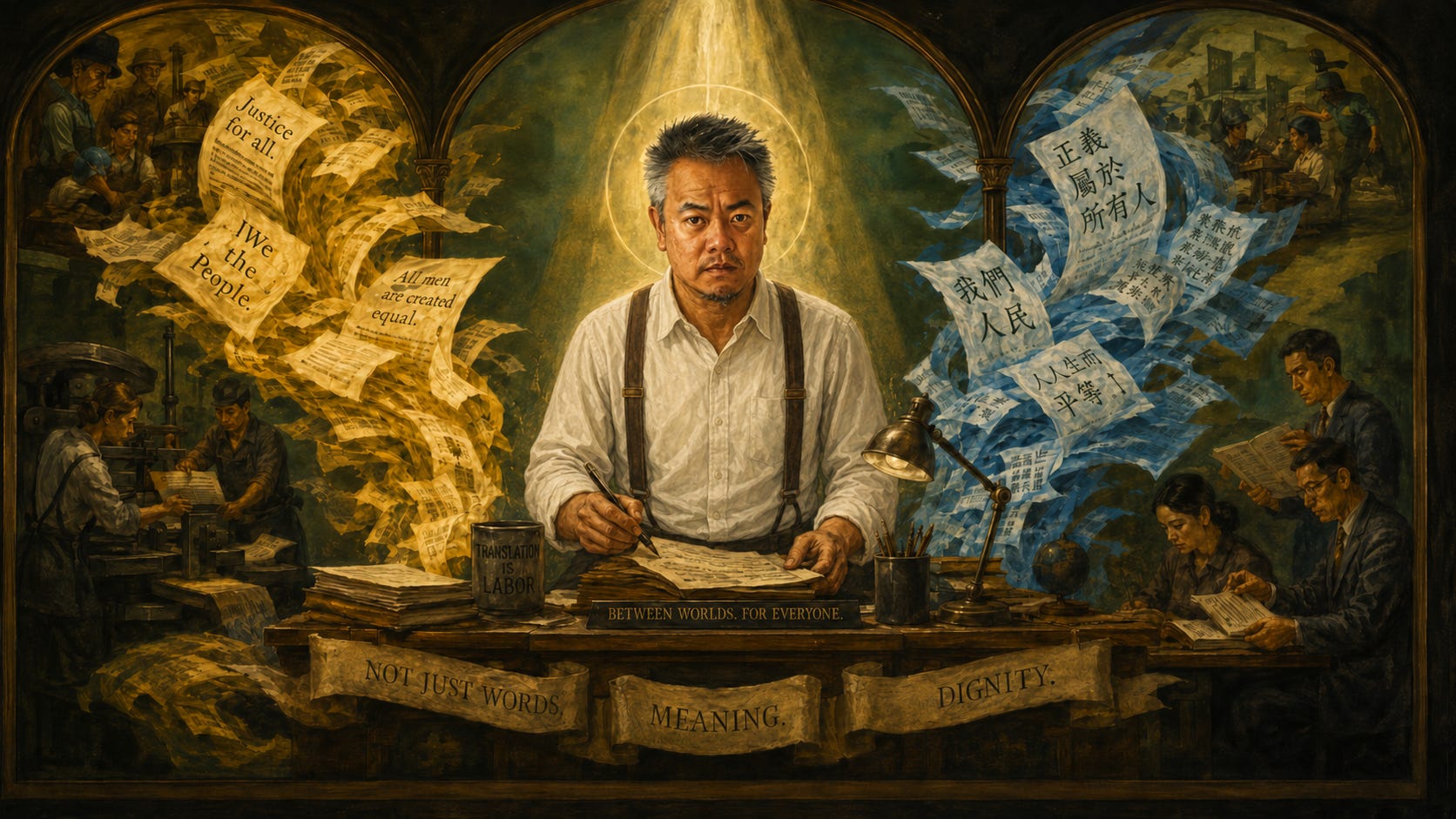
I named it 媽-GPT (MaGPT going forward) because the pun was sitting right there, and I have never once in 49 years left a pun on the table.
It’s a custom GPT with exactly one job: take whatever English I paste in — a Medicare notice, an IHSS form, a text from me about spoons — and turn it into Mandarin my mom can actually use. Mandarin for an 88-year-old woman from Taiwan. Big ideas in small sentences. Formal enough to be respectful, simple enough that she doesn’t have to call me to explain the explanation.
I’m not joking. This is how I start the prompt:
This GPT serves as a Taiwanese Mandarin translator specifically tailored for communication with an 88-year-old Chinese mother. It translates user input into Taiwanese Mandarin (Mandarin as spoken in Taiwan), preserving cultural and linguistic nuances appropriate for elderly native speakers. If a phrase is in all caps, it is retained in English.
See that last sentence? It even handles Chinglish!
It has outlived several models and my patience with basically everything else in that app. It keeps its job because it does its job.
Here’s the thing about being a kid of immigrants: you get hired for a position you never applied for. Researchers have a name for it — “language brokering” — which is a very professional term for being a child and translating your own parent-teacher conferences. The literature says most of us start somewhere between eight and ten years old.
I don’t remember starting. That’s how you know a job is permanent. There’s no first day. There’s just the slow realization that you’ve always worked there, the hours are irregular, and the benefits package is your mother saying 好,我知道了 and hanging up.
In my twenties I once accompanied my mother to the DMV as she was retaking her written driving test. “But Ernie,” you say. “I thought they had written DMV tests in Chinese available.”
Oh, they do. As I corralled Mom toward the part of the building for written tests, I got a tap on the shoulder: an older woman from mainland China. “I’m sorry to bother you; I couldn’t help but overhear you talking to your mother. Can you tell me how she was able to get a version of the Chinese driving test?“
As I started assisting her, I got ANOTHER shoulder tap, this one from a couple in their 60s. “Oh, I’m sorry for troubling you,” the man said. “Can you tell us if we’re in the correct line?”
“WHY DON’T YOU GET YOUR OWN GAY CHILD TO TRANSLATE THINGS FOR YOU,“ barked my mother.
(No, she did not say that at all.)
Last year NBC ran a story about immigrant kids getting replaced by ChatGPT. Parents writing their own emails now. One woman said her dad doesn’t ask her to proofread anymore — he replaced her with a chatbot — and everyone in the piece described it as a relief. Less task-based. Closer, even.
Must be nice.
Because that was never how it went at my house. I didn’t get replaced. I built my own replacement, trained it on everything I knew about one specific woman, and the job didn’t shrink. It just stopped requiring me to be awake for every shift.
And MaGPT isn’t even the only AI in my mother’s life. She has her own — she named it herself, a proper name with a spot in the family tree. (That’s a whole other essay, and I wrote it.) Hers gets asked about dinner. Mine gets fed Medicare forms.
Then it was May, and my dad died.
Estate paperwork is its own language. I got conversational in it fast — death certificates, small estate affidavits, the phone tree at Bank of America. That part I’ve written around before and will write about properly someday, or never.
But somewhere in the folders was the other paperwork. The Chinese documents. His original marriage certificate; the original one, from Taiwan. His diploma from engineering school. But the ultimate mystery: a six-page handwritten document, in my dad’s unreadable cursive. The envelope is simply labeled “To 大姐, 1993.” His sister-in-law.
I uploaded the PDFs into MaGPT and asked it to run the other way. Chinese into English. Not for my mom this time.
For me.
The machine I built so my mother could read things was suddenly helping me read my father.
It reconstructed pieces of a family tree while it worked — names and relationships surfacing out of documents I couldn’t have parsed on my own, in a language I speak at a kitchen-table level and read at roughly a menu level.
What did I learn? Through the diploma, I learned my dad held great pride in his studies. Through his certificates, I learned my paternal grandparents’ Chinese names. And through the letter… sigh
…through the letter I learned that my mom’s eldest sister took my father’s military retirement savings and my mother’s income from the sale of a house in Taiwan and lost the money in a business investment gone bad. My mother eventually forgave her sister. My father never did.
The six-page letter reminded her of the money she owed him — money they both knew she would never be able to pay back — and demanded maybe her children should hear about the embarrassment she had caused his side of the family. It finally answered a question I had asked my entire life to shrugs: why, out of my mother’s twelve brothers and sisters spread across at least four countries, I’ve hardly met two aunts and one cousin. But realizing that opens up more questions than answers, and those answers almost feel as if they’re too late to pursue now anyway.
In the stack post last week I said this one was personal in ways I wouldn’t over-explain. A reader looked at MaGPT anyway and said it sounds like something a lot of people could use.
He’s probably right. Every family like mine has a translator. Some of us have been on shift for forty years. The tools are finally good enough to help, and the companies are finally noticing we exist, and I have complicated feelings about both of those facts that I’ll sort out on some other Thursday.
What I know is this: my mom still needs documents translated. The job was never going to end — I just finally got to hire staff.
And the staff, it turns out, works in both directions. I didn’t put that in the job description. Grief does things.
The envelope is still on my desk. “To 大姐, 1993.” Six pages of the angriest handwriting I’ve ever had to feed a machine. Inside: a full accounting of whose savings she took and lost 20 years before, the specific dreams that went down with the money, and a demand that her children know everything — that the reminder be eternal, that somebody besides him carry this.
But Dad was too good at resentment. Thirty years of it worked. The estrangement is so complete that I couldn’t deliver his message if I wanted to — I’ve never met these cousins. I wouldn’t know which continent to start on.
So the only people who ever opened the envelope and read its contents — the only ones still alive, anyway — are my mother and me, both of us people the letter was never addressed to. And the room it was written for stays empty.
Anyway. It’s Thursday. Mom has a form from the county. Back to work.