

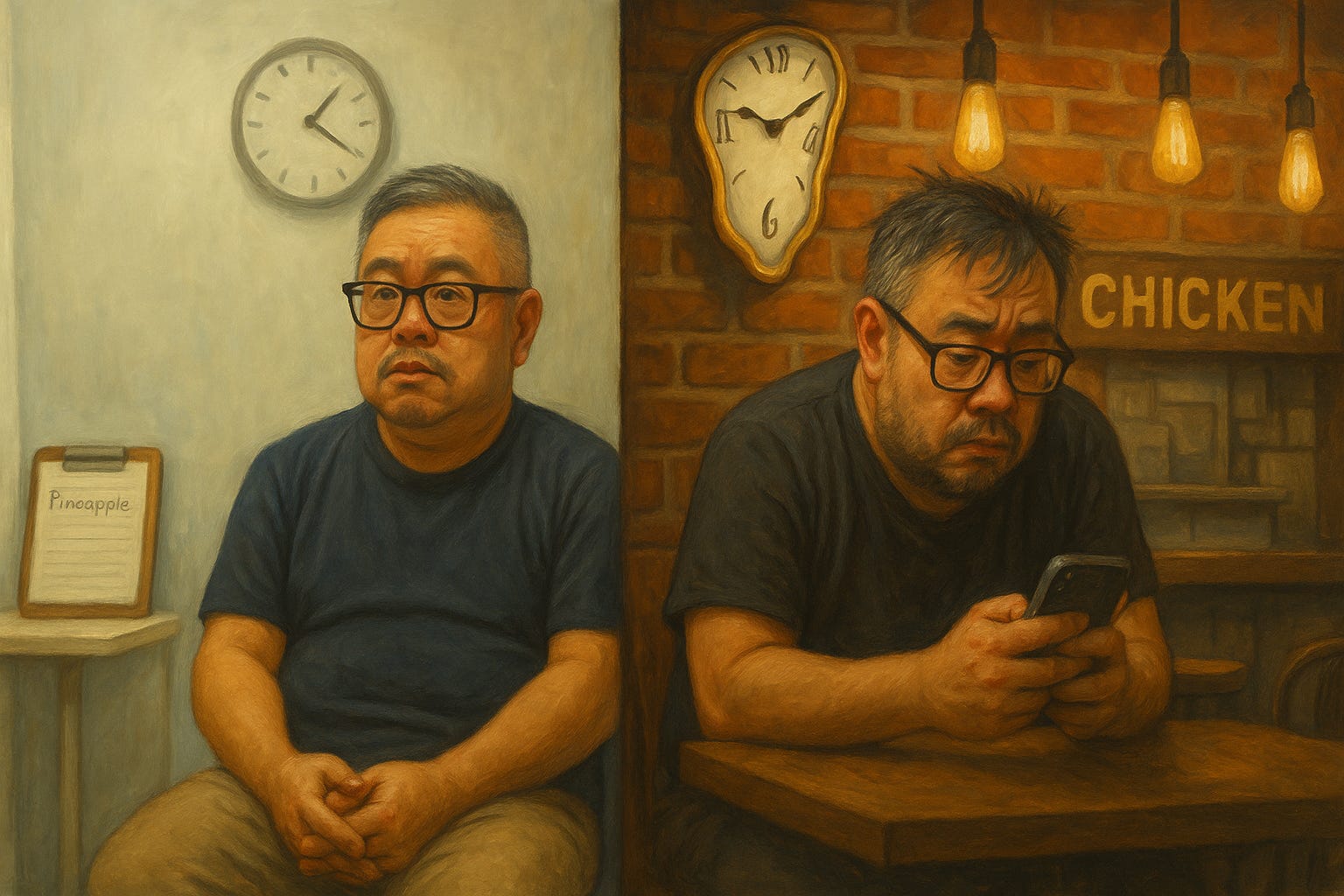
I'm standing in a chicken joint on one of those "hip" streets where gentrification meets poor urban planning, and somehow results in five times as many cars as there should ever be. You know the kind of place—fast-casual with exposed brick walls and Edison bulbs, where they serve free-range chicken on reclaimed wood but still somehow make you feel dead inside. My name still hasn't been called, which is either a new record or proof that time works differently in places that smell like industrial fryer oil and broken dreams.
My phone buzzes. I ignore it. The guy behind the counter is wiping down trays with the kind of focus you only see in people who have truly given up. I am, at this moment, one lukewarm sandwich away from a full existential collapse.
Scene: Proposition Chicken, 12:47 PM
Let’s set the stage: I’ve just come from Highland Hospital, where I spent the morning sitting next to Daniel, who is, and I cannot stress this enough, recovering from being shot. Shot. As in, “bullet throughs the car door, now there’s a hole in my friend” shot. I did the whole stoic Asian-American thing—brought snacks I later learned he couldn’t eat, made awkward jokes, tried not to look at the tubes. I even remembered to ask the nurse if he could have Jell-O, because that’s what you do, right? You show up, you keep it together, you don’t make it about you.
And because Daniel is now officially a “crime victim,” there’s a whole extra layer of hospital security. If you want to visit, you have to give them the magic phrase—“pineapple1”—at the front desk, like you’re trying to get into a speakeasy for people with bullet wounds. I typed it out on my phone, just in case I forgot and accidentally outed myself as an imposter friend. (Imagine getting turned away from your own friend’s bedside because you couldn’t remember the secret word. That’s a new level of embarrassment.)
Afterwards, I drive to Proposition Chicken because, apparently, after trauma, my body craves overpriced poultry. I ordered the fried chicken sandwich and a side of chips, because if I’m going to emotionally eat, I might as well do it right. The cashier hands me a receipt and says, “Should be about ten minutes.” I nod, like a man who believes in the basic decency of the universe.
Ten minutes pass. Then fifteen.
Then twenty.
The place is half-empty, but the kitchen sounds like a war zone—metal clanging, someone yelling “Where’s the slaw?” in a tone that suggests slaw is now a matter of national security. My stomach is growling, but my brain is louder: What if Daniel’s not okay? Did I say the right things? Did I do enough? Am I a good friend, or just a guy who shows up with snacks and then flees to the nearest fried chicken outpost?
A woman in yoga pants gets her order before me. She glances at me with that smug, fancy white-person Oakland Lululemon pity. I want to ask her if she’s ever had a day where the universe keeps poking you, just to see when you’ll snap.
Inner Monologue: The Realization
Here’s the thing: I can handle the big stuff. I can handle hospitals and bullet wounds and the kind of conversations where you have to pretend you’re not terrified. I can handle being the “responsible one,” the guy who remembers the insurance paperwork and the snacks and, yes, the magic phrase you have to whisper to the hospital’s social worker —“pineapple”—so they’ll actually let you in to see your friend.
Because nothing says “modern American healthcare” like needing a secret password to prove you’re not there to finish the job.
I can handle all of it, right up until the moment my sandwich is late. That’s when I start to unravel.
Not in a dramatic, table-flipping way. My college friends have seen that side of me; no one wants to see that anymore. Now it’s more refined, like… like a slow leak. My jaw clenches—my foot taps. I start composing a Yelp review in my head that I’ll never post, because I’m not a monster. But I want to. I want to scream, “I just spent the morning in a hospital, and I haven’t had a job in a fucking year and a half, so can I please get my goddamn sandwich?” But I don’t. I just stand there, quietly losing my mind.
Why is it always the small stuff?
Why do I keep it together through the crisis, only to fall apart over a sandwich?
Maybe because the big stuff demands composure. There’s no room for panic when someone else needs you. But the moment you’re alone, waiting for lunch, all the stress you’ve been holding in finally finds a crack.
Reflection: The Gen-X Pressure Cooker
I think about my parents, who would have never paid $14 for a sandwich, let alone waited for it. They’d have packed a thermos of rice and called it a day. But here I am, a Gen X-ish, Asian-American man, standing in a fast-casual restaurant, quietly melting down because my coping mechanisms are all out of sync with my reality.
This is what adulthood looks like now: you juggle hospital visits, financial triage, and emotional labor, and then you lose your shit over a sandwich. You tell yourself you’re resilient, but really, you’re just collecting “final straws” like Pokémon cards. The tech industry taught me to optimize everything—my calendar, my inbox, my feelings. But you can’t optimize grief, or fear, or the gnawing sense that you’re not doing enough for the people you love.
Sometimes, the universe tests you in the pettiest ways possible. It wants to know: can you keep your cool when the stakes are microscopic but your nerves are shot? Can you survive the slow drip of minor indignities after you’ve already survived the big, cinematic traumas?
Spoiler: Not today.
I start to spiral. I imagine the sandwich never comes. I imagine dying of starvation in a place with reclaimed wood tables and a mural of a chicken wearing sunglasses, which doesn’t even exist. A Chinese period-piece soap opera was playing in the background when I visited Mom a couple of days ago, so I’m in Chinese peasant clothes, which make no sense, but work with me here. I imagine my obituary: “He survived the Bay Area housing market, but not the lunch rush at Proposition Chicken.”
I check my phone for the tenth time. I consider texting someone about my plight, but what would I even say? “Hey, remember how Daniel got shot? Well, my sandwich is late.” Even I know that’s not a real problem. But it feels real. It feels like the last straw.
The Broader Picture: Why the Small Stuff Breaks Us
It’s never about the sandwich. You know that. I know that too.
It’s about the fact that we’re all carrying around a backpack full of rocks—family obligations, joblessness stress, existential dread, the slow-motion horror show of the news cycle, and oh yeah, Dad had one of his rare Alzheimer's lucid moments this week just long enough to yell at Mom and me for abandoning him—and sometimes, all it takes is one more pebble to make the whole thing feel impossible. The sandwich is just the pebble. The rest of it is everything I refuse to put down.
Oh God. Resilience isn’t about not breaking down, is it? Maybe… maybe it’s about learning to laugh at the absurdity of what finally does you in.
Button: The Last Straw (with Extra Sauce)
Eventually, my name gets called. The sandwich is fine. Note to self: don’t let a fried chicken sandwich get cold. The chips are cold. I eat it anyway, because what else am I going to do? I walk out into the parking lot, sunlight bouncing off the hood of my car, and I laugh. Not because anything is funny, but because sometimes, the only thing left to do is laugh at yourself—at your own ridiculous, fragile humanity.
I survived the hospital. I survived the sandwich. Tomorrow, I’ll probably lose my mind over a missing sock or a slow Wi-Fi connection. But today, I’m just a guy with a full stomach and a story to tell. That’s enough.
Oh my GOD, of COURSE that isn’t the actual password. The real one has a symbol at the end.
Aw Ernie! Sending Hugs!
God I feel this. You've always been a good writer, Ernie, but lately your work has just been brilliant. It sucks that you're being put through it, but I hope you realize how good a writer you really are.