

My cousin is a county undersheriff. Has been for years. He’s good at his job in the way that quiet competent people are good at their jobs — you don’t realize how senior he is until you mention his name to someone in law enforcement and watch their face change.
His number has been in my phone for as long as I’ve had a phone. I see it when I scroll. It sits next to my mom’s, my hairdresser’s, and a cousin in Taiwan I haven’t talked to in fifteen years, in a contact list that hasn’t been cleaned out in two decades. I do not call him.
I could. I could call him today. The conversation would be short. The conversation would be: hey, I’m looking for my sister. The conversation would be: yes, that sister. The conversation would be: no, no one has heard from her in two years; last we knew, she was in a board-and-care somewhere. The conversation would be: yeah, I know. I know. I’ll text you what we have.
He would do it. Or he’d put me in touch with someone who would do it. There would be a window of maybe a few weeks where I’d get phone calls and texts I didn’t want to look at, then one phone call I really didn’t want to look at, and at the end of it I would know.
I haven’t made the call.
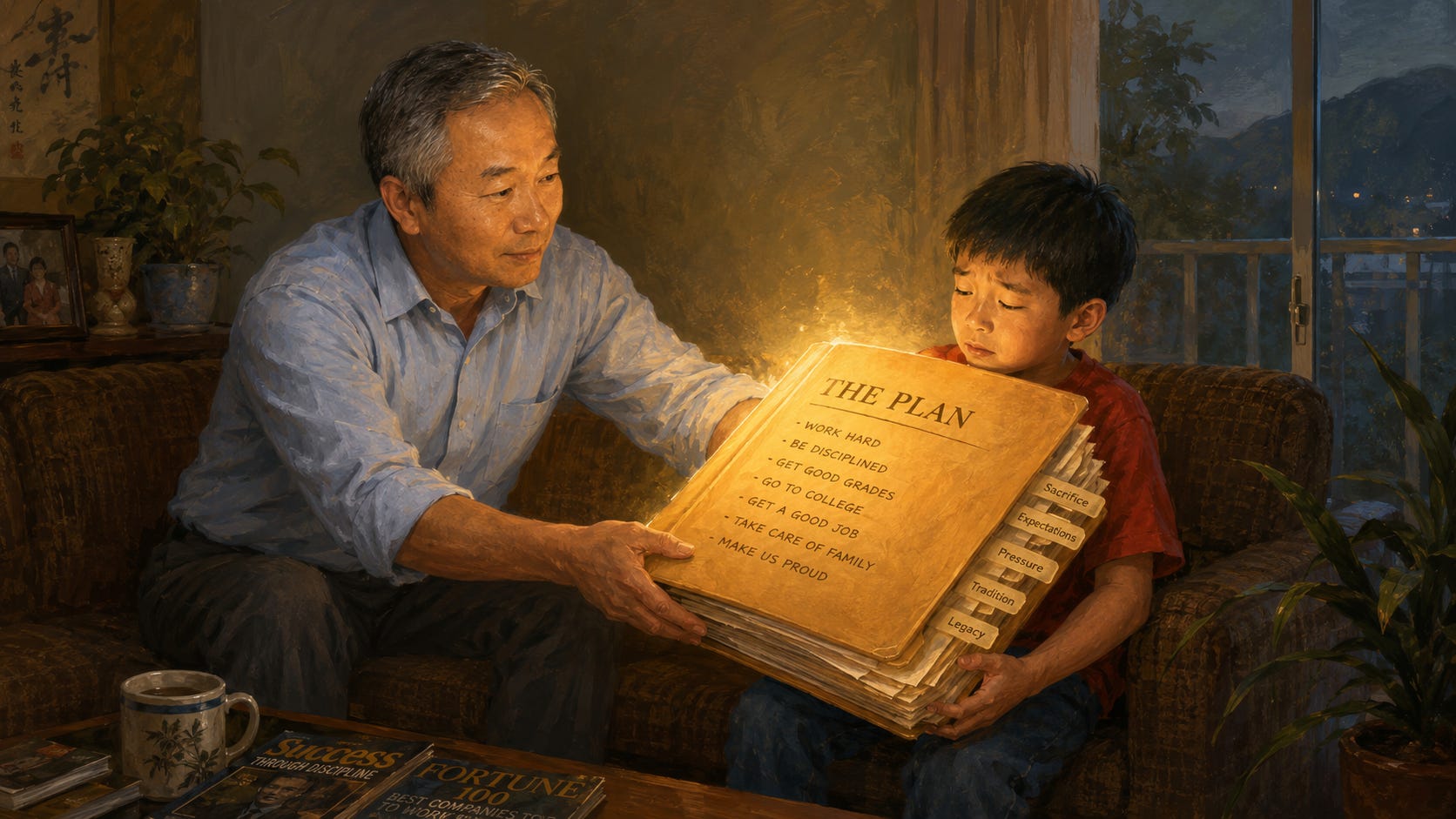
When you’re ten, your dad sits you down — you don’t remember if it’s at the kitchen table or on the brown couch by the sliding door; you have tried to remember and you can’t — and he tells you that your sister is going to be your responsibility one day. Legally. After.
He doesn’t say after what. You know after what.
Angela is twenty. You are ten. You don’t call her Angela when you’re ten, of course, because that would be rude; you call her 姐姐, and then just 姐 before you call her Angela as everyone else does. As if she somehow loses the title of “older sister” because of her mental demons.
Even at ten, you know something is wrong with Angela, though no one has given you the words for it yet. She was a surrogate mother to you, mostly when Angela felt that Mom treated her differently from how she treated me. She’s in some ways more of a mother than your mother. She is also, on the bad days, the most frightening person in your house. You can hold both. Ten-year-olds can hold a lot if you ask them to.
What your dad is doing here is, in his way, the responsible thing. He is a man who plans. He has insurance. He has accounts. He has a back-of-the-napkin operating plan for what happens to his family after he isn’t there. He has identified the family member who will, statistically, be around the longest, and he has briefed that family member on what comes next.
But if present-day me could jump in some sort of time machine and visit the moment Dad is talking to an 11 year old Ernie, I would carefully not touch the child — because, you know, grandfather paradox — but I would sit next to him, look the old man in the eyes and say “yes, he does need to hear this, this is his burden, but for the love of all things good and holy he is only in the fourth grade.”
Here is what telling a ten-year-old he is legally responsible for a twenty-year-old does to the ten-year-old.
The ten-year-old believes you. He files it. He carries it. He is bad at school for the next decade and a half partly because there is a parallel file in his head labeled Angela he can’t look at and can’t put down. He grows up. He goes to therapy and doesn’t bring it up because what would he even ask? He becomes a man who is excellent in a crisis and confused by an ordinary calm Tuesday, and the only honest answer for why is: he’s been waiting for the call for thirty-nine years.
The call never comes because Angela goes missing instead.
Angela’s timeline, if you want it. (You don’t, but it’s useful.)
1982: First break. She’s fifteen. Bipolar disorder with schizophrenia and delusions of grandeur is a phrase you distinctly remember her being described as at some point. Auditory hallucinations. Delusions that TV personalities were speaking to her. Paranoia about celebrities trying to kill her. Not always celebrities. Usually, it was Satan, Jesus Christ, or Barbara Bush.
1995: she’s twenty-nine, living independently for once, working as a substitute teacher in the East Bay. She stops her medication — she’s decided Jesus will cure her. She burns her diploma. She drives to Los Angeles to find a man named Michael, who does not exist. The car gets repossessed. She moves back into the family home. The independence experiment is over.
1999: She goes after Mom at the dinner table. You’re the one holding her back when she bites a chunk out of your arm. Dad won’t call the police. You do. You give your parents an ultimatum: put her somewhere, or lose me.
2000: In January, she runs away for two weeks. A hospital in Los Angeles calls; Dad drives down to get her. By April, she’s institutionalized — Mom can’t take the threats anymore and demands Dad admit her. You find out the way you find out everything: secondhand, on a visit home, Mom sorting junk mail. “Where’s jiejie?” “She’s gone.” You don’t remember how or when she’s released.
2016: She beats Mom with a TV remote. Police photograph the bruises. Mom files a restraining order; a judge makes it permanent for five years. Angela moves into board-and-care ten minutes from Mom’s house. Mom breaks the restraining order every week to take her to breakfast at McDonald’s.
2019: She leaves board-and-care, off her medication, and moves back into the family home with nothing but the clothes on her back. She refuses to leave.
2020: another assault, another TV remote. This time she’s arrested — for elder abuse. Then there’s the stint at Santa Rita — her first stretch — during COVID, when she tells no one about her mental health history. (You learn about the jail part secondhand. You always learn about the Angela parts secondhand.) She’s arrested four times that year. At one point, the jail-to-home cycle repeats itself almost daily.
She finally agrees to a board-and-care facility. She stayed at two facilities for a couple of years.
Two years ago, she called Mom from a board-and-care facility you don’t have the address for. She told her the food was terrible.
That was the last time anyone in our family heard her voice.
She could be dead. She could be alive in a shelter somewhere, in a different state, in the kind of place where people end up when their families have failed them sufficiently. She could be alive and well and choosing not to call us. And honestly — honestly — given everything, given that I am writing this sentence and haven’t made the phone call that would start to answer the question, I wouldn’t blame her at all.
I have not searched for Angela.
The for-the-record answer is: Dad was dying. Then Dad was in hospice. Then Dad was dead. There was a funeral. There was a will. There was Mom staring vacantly at the gravesite, remarking that it was too warm for an outdoor event. The bandwidth wasn’t there.
That’s the short version.
The real answer is: I think I have been quietly grateful for the silence.
I don’t love that sentence. I don’t love being the person it’s about. But it’s the sentence, and the law of this thing is that you write the sentence even when you would rather the sentence just not fucking exist.
If she’s alive and unreachable, fine. I can live with that. But if I find her, things happen. There’s a job I was assigned at ten that I still haven’t done at forty-nine. There’s a debt to my mother that stops being theoretical and gets a dollar amount. And there are the phone calls — case workers, county systems, the whole apparatus — possibly for the rest of my actual life.
So no. I have not searched for Angela.
The week you bury one family member is the week you finally count who’s left.
I have a mother. I have friends who showed up at the funeral and friends who texted because they couldn’t. I have cousins, including a cousin who is a county undersheriff and has had his number in my phone the whole time.
I have a sister. Or I don’t.
A ten-year-old was told he would someday be responsible for his mentally ill adult sister. Forty years later, his father is dead, the sister is missing, and he still doesn’t know whether the responsibility is legal, moral, imaginary, inherited, or simply the last thing his father left behind.
The phone is on the table. The number is right there.
Yep.
This is excellent. Maybe one of the best things you've written. It's so touching, brutally honest, insightful and heartbreaking all at once. Carer fatigue is a thing and it's legitimate. Thanks for sharing.
My brother was 28 and I was 18 when his first bipolar emergence happened. I was abroad, and I cried for over a day, only stopping for sleep. It was bad enough that my then-boyfriend took me to a doctor and I was given medication to help me stop, because I couldn't physically stop.
I thought I could take care of my brother when I returned from abroad, so I moved in with him so we could share resources while I went to college and he could get back on his feet. That only lasted until he decided he didn't need his meds. His friends at the time told me that I was crazy, that I was jealous of his happiness, and that I was not trustworthy... based on what he told them.
I moved out. He was institutionalized six months later. I never talked to them again, even to tell them how hurt I was that they didn't believe me.
I know the place where you are. Not knowing where they are, not knowing if they're harming themselves or others, not knowing how to handle the Void they represent- the UnPerson, the Unsolvable Problem. You maybe didn't feel responsible a month ago, you know, "before," because there was a thread there in the legal personhood of your father. The responsibility for the Problem was your father's, as if he were the rock that supported her... but she was Wyle E Coyote standing on a ledge that was severed from that cliff a while ago. She has been falling for a long time.
You do not have to be that ledge. She's in movement and there is velocity there. You do not have to be the anvil or the net to catch her or the rope she cannot grasp.
I hope you are able to gracefully let her go, to remain falling, and understand that you didn't push her in the first place. It's not your responsibility to accept her impact.
I hear your pain and I wish you peace.