

The second the attendant wheels my father into the Visitor’s Room, he tracks me with his eyes.
I don’t know if he knows it’s me.
Dad is in memory care now. This is the sentence I say matter-of-factly, the way you say he lives in the East Bay or he retired, because if you say it the other way — the honest way — you have to sit with what it actually is: a locked ward in a building two blocks from my mother’s house. It costs $6,700 a month. I mention this only because it tends to end conversations.
When I show up, the person who comes to visit him is, as far as either of us can tell, a man he can’t quite place.
He hasn’t said my name in months. He hasn’t said much of anything, really. Alzheimer’s has taken the words. What’s left: his eyes, which still move. His face, which still registers. And whatever is happening inside him that I will never fully have access to, which is, in some ways, not so different from before.
I’ve been thinking about the version of me that’s frozen in there.
The last version of me my father fully, consciously knew was someone in his mid-thirties, living in Miami, single as far as he was concerned, a software person who was possibly being manipulated by a “bad friend” into stealing the family property. This is, to put it generously, not a complete picture. My father knew I was gay the way he knew a lot of things he found inconvenient — at a slight angle, facing away from it, hoping it would resolve itself without requiring a conversation.
He signed his health care directive to my aunt. Not to me. “Because you live in Florida,” he said, with the composure of a man who tried to convince both of us that this is a geographic disagreement.
I said: That’s fine.
For a while, I meant it. I was genuinely content not having anything to do with him. We had our distance, and I had mine.
Then my aunt called. She was getting old herself, and my mother’s relationship with her had curdled to the point where Mom had to ask my aunt’s permission to see her own bank statements. Her own. My aunt was tired of being the new target once Dad was no longer available, so she asked me to take over, and so I did.
So that’s the real story. Not that I decided to stay; that I got called back in, and I went.
Last visit, I brought mom. She hadn’t seen him in months — she lives two blocks away, and she hadn’t seen him in months, which tells you something about the two of them that I don’t have the energy to unpack right now.
Dad didn’t react when I walked in. Eyes tracking, nothing more.
Then Mom appeared in the doorway.
He recognized her immediately. You could see it — something shifted, some older circuitry came back online. And what came with it, rising up through the Alzheimer’s like the one thing in him apparently indestructible, was a scowl.
He mouthed something. I watched his lips.
莫名其妙.
Baffling. Inexplicable. What is this nonsense?
It’s a phrase you use when something makes no sense to you, when the world has presented you with something you find absurd and slightly offensive. My father, who no longer has reliable access to language, who hasn’t said my name in months — his last emotional reserve went to contempt for my mother.
I almost laughed. I didn’t, because mom was right there and hadn’t noticed, and when I quietly told her what he’d mouthed, she started to get angry, almost combative, and I had to steer her out of the facility before it became a thing.
So that was the visit.
There’s a thing that happens when someone gradually loses their memory. People talk about what the person still has — he still knows the music, she still laughs at the same jokes. They’re looking for what’s intact. What’s still reachable.
The last reachable thing in my father, apparently, is resentment toward my mother.
I’ve been sitting with what it means that I walked into the room and got eyes tracking, and she walked in and got 莫名其妙. Maybe it’s nothing about me at all — just the specific, ancient, 50-year marriage fury that Alzheimer’s couldn’t touch.
Either way, the version of me inside my father’s memory is a version I barely recognize anymore. The little soldier. The obedient one. The son who bought the condo dad pointed at because WALUE and didn’t ask too many questions and bent himself into whatever shape was required and called it filial duty.
Dad was proud of that version — not demonstrably, but in the specific way that Chinese fathers of a certain generation signal approval: by not disapproving. By telling you what to do and expecting it to be done.
I don’t know if that Ernie is still in there. I think I retired him around the time I stopped apologizing for who I was. Maybe Dad noticed. Maybe that’s what happened to the health directive.
Maybe it doesn’t matter anymore. It won’t be until their house goes into escrow and becomes one more thing I have to handle. But that’s a problem for future me, and future me has enough going on.
I don’t know what my father sees when he tracks me with his eyes. I don’t know if the version of me he has left is the real one or the cleaned-up one, whether I’m a stranger, his son, or just a man who lives inside a visitor’s room sometimes.
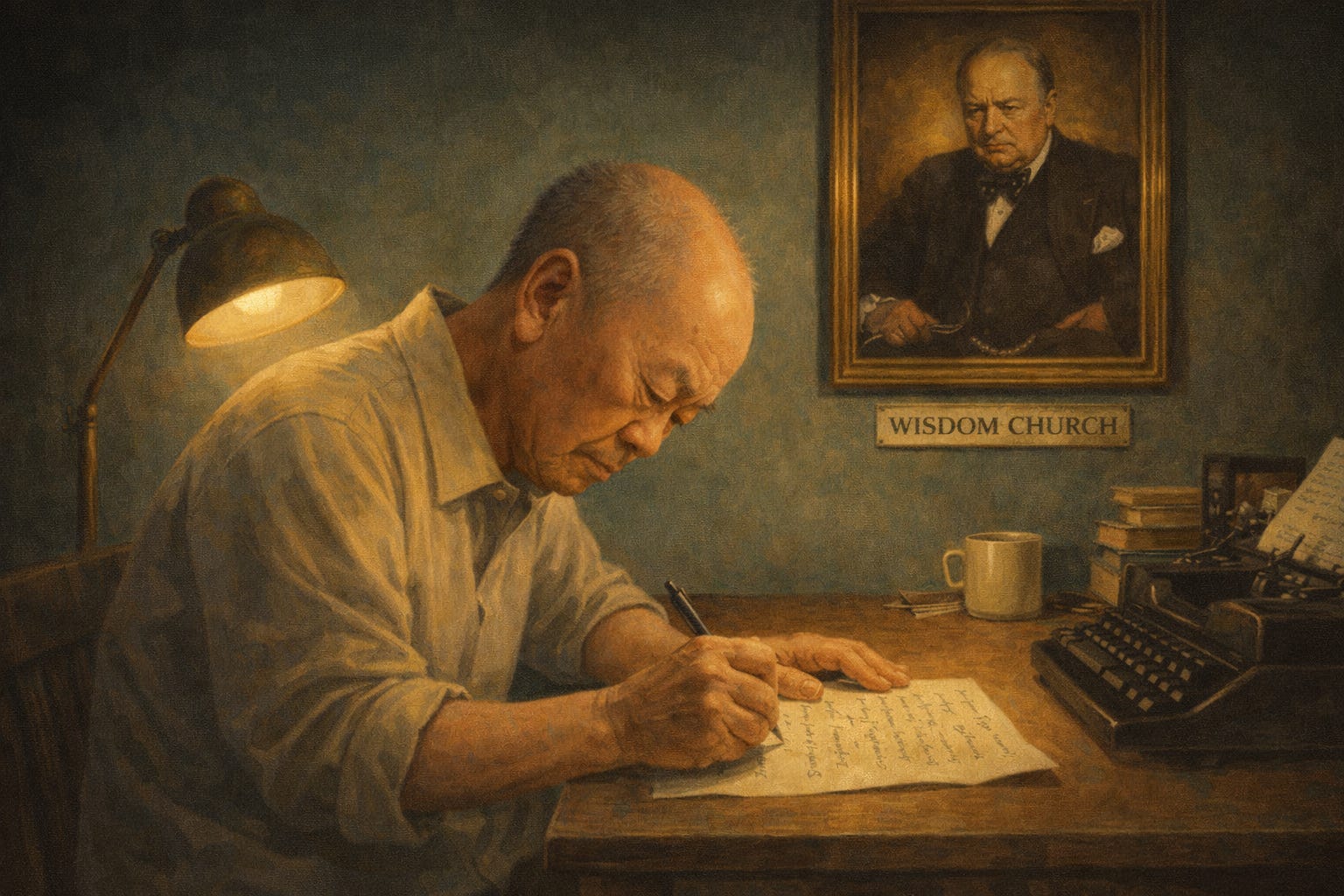
I do remember the last thing he said to me. Be Chinese. This was before the words went. I was living in Florida with a man, going against everything he’d written me over the years — MS Word documents, actually, sent in his second language, doing his best. I still wish you to try to accept a girl to help you, he wrote once. I will be the happiest man if my son like to try. Otherwise I have nothing to say. Only for myself, the world is very sad. He invoked Winston Churchill as evidence that people can change.
He called him Wisdom Church.
And then, years later, he looked at me and said, "Be Chinese." Meaning: not this. Not what you’ve become. Not American.
I found it condescending at the time. One more thing I had to absorb through no fault of my own.
I think about it on the drive home from Fremont. I’ve been showing up for years. I handle the logistics. I lead Mom out of the room before it becomes a thing. I sit with a man who tracks me with his eyes and may or may not know I’m his son. I don’t know what you’d call all of that, if not Chinese.
莫名其妙, he mouthed at my mother.
Yeah, Dad. Me too.
This is a heavy weight to carry. I found my own scenario of being rejected by family yet still bound by duty to do for them what they can’t do for themselves.
White friends have repeatedly expressed astonishment - they’d have written off their parents for 1/100th the level of disrespect and condescension we’ve experienced. I’m sure you’ve experienced this too.
Ernie, I'm moved and encouraged by your honesty. Encouraged as in: courage to speak truth when it breaks your heart.