

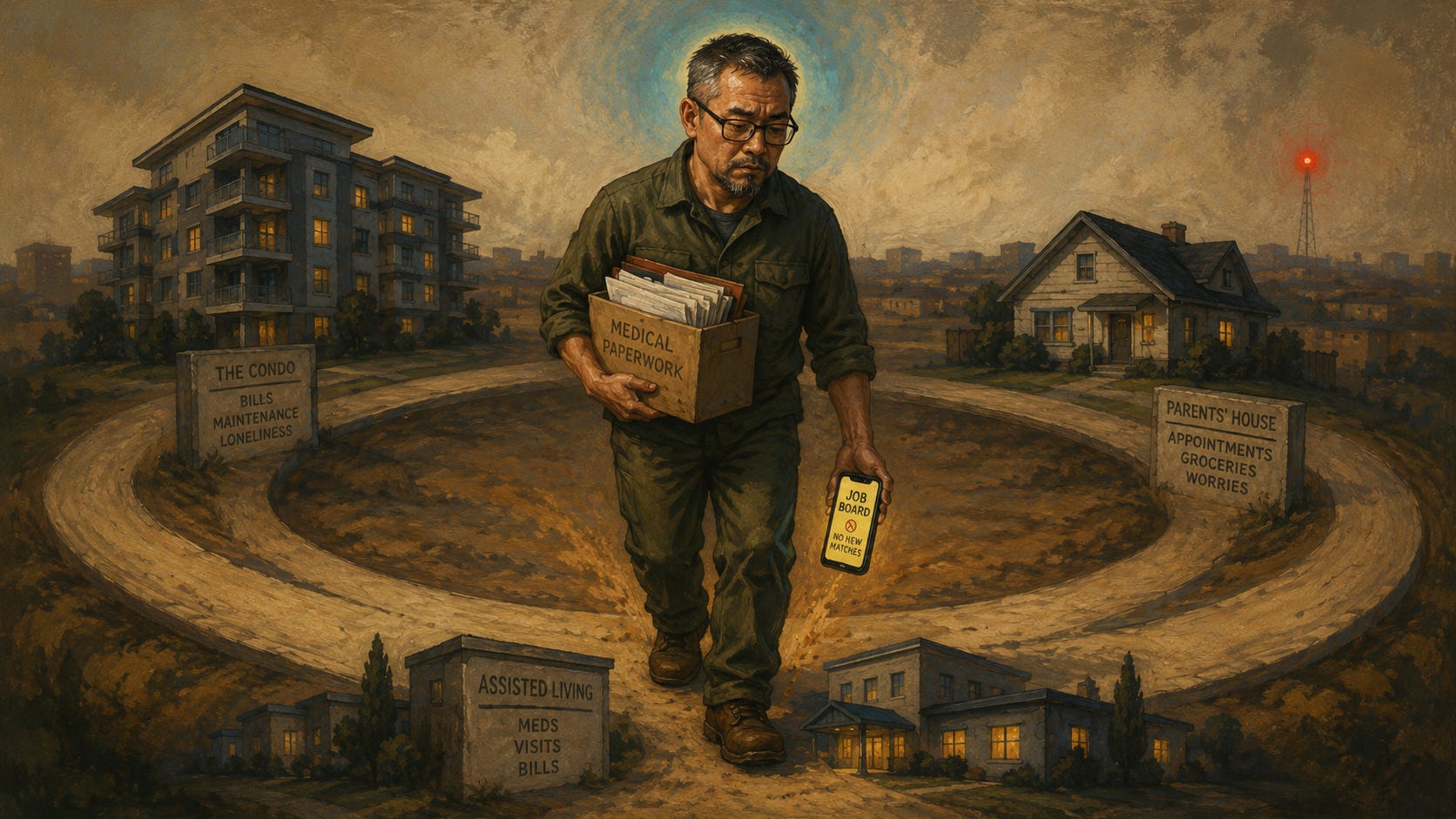
People keep telling me I need to talk about my “unique experiences.”
You know the advice—every career article and every spotless LinkedIn strategist preaches it. Your unique story is your edge. Lean in. Stand out.
But that only works if your experiences are photogenic. Mine were, at first. Then, for years, they weren’t.
Life became a loop: condo, parents’ house, assisted living, repeat. Screens everywhere. Emails you don’t answer. No conference swag, no business trips, no team dinners with awkward small talk. Just the fluorescent buzz of decline. Someone is always dying. You juggle paperwork and job boards and hope nobody notices you’re failing at both.
That’s what caregiving looks like from the inside.
But let me back up, because the story doesn’t start there.
I moved to Miami for a relationship. This is, as I have said before, a thing people do. Miami is many things, but it is not, historically, a great place to maintain a career in engineering if you are the kind of engineer who needs a certain kind of infrastructure around them and didn’t think too hard about what that meant before getting on the plane.
So I found work. Remote gig for a Texas company. Civic tech fellowship. Almost started my own thing, but turns out I need other humans to bounce ideas off, not just my own echo. Joined my friend’s startup. Cue the usual: burnout, forced sabbatical, fired the day before I was supposed to come back. So I taught. Until I didn’t.
Everything had a Tech label. I didn’t ask if it was real engineering. The titles sounded good. Good enough.
Spoiler: it wasn’t.
What I was actually doing: teaching people to become programmers instead of being one myself. Writing curriculum. Building the apparatus that explains the thing rather than building the thing. I was good at it. It kept the lights on. Each individual step made sense. Collectively, they added up to a resume that, by the time I looked up, no longer read as “engineer,” even though the 20 Under 40 profile in the Miami Herald said otherwise.
Didn’t even notice it happening. Still sitting with that.
I moved back to the Bay Area three years ago. I was going through a breakup. And my parents needed me — that part was true and real, and I’d do it again. But I also came back with a specific, quiet confidence about the job situation. This is the Bay Area! There is always demand here! Surely, with my background — Code for America, civic tech, years of experience, all these words on a page — something would materialize.
I want to be fair to myself: that logic wasn’t crazy. It just turned out to be wrong.
Caregiving went from background noise to full volume. Dad’s decline wasn’t something I flew in for anymore. It was every day. Packed his stuff. Took him to the hospital. Had to get him sedated because he’d get angry if we tried to get him on the shuttle. Four blocks away, but might as well have been Mars. Back and forth. Parents’ place. Assisted living. Condo. Paperwork. Screens.
And running in parallel, or trying to, was the job search. Which, in practice, meant it ran in the background. Which, in practice, meant it ran badly.
The Bay Area has demand. Just not for whatever showed up in my particular resume.
About a year in, I made it through the first round at a FAANG company. This felt like something. Progress. Evidence that the logic hadn’t been completely wrong. I had been cramming for the DSA exams like a Japanese teenager trying to pass a University entrance exam.
Then, a few days later, you get a call.
“You were being interviewed as a mid-level engineer,” they told me. “Not senior. With your years, we can’t keep you there—you’ll retake it at the senior bar.”
Which was the opposite of what I wanted. Mid-level was the point. I’d come in hoping to be measured against a rung that matched the actual shape of my career, not the one my resume implied.
I tried to explain: the Miami years, the teaching, the pivot that wasn’t really a pivot so much as a slow drift I didn’t notice until it was already the shape of my life. A special case, I said. Couldn’t I come in a level down, where the bar matched the work I’d actually been doing? I’m a special case.
“Doesn’t matter when you have the experience,” they said. And then, there was nothing they could do.
I’ve thought about that sentence a lot: You have the experience. As if the experience I had was the thing they were measuring, and the gap between what they saw on paper and what showed up in the interview was just a performance problem, a calibration issue, something I could fix if I prepared better next time.
What they couldn’t fathom — what the rubric doesn’t have a field for — is that special cases exist. A resume can tell a true story that the industry’s hiring pipeline isn’t built to read, because why bother with the special case when there are literally 100 other people in the pipeline, fifteen to twenty years younger than you, who did exactly what they wanted them to do?
“I understand,” I blurted out. I didn’t. I said it was fine. It wasn’t.
So I retook it at the senior level. I failed.
The industry has a specific idea of what counts. Titles at recognizable companies. Continuous tenure. Output that can be expressed as scale — users, systems, team size. The narrative of someone who kept moving forward on the approved path, who didn’t stop to do anything messy or hard to quantify or god for-fucking-bid human.
Caregiving has no metrics, besides “try not to have them die today.” But there’s no good way to put “kept two elderly parents who hate each other alive and functional for several years while managing their finances, their medical decisions, and the slow bureaucratic machinery of decline” on a resume in a way that parses. It doesn’t compress into a bullet point. It doesn’t have a title. Nobody gave me a performance review for it.
Teaching? Same problem. At least if you’re trying to get slotted into a box. You can explain it, and it makes sense, but by the time you finish, the rubric’s already moved on.
The specific cruelty isn’t being rejected. Rejection, I understand. The specific cruelty is being told: you have all this experience — and having that be, simultaneously, true and completely beside the point.
Three years in, the money is draining. I’m not going to dress that up. My dad died in May. I inherited some of his savings. I have opinions about all of these things.
The Bay Area I came back to is doing its thing: building, funding, pivoting, AI-ing. Everyone has a deck. Everyone is in a moment. The energy in this city is, as it has always been, the energy of people who know exactly what they’re doing and are moving very fast toward it. They throw terms I was unaware of before I left for Miami, their new mantras: 996. Permanent underclass.
I’m not one of those people. Not right now.
The question I keep not quite answering is this: who am I here, professionally, if the version of me that existed before I left is no longer relevant? I came back expecting to find that person waiting. The industry looked at my resume and said, “We don’t see him either.”
Two roads diverged in a wood, and I took the one less traveled by. I do think it made all the difference. And I’d do it again. But I’m still paying for it.
All three of those things are true at the same time, and I don’t have a tidy way to end that sentence. So I won’t try.
The inbox is still open. I’m still looking. There are no photographs.
I don't want to be rude but this is bugging me so I'm going to be rude. Sorry. Have you talked to any women in your industry? This is a very common path. Start career, leave career to take care of kids, try to get back into career, leave again to take care of parents, try giving career another go. At least you can commiserate.